

In the years after the Civil War, as African-Americans explored the new opportunities that emancipation and Reconstruction afforded them, a central Kentucky teenager looking to better his own life found a fast track. A Thoroughbred racetrack, that is.
From his first ride in 1875 at the age of 14, until his death in 1896, Hall of Fame jockey Isaac Burns Murphy accrued more than 600 victories, including three Kentucky Derbys.
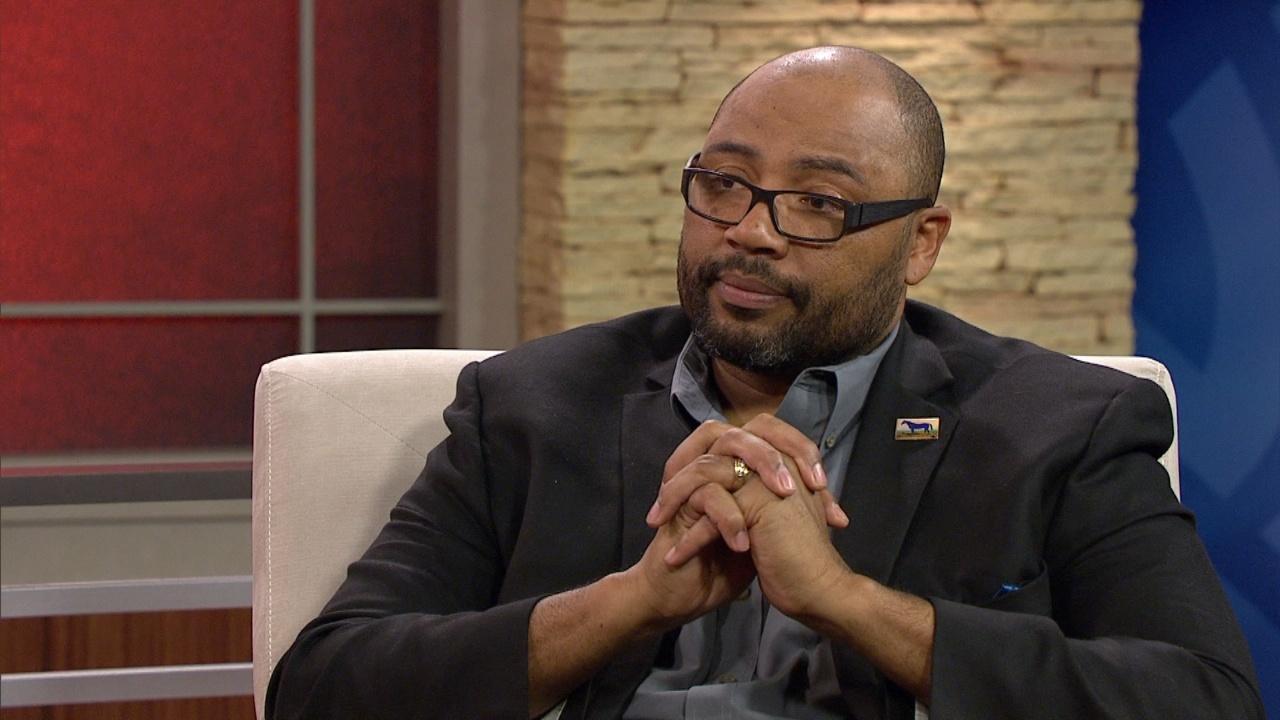
Yet few outside of Thoroughbred racing know about Murphy’s legacy as not just the best African-American jockey but perhaps the greatest American jockey of all time. Historian Pellom McDaniels III is sharing Murphy’s story with a wider audience through his book, “The Prince of Jockeys.” McDaniels talked about the biography on KET’s Connections with Renee Shaw.
An Era of Change and Opportunity
McDaniels says Murphy’s story illustrates the dramatic changes African-Americans experienced after the Civil War.
“Reconstruction, this time of great possibility, not only throughout the south but specifically in Lexington, Kentucky, was the foundation for Isaac Murphy’s success,” McDaniels explains.
He says Lexington was brimming with new educational and social opportunities for newly freed African-Americans, including the Howard School and the Colored Fair Association. McDaniels believes that Murphy, who was born in 1861, was shaped by institutions like those and by the strong sense of community among Lexington blacks.
But Murphy’s turn to the horse world wasn’t out of desire, McDaniels says, but out of necessity. Murphy’s widowed mother lost what little savings she had in the collapse of the Freedmen’s Bureau bank. She was also dying of tuberculosis. So McDaniels says she apprenticed her young son to a local racing stable owned by Lexington breeder James Williams and his partner, Richard Owings.
“Coming under the care of Williams and Owings and also [prominent African-American trainer] Eli Jordan, who was a family friend, helped guide him and helped produce this wonderful, elegant specimen of manhood,” McDaniels says of Murphy.
Riding Horses to Fame and Fortune
Murphy’s winning ways and gentlemanly manners made him a popular jockey on the Thoroughbred circuit. McDaniels says Murphy won 44 percent of his races, a success rate that’s never been topped, and won Kentucky Derbys in 1884, 1890, and 1891. The young jockey also secured numerous riding contracts that guaranteed him between $5,000 and $10,000. McDaniels estimates that Murphy may have earned almost a million dollars annually at the peak of his career.
But that success also drew the ire of racists who disliked the stature Murphy and other prominent African-American athletes of the day were gaining. McDaniels believes that, in retaliation, Murphy was poisoned in 1890. Murphy survived that attempt on his life but the incident left him with the reputation of being an alcoholic. His popularity quickly crumbled, and Murphy died of pneumonia in 1896 at the age of 35.
“To have that ending be the end of the story for me is unacceptable,” McDaniels says. He prefers to focus on how this African-American child born at the beginning of the Civil War rose to become everything his community hoped he could be and that his time in history would allow him to be.
An Athlete Who Studies Athletes in History
McDaniels, who is Curator of African American Collections and Assistant Professor of African American Studies at Emory University, says his interest in Murphy stems from a long-standing desire to explore the impact of black sports figures on 20th century America. An athlete himself, McDaniels played football at Oregon State University and later with the Kansas City Chiefs and Atlanta Falcons.
“I absolutely love football because it is a space where you develop skills, you learn how to be disciplined, you work as a team, you set goals for yourself and for your teammates,” McDaniels says. “The skills that you learn with sports along with what you learn at school are transferrable to different occupations.”
When an injury sidelined his NFL career, McDaniels went back to school to get a doctorate in African-American Studies. In addition to his research and teaching work at Emory, McDaniels continues to promote the legacy of Isaac Murphy. He’ll be back in Lexington for the Breeders’ Cup this fall with an exhibit about the legendary jockey.
“My hope is that what I’ve done with the book and what I’ve done with the exhibition and my public scholarship is to create the momentum for Lexington [and] the University of Kentucky to drive their students to think about local history,” McDaniels says. “The history here around Reconstruction is tremendous.”
(Originally published on May 9, 2015.)