

To conclude the recent Fox News debate among 10 of the Republican presidential contenders, a viewer asked the candidates if God had told them what they should do first upon reaching the Oval Office.
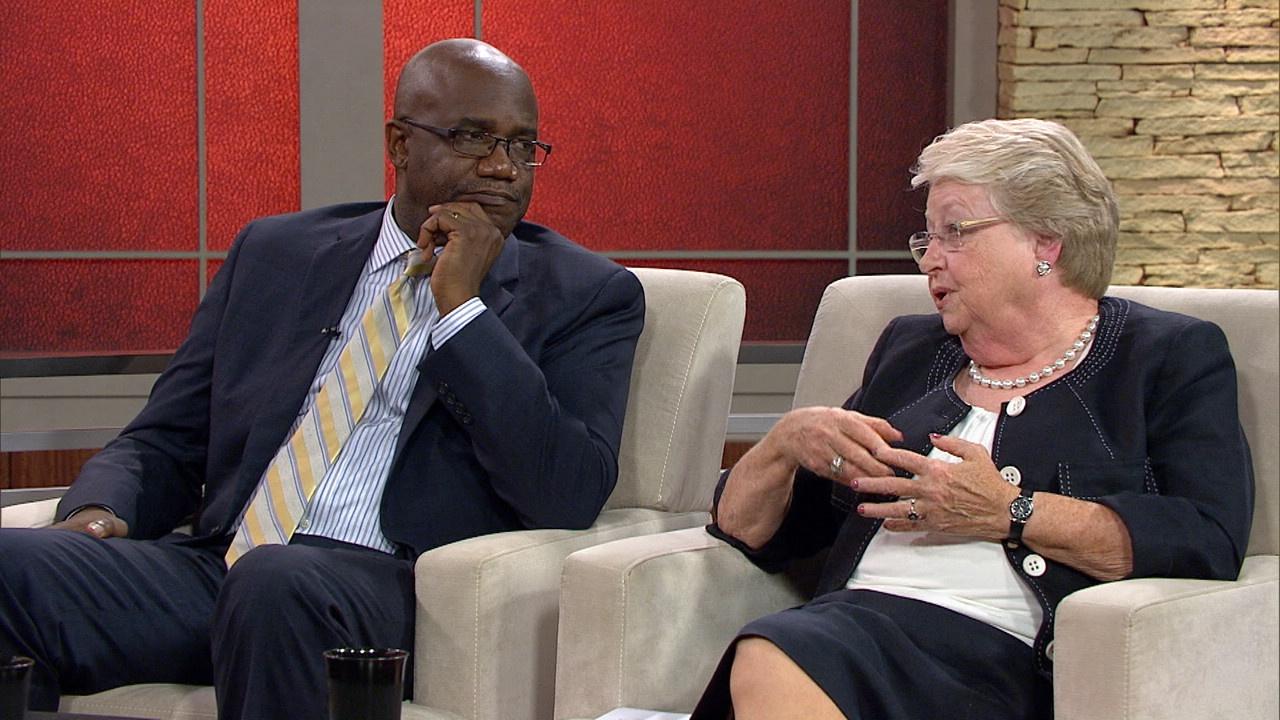
But is that blending of the religious and the political appropriate in a country that has historically upheld a separation of church and state? Reverends Anthony Everett and Nancy Jo Kemper explored that question on KET’s Connections with Renee Shaw.
The Role of God in Politics
The ministers say they were troubled by what that question from the debate implied about God and political leaders.
“What it tells me automatically is that the person asking question is saying, ‘I’ve got my concept of who God is, and that’s the only way God can be, and so do you fall in line with my concept of who God is?’” says Everett, who is pastor of Wesley United Methodist Church in Lexington.
Instead, Everett says he believes we each view God through the lens of our personal experiences, which creates different but equally valid perspectives on the nature and role of God in our lives.
Kemper has been minister at the New Union Christian Church in Woodford County for almost two decades. She says she prefers a political leader who is a committed member of a faith community and has an active prayer life, but not someone who says they follow God’s orders.
“I’m worried about a theocratic fanatic who might say ‘I only get my messages from God,’” Kemper says. “I want someone who bases their actions as our national leader on not only their faith and their upbringing but [on] reason [and] science.”
Changing Views of Homosexuality
Kemper argues that the country is experiencing what she calls a dangerous anti-intellectual spree. She considers that one reason why church attendance is declining in the United States. A recent report from the Pew Research Center on Religion and Public Life shows that participation in Christian denominations is dropping, while the percentage of people joining other religions or not embracing any particular faith is increasing.
In addition to being anti-intellectual, Kemper contends some churches are anti-science, homophobic, and too focused on literal interpretations of the Bible and biblical traditions. Everett adds that those who view the scriptures from a 1900s perspective are failing to put the Bible in a contemporary context. He points to the gay marriage debate as an example. He says his denomination, the United Methodist Church, still opposes gay marriage even as the general public becomes more accepting of same-sex unions.
“I think the [U.S. Supreme Court] decision gives us some reference point to say, ‘Look at what society is doing, what type of changes do we need to make?’” says Everett. “And in 2016 at our general conference… there will be a discussion [and] they will be able to vote on whether or not same-sex marriage is allowed within the church as well as our ministers being able to perform same-sex marriages.”
Kemper says family and friends of LGBT people have pushed churches to be more welcoming of those individuals, and they’ve helped shed light on new interpretations of scripture. She says the original Hebrew and Greek wording that was traditionally thought to describe homosexuality in specific Bible verses actually refers to things like prostitution, sexual violence, and predatory relationships.
“There is in no way any condemnation in any of the seven particular passages of scripture against committed, same-sex, consensual relationships,” Kemper says.
Finding Grace in Tragedy
Kemper contends the moral voice of all faith groups is vital to public debates on current issues, and as a way to help people make sense of terrible tragedies like the Charleston church shootings that killed eight African-American parishioners earlier this summer.
Religion and politics mixed even then as Pres. Barack Obama delivered the eulogy for the Rev. Clementa Pinkney, the Emanuel African Methodist Episcopal Church pastor who also died in the incident. Both Kemper and Everett praised Obama’s performance at that funeral.
“I was in tears watching the whole thing,” Kemper says. “You can’t preach that kind of a eulogy and not understand the gospel.”
“He was wonderful,” Everett says of Obama’s remarks at the June 26 memorial for Pinckney. “I think it was on point that he focuses on this is where we come from, this is where we are, but we are so much greater than what we are right now.”
The ministers say the Charleston shootings provided their congregations a critical opportunity to reflect on the deep divisions that plague American society and the transformative power of grace in their lives.
“I know in my own congregation there were tears and such a sense of contrition and an open acknowledgement of the white privilege by which we have lived for so long and our blindness to the ongoing racism that it was a humbling, humbling moment of teaching us about what grace really is,” Kemper says of her Woodford County church.
Everett says the families of the Charleston victims set a powerful example for the nation when they forgave the white supremacist charged in the shootings. He says that points the way to healing and justice in the future.
“I think that forgiveness is actually a door that opens up to reconciliation,” Everett says.