

Imagine a region that’s struggling to recover from the collapse of its signature industry.
Some 1,300 people attended the recent Shaping Our Appalachian Region (SOAR) summit in Pikeville to discuss how eastern Kentucky can expand its future beyond coal mining. In the process they heard about how communities in northeastern Ohio survived the demise of the steel industry.
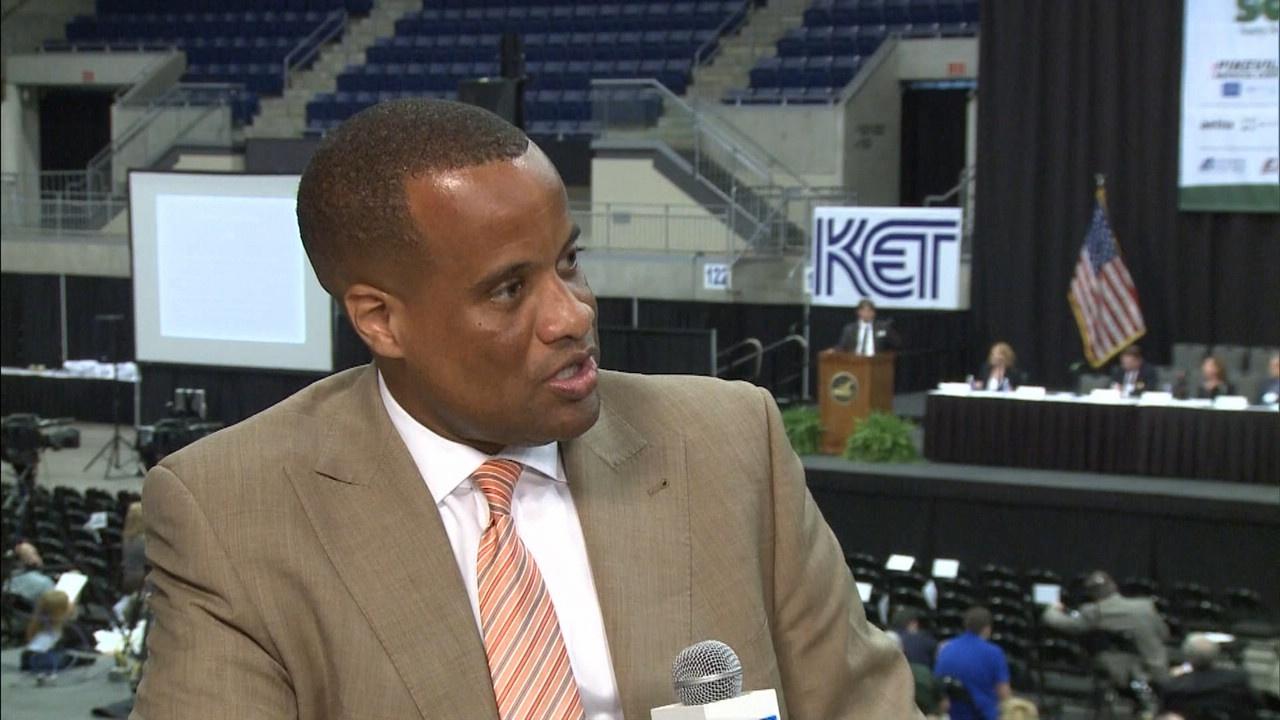
U.S. Assistant Secretary of Commerce for Economic Development Jay Williams is a former mayor of Youngstown, Ohio. He shared the story of his city’s revitalization with attendees of the SOAR summit and with KET’s Renee Shaw on Connections.
A Handout That Never Came
For nearly a century, Youngstown and the surrounding Mahoning River Valley prospered thanks to its thriving steel industry.
Then on Sept.19, 1977 – what locals call Black Monday – the city’s largest steel mill closed, putting thousands out of work. The region that had depended on a single industry for much of its employment and identity fell into a tailspin and languished for decades.
“We literally stood idle with a chip on our shoulder waiting for someone who we thought owed us something,” explains Williams, who is a native of Youngstown. “We had manufactured the steel that had helped win the world wars, we had manufactured the steel that helped build the infrastructure of this country.”
Instead of getting a handout from a grateful nation, Williams says the residents eventually realized the future of Youngstown was in their own hands.
The Turning Point
In 2002, a quarter century after the last steel mill closed, more than a thousand northeast Ohioans joined a revitalization effort dubbed Youngstown 2020. Citizens, city leaders, and representatives from Youngstown State University collaborated on a plan to diversify the local economy, clean up blighted neighborhoods, and foster entrepreneurism, especially among younger generations.
Williams had a career in banking before moving into public service in Youngstown. In 2006, he became the city’s youngest mayor and the first African American to hold that office. He says residents had to accept that Youngstown would be a smaller city and that they would have to adapt to a different role in the global economy.
“There’s still lots of challenges,” Williams says, “[but] Youngstown and Mahoning Valley is no longer being defined by the collapse of one industry. We’re being talked about [as] the community that came together, created a vision, created a plan, [and] took ownership and pride in it.”
A Legacy of Coal
Despite one area being urban and the other being rural, Williams argues that Youngstown and eastern Kentucky share some important similarities. First is their historic dependence on a single industry. While globalization spurred the decline in Ohio’s steel industry, domestic market and regulatory factors have decimated the Appalachian coal economy.
Williams acknowledges that tougher environmental regulations promulgated by the Obama administration are a part of coal’s decline. But he also argues that the higher costs of mining coal along with the rise of cheaper natural gas have played an even bigger role. Regardless of the causes, though, Williams says Kentuckians must be focused on the future.
“The fact that this region has embraced and has a proud heritage in coal mining is something to build upon,” Williams says. “It’s still going to be an important part of the economy, but [don’t] get stuck on ‘This is what we’ve done for 100 years, this is what we’re going to do for the next 100 years.’”
Reintroducing the Region
Williams notes two other similarities between Youngstown and eastern Kentucky: Both have populations that want to stay in their home communities, and both regions have lower costs of doing business. Williams says that with high-speed broadband service coming to Appalachia, it will be much cheaper for technology companies to operate here than it would be on either coast. Plus, he says there’s a local workforce that wants those jobs as a way to build a better quality of life in eastern Kentucky.
Finally, Williams notes the tremendous physical beauty of central Appalachia. He says it’s one of the distinctive factors that local leaders can use to help re-brand eastern Kentucky and reintroduce it to the world. Williams contends the lessons of SOAR can be helpful to any community facing significant economic decline.
“This is something that other regions across the country and indeed other regions in other parts of the globe would be interested in because we’re not the only ones going through it,” Williams says.