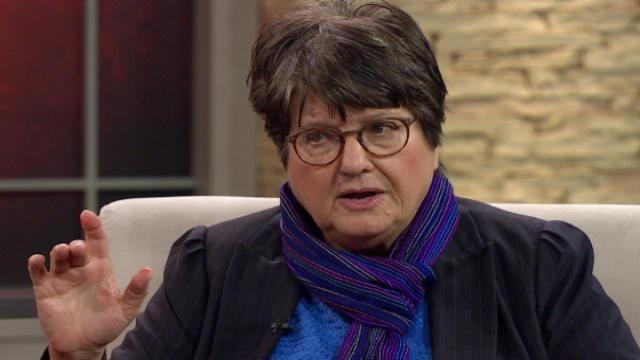


When Sister Helen Prejean witnessed the electrocution of a convicted murderer – an execution that no religious leader protested – she says her soul was set on fire.
And that fire became her mission to abolish the death penalty in America.
Prejean has chronicled that fight in two books, “Dead Man Walking” and “The Death of Innocents.” She joined KET’s Renee Shaw on Connections to discuss her work.
‘A Deeply Flawed’ System of Justice
It’s been 30 years since Prejean accompanied Patrick Sonnier to his death in Louisiana’s electric chair. Since then she’s counseled five other death row prisoners who were executed. Her experiences have given Prejean a unique look at capital punishment and criminal justice, and she contends the system is deeply flawed.
“It’s held together with bailing wire and duct tape and Elmer’s glue,” Prejean says. “It’s frail and it’s broken because it’s made up of human beings.”
Prejean points to vague and subjective guidelines from the U.S. Supreme Court that indicate the death penalty should be reserved for only the “worst” criminals. She also says the decision to request a death sentence is left up to the discretion of individual prosecutors.
Then there’s the defense side of these court cases. Prejean says only poor people end up on death row because they’re the most likely to have had inexperienced and ill-prepared attorneys or over-worked public defenders to represent them.
“With poor people, it’s a slam dunk,” Prejean laments.
Lingering Trauma for the Victims’ Families
Not only does Prejean argue that the death penalty is unfairly and sometimes inaccurately applied, she also says that it offers no benefit to families of the victims of the original crimes.
She explains that when state officials debated whether to abolish the death penalty in New Jersey, 62 murder victims’ families testified in favor of ending capital punishment. (That state abolished the death penalty in 2007.) Prejean says that every step of the process – the conviction, the appeals, the death warrant, and the actual execution – serves only to reopen the wound for the families and loved ones. Prejean also describes how some families feel pressured to support the death penalty when a relative is killed, because otherwise people might think they didn’t love the victim enough.
That’s not to say that Prejean doesn’t understand the desire some families have to see a murderer put to death. She says the lingering trauma of the violent act can leave people angry and vengeful.
“In the beginning anger is good, because it gets you out of bed in the morning,” Prejean says. “But if it stays with you, anger can kill you. It eats you up.”
A Mission to Educate and Activate
Prejean was born in 1939 and raised in a middle-class family in New Orleans. It was the days of Jim Crow, and Prejean says she never questioned the nature of segregation in the South. She admits she didn’t even know the last names of the African-American servants who worked for her parents.
She entered the Sisters of St. Joseph of Medaille religious order in 1957, but it wasn’t until she started work in a New Orleans housing project in the early 1980s that she began to understand the plight of the poor. While there, Prejean was asked to counsel the death row inmate who later became the subject of her best-selling book “Dead Man Walking.”
These days Prejean works to educate and activate the public on the death penalty. She says citizens will have to push politicians to abolish capital punishment and force them to address the poverty and other root causes that contribute to most crime in this country.