

Although breastfeeding rates continue to rise in the United States, health officials are concerned that mothers aren’t continuing the practice as long as doctors recommend.
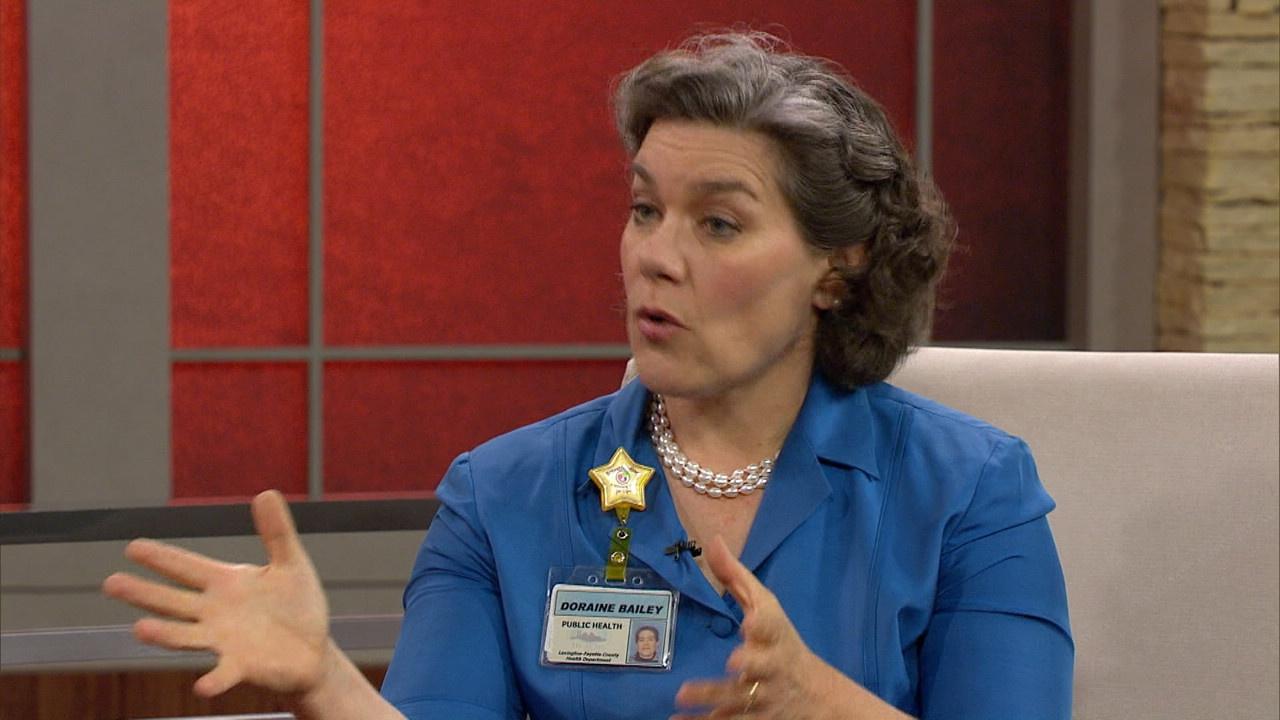
On KET’s Connections, host Renee Shaw explored the issue with two lactation specialists and a new mother to learn about social and cultural issues that new mothers and their babies face.
According to the most recent data from Centers for Disease Control, about 80 percent of American mothers say they have breastfed children at some point in their lives. In Kentucky the rate is about 61 percent.
Although health officials recommend breastfeeding for at least 12 months, only minority of women actually do that. Nationally the rate of mothers who are breastfeeding a year after birth drops to about 27 percent. In Kentucky it’s about 23 percent.
Workplace Issues
Family finances can be a significant factor in determining how long a mother continues to breastfeed her baby, according to Lexington-Fayette County Health Department lactation specialist Doraine Bailey. She says many moms are committed to breastfeeding while they’re on maternity leave, but then stop the practice when they return to work because they need to focus on earning income for their families.
Bailey says that mothers may not know that Kentucky law gives them the right to breastfeed or express milk in public or private places. She adds that a provision of the Affordable Care Act mandates that employers accommodate their non-exempt, hourly waged female workers who need to pump breast milk at work.
“There are a lot of very, very clever and interesting ways that employers have supported moms,” Bailey explains. “A chair, a table, an outlet, those are the bare minimum that a mom needs. It doesn’t take a lot of space, it doesn’t have to be a dedicated room, especially if you only have one or two women.”
Even retailers are making accommodations for new mothers as a way to boost customer service and loyalty. Bailey says some big-box department stores allow moms to use dressing rooms as a private space to feed their child or express milk.
The Rise of Kangaroo Care
Bailey says more can be done to help new mothers get comfortable with the idea of breastfeeding while they’re in the hospital and to support them once they go home. Rather than whisking a newborn off to a nursery, Bailey says more hospitals are employing the practice of “kangaroo care.” That’s where a newborn child is laid on a mother’s chest so they can establish skin-to-skin contact.
“Putting that baby there triggers a lot of maternal instinct and it also helps that baby have a gentler transition from the safety and security of the womb out here into the world,” Bailey says. “We can put moms and babies together instead of artificially separating them.”
And kangaroo care is producing dramatic results. Bailey says a University of Louisville study of Kentucky hospitals that use the technique found a 30 percent increase in breastfeeding initiation by new moms.
The Experience Across Generations
Shortly after the birth of her son, Stacie Williams joined a University of Kentucky research project about breastfeeding among African-American women. She says the participants were divided into two groups: women who were actively breastfeeding, and friends and relatives who assist breastfeeding mothers.
“The idea was to find out what are the ways in which black women are being supported or not supported toward their desire to breastfeed,” says Williams, who is a librarian at UK.
Williams says it was interesting to hear the stories of other mothers and compare them to her own experiences. She says her mother breastfed her as a baby, so she knew it was something she wanted to do with her own child. Williams says she recently weaned her son after he turned 1 year old.
“Had I not seen the examples for myself, I definitely don’t know that I would’ve attempted to do it for as long as I did, and, sure, maybe even not at all,” Williams admits. She says her grandmother, who did not breastfeed, was surprised by and curious about how long Williams decided to breastfeed her son.
Cultural Self-Consciousness
Another researcher at UK is exploring how Hispanic-American women feel about breastfeeding. Ana Maria Linares, a registered nurse and lactation consultant at the school’s nursing college, says Hispanic mothers generally have a higher intention to breastfeed than do African-American women. But she says Hispanic moms who immigrate here are influenced by the prevalence of baby-formula use in the United States.
“They come here and they say, well, American people are formula feeding, and they are so intelligent, so it must be the right way,” Linares says.
The problem comes when those mothers supplement their breast milk with formula. Linares says the babies fill up on the formula and want less of their mother’s milk. Over time the mother produces less milk and won’t be able to breastfeed her child for as long.
Linares says Hispanic women are also reluctant to breastfeed in public or express milk at work because they feel like their ethnicity already draws unwanted attention to them. Therefore doing something as intimate as breastfeeding only exacerbates their self-consciousness.