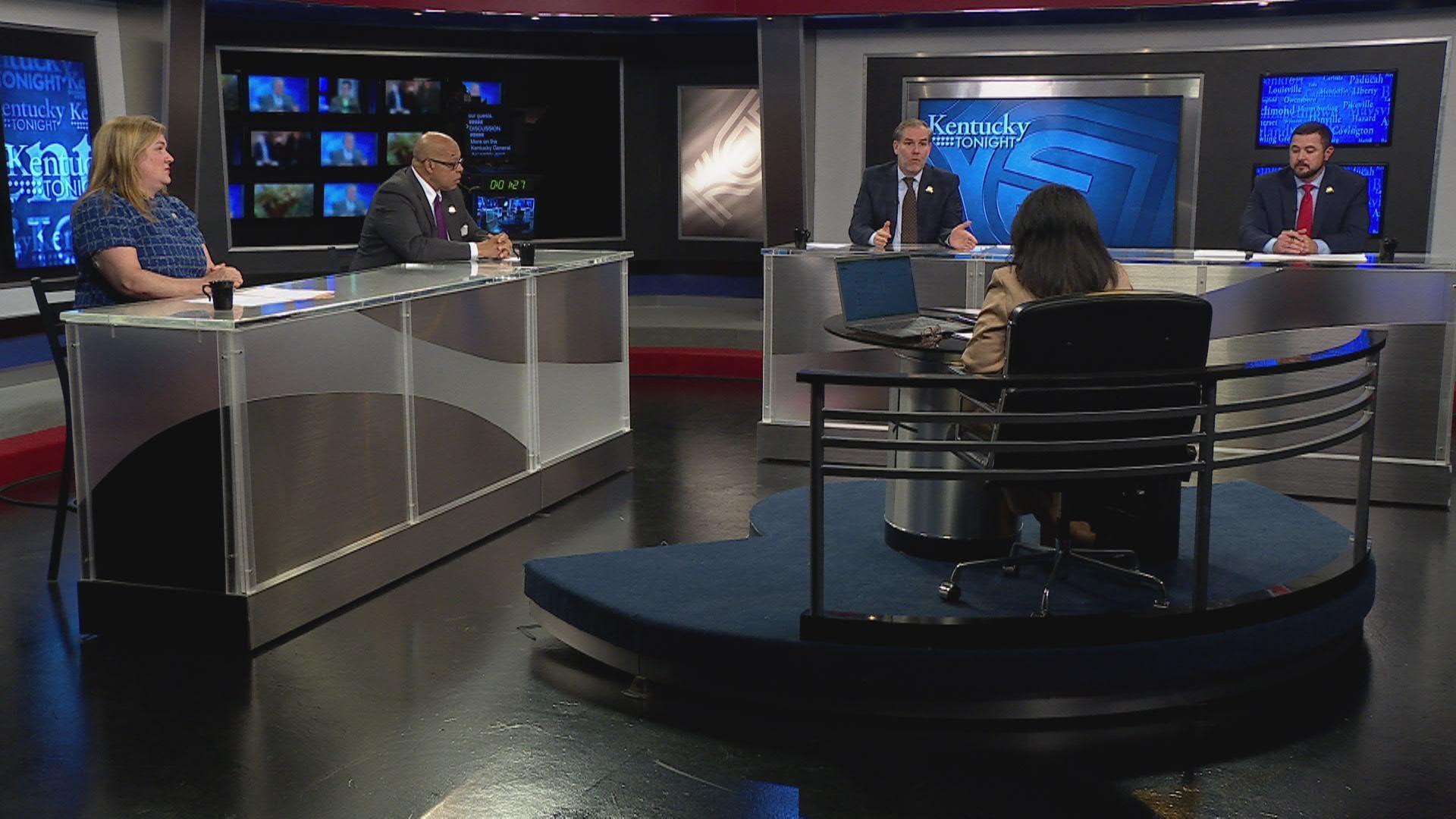
As state lawmakers convene for part two of the 2025 General Assembly session, tax and spending issues will likely take center stage even though this isn’t a budget-making year for the legislature.
In the first week of the session back in early January, the House of Representatives approved House Bill 1 to cut the individual income tax rate by 0.5 percent. Despite concerns over potential impacts on state revenues, the measure passed with bipartisan support.
“We’ll lower it to 3.5 (percent) and hopefully put an additional $718 million back in the pockets of Kentuckians to spend in the economy,” says House Speaker Pro Tem David Meade (R-Stanford).
House Minority Whip Rep. Lindsey Burke of Lexington was among a handful of Democrats who voted for the reduction. While she says the move is a “strong and wise” choice for the commonwealth, she still has concerns about the continued push to ultimately eliminate personal income taxes.
“The thing I worry about is that we don’t necessarily have a plan for how we’ll address any shortfalls that could come along the way,” says Burke.
The Senate is expected to pass HB 1 on its first day back into session on Feb. 4.
K-12 and Higher Education Spending
Republican leaders say they don’t expect to reopen the state budget, even though they may be asked to resolve several spending issues. For example, Kentucky Education Commissioner Robbie Fletcher recently warned lawmakers that public schools will likely face a $40 million shortfall in funding this year.
Meade says that potential deficit is troubling, but he contends what’s more problematic is KDE’s seeming inability to provide accurate budget estimates to lawmakers.
“We continue to fund education at record levels,” says Meade, “but we can only do that with the proper data that’s coming from KDE.”
Senate Majority Floor Leader Max Wise of Campbellsville says this is the fourth time since 2000 that KDE is projecting a shortfall. He and Meade say they will wait to get final data from Commissioner Fletcher in early March and address any shortfall at that time. They say Republicans will continue to increase per-pupil funding known as SEEK, but in return, they say they want greater accountability on how that money is spent.
Burke says she’s glad Republicans are willing to address any current deficit, but she fears part of the problem is that KDE doesn’t have sufficient funding to even accurately project its fiscal needs. She contends this is another indicator of how public education in Kentucky needs more funding.
“Last budget cycle, the House Democrats pushed for greater SEEK funding,” says Burke. “Had those been enacted, this wouldn’t be the shortfall.”
Beyond any immediate deficit, a group of Kentucky students recently sued the state saying the public school system no longer provides an adequate or equitable education as mandated by the state constitution. Burke says she thinks those students have a legitimate argument and the lawsuit could force lawmakers to finally fix longstanding issues within the state’s public schools.
Several of the state’s public universities have requested additional funding for major new initiatives. Murray State University hopes to launch a veterinary school, which comes with an estimated $87 million price tag. Eastern Kentucky University wants a school of osteopathic medicine, and Western Kentucky University has proposed several new doctoral research programs.
Meade says lawmakers could approve these requests this year but wait until next year during the regular budget session to make the requested budget appropriations.
Discussions about DEI and CPE
Lawmakers are expected to revisit the issue of diversity, equity, and inclusion (DEI) policies and offices within state universities. The General Assembly failed to reach final approval on an anti-DEI bill last year. Meanwhile, President Donald Trump issued an executive order during the first days of his administration to target DEI initiatives.
While the impacts of that order take shape, Wise says state lawmakers will continue to discuss policy options for DEI in Kentucky’s higher education system.
“I know that there’s some legislation that’s being discussed. I don’t think it’s yet been made public. I’m interested to see what that’s going to be,” says Wise, who co-sponsored anti-DEI legislation last year.
Supporters of DEI efforts contend the attacks are unwarranted. Senate Minority Caucus Chair Reggie Thomas (D-Lexington) says several state universities have already shuttered their DEI programs, which leaves him wondering why any legislation is necessary. He contends that the initiatives in higher ed have helped minorities, women, rural Kentuckians, veterans, and those with disabilities have greater opportunities to succeed in college. He also argues that the anti-DEI movement is filled with “hidden agendas” and “nefarious concepts.”
Meade says DEI efforts are unnecessary since state and federal policies already provide unrepresented populations with equal opportunities. He also says colleges have minority student offices that help with graduation rates.
“DEI policies in our state have proven to be costly, redundant, and ineffective,” says Meade. “It has created more division, it’s been more expensive, and it’s been less tolerant.”
Yet, those college DEI offices have had successes, says Burke. She points to a 7 percent increase in graduation rates for underrepresented minority students in Kentucky during the 2022-2023 academic year. She says eliminating DEI efforts could have unintended consequences.
“If we want Kentuckians to succeed, we need to recognize that they’re not all the same, and different tools and strategies help people live their best lives,” says Burke.
Another proposed measure would overhaul governance of the state’s colleges and universities. House Bill 197, sponsored by Rep. Steven Doan (R-Erlanger), would abolish the Kentucky Council on Postsecondary Education and transfer its responsibilities to the Kentucky Higher Education Assistance Authority.
Meade says there’s not been much discussion in leadership about the proposal. He says CPE my need “some refining,” but he doesn’t think disbanding the decades-old agency is the answer. Burke wonders about the possible impacts to students should CPE be eliminated. She calls the idea “reckless and ill-informed.”
Legislative Operations
In serving as the new Senate Majority Floor Leader, Wise succeeds Damon Thayer who held that same post for a dozen years before retiring at the end of 2024. Wise says he will bring his own style to managing the chamber.
“I’m going to lead the way I’ve always led in Frankfort: Developing relationships, being who I am, being genuine,” says Wise. “I think that’s the best way to accomplish things.”
The House and Senate adopted new procedural rules at the beginning of the session, which Republican leaders say will make operations during this 30-session smoother and more deliberative. Senator Thomas and fellow Democrats fear those rules will end up limiting debate on contentious measures, especially in the waning days of the legislative session when wholly new proposals can be slipped into so-called “shell bills” and fast-tracked to passage.
“That action of having bills voted on without any public input, any public review, any ability for the legislators to read the bills, that is going to be called out every time that happens,” says Thomas. “That is not democracy.”
Senate President Robert Stivers (R-Manchester) has asked members of his caucus to limit their bill filings this session to no more than five measures. (House Republican leaders have not made a similar request of their members, according to Meade.) Wise says the goal of that “gentleman’s agreement” is for senators to work on quality of bills rather than quantity.
“Let’s focus on maybe for each member, what’s your five priorities that you truly think are good for the Commonwealth of Kentucky, good for your district, and good for the wellbeing of the taxpayers,” says Wise.
Thomas says Senate Democrats have no such agreement. He contends lawmakers should propose bills that correct a problem, address an issue, or advance the state, regardless of how many proposals that might entail.
“You certainly can file too many bills, but I don’t know what that number is,” says Thomas.
For his part, Thomas is encouraging lawmakers to consider a bill to raise the minimum wage in Kentucky. He also supports government investment in affordable housing, but he says he opposes regulating Artificial Intelligence (AI) because he fears that could stymie its development in critical areas like national security and defense.