Conversation with Rep. Morgan McGarvey (KY-3rd district)
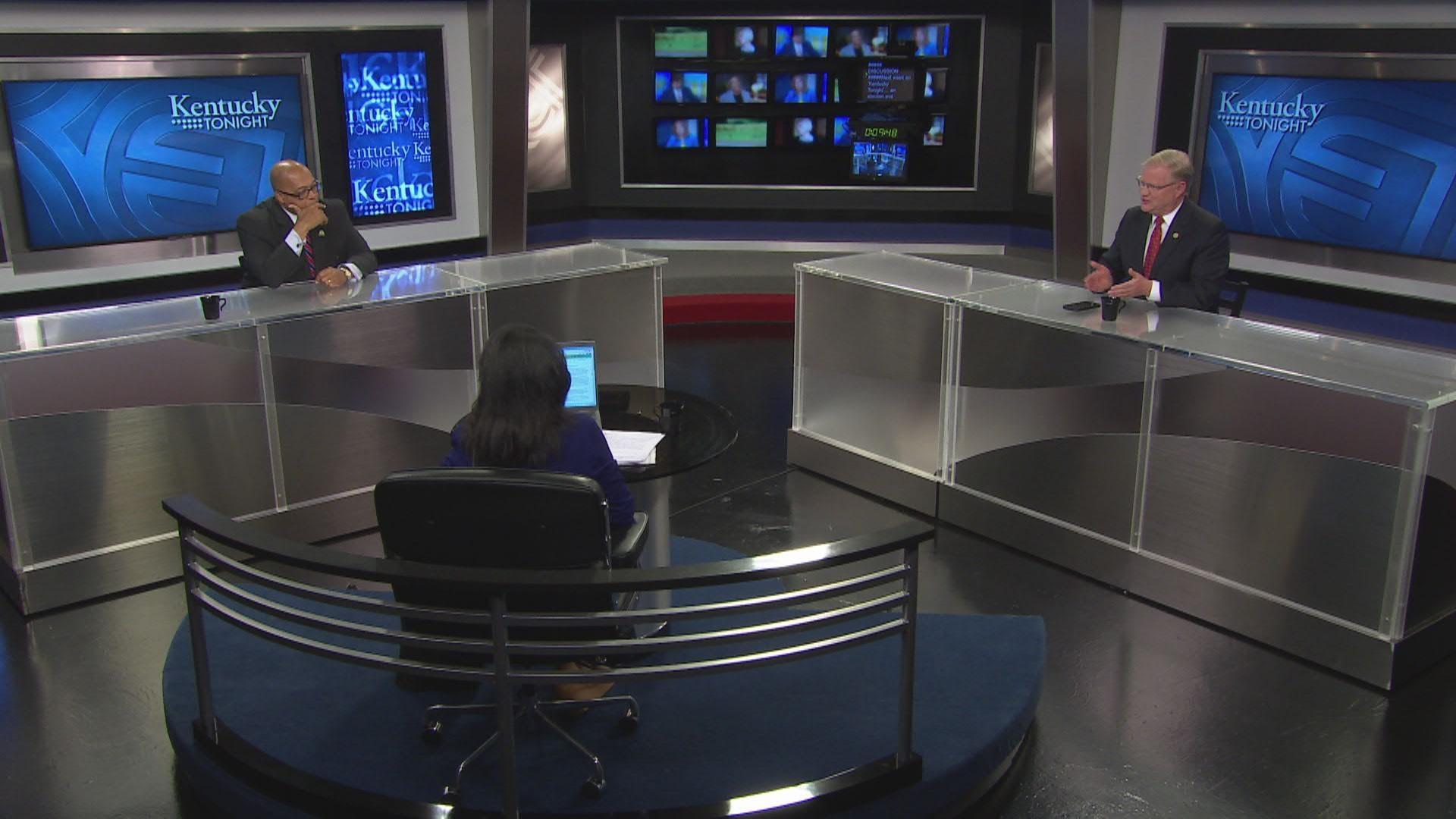
Renee Shaw: Good evening, welcome to Kentucky tonight, I'm Renee Shaw. Thank you so much for joining us. In-person, no-excuse, early voting begins Thursday in Kentucky as we move closer and closer to Election Day, November 5th. We'll talk about the legislative, presidential, and constitutional amendments on the ballot with state Senators Damon Thayer and Reggie Thomas in our next half hour. But first, Congress. There are contested races and four of our six U.S. House districts. In district three in Louisville Congressman Morgan McGarvey, a Democrat, is running for reelection. He faces a Republican challenger, Mike Craven. Mr. Craven did not meet our criteria to appear tonight. Congressman McGarvey met our criteria and accepted our invitation. As always, we do want to hear from you. You can send us your questions and comments by X, formally Twitter, at PubAffairsKET. Send an email to KYTonight-at-KET-dot-org. Or use the web form at KET-dot-org-slash-KYTonight. Or you can simply give us a call at 1-800-494-76-05. Well, welcome Congressman McGarvey.
Morgan McGarvey: Thank you, Renee...
Renee Shaw: Good to see you...
Morgan McGarvey: Good to see you.
Renee Shaw: ...in a different capacity. You've been on this show many times as a state senator, and, so, it's good to have you in this capacity. I do want to revisit when you made your initial bid in 2022. You really touted the bipartisan record that you had in the Kentucky state legislature, in which you served for ten years, as a reason for why voters in the third Congressional District should send you to Washington. You said your campaign two years ago that, “I refuse to accept the notion that we can't get things done.” Many question what has gotten done in the last two years. And as a freshman, what can you say you had a hand in delivering directly to the people of the third Congressional District in Kentucky?
Morgan McGarvey: Yeah, thanks. I still am one of those people who believes we can work together, who believes that, that we can and use government for good. And I haven't lost that. Now, it has been a challenging environment in Washington. My term, when I'm diplomatic about it, I say it's been historic. Think about how it started: For the first time in 100 years, we didn't elect a speaker on the first ballot. The first time in 150 years. It took 15 votes to elect a speaker. That's, of course, foreshadowing to the fact that the Republicans and the extremists in their party ousted a speaker for the first time in the 247-year history of our republic. We nearly defaulted on the debt ceiling for various reasons. There's been all sorts of rancor. Marjorie Taylor Greene tried to depose another speaker. So, there's been a challenging background. But I still try to work and get things done. I’m serving on two committees right now where I think bipartisanship happens. I’m on the Veterans and the Small Business Committee. I was the first freshman Democrat in the entire country to pass a bill through the United States House of Representatives helping our veterans get the education benefits that they need and they deserve. They've earned them. I also passed a bill on to help entrepreneurs, to help the American dream be possible for every American, including our Americans with disabilities. They don't have, they still have some of the barriers that not everyone has. And so I worked with one of the, the chairman of the subcommittee, Congressman Molinaro out of New York, and passed a bill that way. So, so to help our small businesses, to help our veterans. and working on those things. Of course, and one of the things we do in Congress is funding as well. I have brought back millions of dollars to the third Congressional District to help with everything from infrastructure, to nonprofits with grant money for, for new sources of, of making sure energy remains clean and those sorts of things. So, so we hit the ground running, but, yes, it is a challenging environment.
Renee Shaw: You are the lone Democrat in Kentucky's federal delegation. How are you working with your Republican colleagues in this state, and what have you been able to deliver?
Morgan McGarvey: Yeah, I don't want to get any of them in trouble with this answer, but the Kentucky delegation really gets along. I think we all get along with each other and recognize that, you know, we're going to have our differences. And believe me, I have some policy differences with our Republican members of Congress. But then on certain things, we're here to help Kentucky. One thing I've done is I've co-chaired the Bourbon Caucus, which, of course, is important to Kentucky, but also, I think is important to helping foster bipartisanship. I co-chair it with Andy Barr, the congressman from central Kentucky. Have certainly worked with other members of our delegation. Senator Rand Paul and I co-sponsored, he introduced it in the Senate, I introduced it in the House, the Breonna Taylor No-Knock Warrant Bill to ban no-knock warrants nationwide. So, I've worked on all sorts of legislation, all sorts of issues important to Kentucky with all the members of our delegation.
Renee Shaw: What do the constituents in the third Congressional District tell you? You've been back in the state for some time on, on these recess periods and beyond. What do you hear from them about as really top of mind for them that they want to send you back to Washington to address?
Morgan McGarvey: Yeah. One of the things I love about the job is the fact we get to spend so much time at home, and, and get to go back and forth. When I was in the state Senate, we were citizen legislators. And even though we're more full time in DC, we certainly come home a lot. Look, you know, people talk to me a lot right now. In particular, we hear a lot about, you know, jobs in the economy. Making sure that those good jobs in Louisville in particular continue to exist. We hear a lot about education right now and I imagine part of that is because of Amendment 2 and the fact that that amendment is very likely going to take public tax dollars away from public education, put it towards private schools. It's not as much a federal issue for us, but certainly hear a lot about it right now. We hear about health care, the continued cost of prescription drugs, the fact that not everyone has access to health care. And of course, one thing I continue to hear about, and I think this is, again, because we're in Kentucky, is reproductive rights. The fact that no woman or girl in Kentucky can receive an abortion, even if she's the victim of rape or incest. The fact that Project 2025, that you see on the federal level, is seeking to impose a national abortion ban, possibly even limiting contraceptives. We still hear, hear a lot about that issue.
Renee Shaw: I want to get to one, we'll take those in pieces, but I want to talk about the economy, wages, and labor. And it's more than just the middle class. We've heard from one of the criticisms of the Harris-Walz campaign is that the vice president really focuses and touts on her plan to buoy the middle class, right. There’s no talk or very little talk, I will say, of income inequality. In order for there to be a middle class, there has to be a lower class, those in poverty. What is she missing about income inequality that you wish she would say? And when you think about the communities in the district in which you serve that really want to hear that message, what should be said and what would you go back to Washington to fight for?
Morgan McGarvey: Well, I think we are working on, on income inequality. We are working on a tax code that works for everyone. And one thing I would point to in the next Congress, you talk about what pe--- people aren't really talking about this yet because I don't think it's top of mind given the election. But regardless of who the president is, regardless of who's in control of the House or who's in control of the Senate, the Trump tax cuts will expire at the end of 2025. He wants to continue tax breaks for his billionaire buddies while the child tax credit has already expired. This is something we can work on. I think we can get bipartisan support around the idea that our, our working poor – we should never even have the words working poor, they shouldn't exist – that our middle class are working poor need some help? They need, they need a break. And so you, you hear talk about increasing the minimum wage. You hear talk about making sure that we have a fair and just tax code that benefits all Americans and continues to lift all of us up. I think that's entirely possible. And I think that you see that as a goal of both the Harris administration and the House Democrats to have an economy that works from the bottom up and the middle out.
Renee Shaw: Let's talk about tariffs. This may be perhaps where you and your Republican colleagues in the Kentucky federal delegation may agree. We at least know that the U.S. Senators, Rand Paul and Mitch McConnell, they are not for Donald Trump's plan on these hefty tariffs on imports. Do you agree with these free trade Republicans who are against Trump's plan? And they tout that look at all the jobs that have been created because of the exports that the U.S. engages in. Do you agree with that?
Morgan McGarvey: You know, most economists right now are saying that Donald Trump's tariff plan is going to cost the average American family an additional $4,000 per year. To say just we're going to have blanket tariffs on everything without looking at it is not the right approach, but it's typical of the Donald Trump approach. Nothing he says uses forethought or afterthought. He's not worried about actual policy. He's not worried about what actually helps people. He's worried about what helps himself. And so, that type of blanket statement, the fact is he might actually do it. And I think it would that type of just blanket plan would have a profound impact that could hurt most American families.
Renee Shaw: If Donald Trump is elected to a second term in the white House. How would Democratic members of Congress, whether they're in the minority or the majority, deal with a second Trump administration? Will you be the obstructionists, or would you try to find ways in which you could work together?
Morgan McGarvey: I think it does matter whether you're in the majority or the minority. And I'll start with that just because you see it in Frankfort, but it's even more pronounced in the United States House of Representatives, how much the majority controls the flow of legislation. And so, you know, look at what Project 2025 is, where they have things like a national abortion ban, where they have things like a health care plan that would rip healthcare away from one million Kentuckians. If the House Democrats are in the minority, they might not be able to stop those extreme things from going through. If they are in the majority, they're going to be able to stop those extreme things from going through, and I think what you've seen from House Democrats over the last several years is the willingness to govern. Look what just happened in the recent Congress I've been a part of where we had to say, okay, we have to make sure we don't default on our country's debt for the first time in our history, which would have had catastrophic impacts. And we worked with Republicans on that. We worked with Speaker Mike Johnson just recently, when Marjorie Taylor Greene tried to kick him out of the speakership. You've seen a willingness of Democrats to make sure we are governing. We want to do things that we have to do next Congress. We haven't passed the Farm Bill yet. As we sit here tonight, we haven't passed a budget yet. We know that there's going to be an opportunity for significant tax reform that can help the middle class and the working poor here in this country. We're willing to work on those things. The obstruction has always come from Donald Trump and his brand of extremists. And so I hope we're in a place where we can push back against that and continue to govern. It will be much harder with him as president.
Renee Shaw: When we think about how Kamala Harris became the nominee for the Democratic Party for president, there was a lot of consternation and conversation around that. Had she not been vice president and the heir apparent in this race, do you believe she would have been the best choice to be the Democratic nominee? Who would you have preferred?
Morgan McGarvey: You know, you're asking me that question and, of course, that's a wonderful hypothetical. She was the number two. She is the vice president. She's been a prosecutor. She was the attorney general of California. She was a United States senator. She was the clear choice to assume and be the nominee for president of the United States. And, and I, I, I thought when Joe Biden stepped aside, I think he made a wonderful and selfless decision where he put his country before himself.
Renee Shaw: And you had called for that to happen.
Morgan McGarvey: Yeah, and it was a hard, I mean, a really hard thing to do. I think he's a, I think he's a really good person. I think his record as a really, as a really good record as president, look at his accomplishments. The Inflation Reduction Act, the Chips in Manufacturing, the bipartisan infrastructure bill, which is benefiting, I mean, how many Kentuckians with everything from the Brant Spence Bridge to thousands of Kentuckians having clean drinking water? He's done a great job.
Renee Shaw: But is she the right leader at this time?
Morgan McGarvey: I think she is. I mean, she has a record, too. She has a vision, too. I've gotten to know her little bit since being in Washington. I interviewed her even in front of the entire House caucus this, this past winter. She's really smart. She's really caring. She's, she's got a really good sense of humor, too, when you're around her. She's also tough. She's a good leader. Look at her choice for vice president. When she went through that process, she made a choice for who she thought would be best and someone who could step in and do the job on day one. She's going to be able to go to bat for the American people and I, I think that, that it was such a clear choice that that's why you saw the party coalesce around her so quickly.
Renee Shaw: You mentioned a few moments ago about how reproductive rights has come to the fore as one of the top issues that you hear your constituents talk about, and indeed, we do hear that across the state. You support making the right to an abortion a federal law by codifying Roe v. Wade. Is the national platform by the Democratic Party on abortion rights, that that should be guaranteed a right at any stage during a woman's pregnancy? Should there be limits?
Morgan McGarvey: So the Supreme Court, when, when they ignored and overturned precedent, taking away rights for the first time in the history of our country from women. They took away Roe v. Wade, which was the law of the land, which should be the law of the land now. Roe v. Wade should be the law of the land. And, and that's where it was. That's where it should go back to. And, you know, we know these decisions are best left between a woman and her physician.
Renee Shaw: At any time during the gestation period?
Morgan McGarvey: That's, that's not what Roe v. Wade, this is, Roe v. Wade needs to be the law of the land where these decisions, again, are best left between a woman and her physician.
Renee Shaw: You know that lots of people are often concerned about the Democratic position of abortion rights extending to the ninth month of pregnancy. You want to set the record straight on where you are on that issue.
Morgan McGarvey: You know, I think that these are scare tactics. I think these are scare tactics by a party that is pushing for a national abortion ban even as early as 15 or six weeks, six weeks when you don't even know you're pregnant. What they can't point to is women who are walking into a doctor's office in the ninth month of pregnancy and they're seeking to have an abortion just in some willy-nilly fashion. That's not happening. They're using it as a scare tactic because they don't trust women to make their own decisions about their bodies.
Renee Shaw: And you don't support that.
Morgan McGarvey: Well, what I support, again, is having women have the right to make their own health care decisions about their bodies...
Renee Shaw: Guns...
Morgan McGarvey: ... with their physicians.
Renee Shaw: Gun violence. You've co-sponsored at least 12, I hope that's correct, gun control or gun safety bills. None have passed the Republican-controlled House. You've, you’ve proposed safe storage, universal background checks, banning assault rifles. What other approaches are you willing to consider to gain bipartisan support for gun safety and reducing gun violence?
Morgan McGarvey: We want bipartisan support. One of the things I worked on in the state Senate that we're trying to work on a national level we know works are extreme risk protection orders, crisis aversion, risk retention order here...
Renee Shaw: Which you tried in Kentucky as a state senator...
Morgan McGarvey: ... and got some bipartisan support here as well. We know that over half the gun deaths in this country and in our state are death by suicide. We know we have to deal with that. There are so many things we can do. I've joined the Gun Violence Prevention Task Force, and one of the things we do, we don't do it in the limelight. We don't carry it out on social media. You don't see us on the, on the Sunday talk shows working it. We're going around and we're asking members of the Republican Party, where can you meet us on this issue? Look, I may want to go further than one of my Republican colleagues on what we should do around commonsense gun reform. But I want to make progress because it'll save lives. And I think one of the more frustrating things we've seen in this is the number of people we talk to, and you get agreement, and you're talking, you're listening to each other, trying to actually solve these problems. And then when you get down and say, but can you support it? And they say, well, if the NRA is going to be against it, I'm going to have to be against it, too. It's really frustrating and it’s sad. I was in the Wesley House this morning off Preston Highway in Louisville, Kentucky. They have a wonderful Head Start program, kids 0 to 5, and then they have an after-school tutoring program to help kids out. And on the door were the instructions on a big poster about what to do in an active-shooter incident. This is the world our kids are growing up in where active-shooter drills are now happening in our preschools. We’ve got to do something because doing nothing isn't working.
Renee Shaw: I want to revisit a term you just used or series of terms, crisis aversion, rights retention, and for people who are not quite clear about what that means, explain. Yeah.
Morgan McGarvey: Yeah. So, I mean, look, we know, particularly when you're talking about suicide and suicide and gun violence, that people who are in crisis, they might not stay there. But when they reach that lowest point and they are so clearly a danger to themselves or others that a court or a law enforcement official says you're a danger to yourself right at this moment, is the temporary removal of a firearm. Because if you don't have that firearm at that moment when you reach your lowest point, you might not use it. And in that instance, you can still get the firearm back, but it could prevent suicide. I mean, I'm on the Veterans Committee right now. The single most at-risk group for suicide in this country are white men over 50 who served in the military and own a firearm. And so, you know, when we talk about this, we have to talk about it in a real way. Yeah, we want to protect people's rights, but we also want to protect people. And working with people in a, in a sensible, commonsense, bipartisan way, we can save lives.
Renee Shaw: Along the lines of gun violence. When you spoke with community members in your district earlier this month about their concerns, there was conversation about youth-centered violence and public safety. What did you learn from stakeholders there that could inform the public policy that you might propose in Washington, or even advocate funding for to deal with systemic issues that lead to the violence or the root causes?
Morgan McGarvey: Yeah, we, we have to work on root causes, and I think we have to talk about this...
Renee Shaw: And what are the root causes?
Morgan McGarvey: ... more honestly. And I think when you talk about root causes, there's not one root cause. If there was one root cause, we would immediately go toward attacking it. There are many, I think let's talk about affordable housing. Affordable housing is one of the root causes when people don't have a stable roof over their head, when kids don't have a stable roof over their head. Education and health care, our root causes. You don't have access to these things. What type of environment are you growing up in? Education to be one of the root causes of crime. Making sure we're properly funding education. Poverty is one of the root causes of crime. And so, you know, I think we can have a multifaceted approach to this, but we can talk about it in that way where look, you know what? You can't just, you can't just talk about guns. You can't just talk about mental health. You should talk about guns. You should talk about mental health. But let's also talk about the root causes of crime and how we attack those. Talk about them in the public safety context because this is where you can find agreement. Everyone I know wants to live in a safe neighborhood. And when you talk about these things, that this can make all of us better, it can make all of us safer, it can return dividends on our investment, then I think we can make some progress.
Renee Shaw: What are the conversations or that you've heard, or the advice that you've gotten from Mayor Craig Greenberg or the new police chief, Chief Humphrey? What have they said would be some possible solutions that currently aren't being discussed?
Morgan McGarvey: You know, on the federal level, we have a good working relationship with the city. I can tell you since he has taken his role as chief, I have not sat down with Chief Humphrey and talked specifically about this. We will. I've actually met with Chief Humphrey before he was the chief, but it, it's his show now, and so we're certainly looking to sit down with them. We have a good working relationship with the city. Most of what we can do from the city is try to look for grant money, is try to look for community-funded projects where we can have an impact. Some of these can be big things. We have some big ideas and some of the things we could do. Some of them can be seemingly small. We just announced, I got a community funded project last year for lights under some of the overpasses on I-65 in downtown Louisville. Not only is this going to be a welcoming thing as you're coming into the heart of our city and downtown, we want to get more people downtown in Louisville, Kentucky. It's also a public safety thing. And having those lights under the under, under the overpasses, is going to make it a little safer there. So, we're working with them on those issues. The mayor was at that press conference as well, and finding ways that we can help.
Renee Shaw: Let's talk about the state of our democracy. Over the past few years, the country has seen a dramatic rise in partisan animosity, and many are concerned about the dangerous implications for the health of our democracy. Grade for us, if you will, the political well-being of the country right now. And as a public servant as you are, how will you commit to bridging those partisan divides regardless of who is elected president, even if it's not your person?
Morgan McGarvey: Democracy shouldn't be a partisan issue. Ben Franklin was famously asked when he walked out of the Constitutional, Constitutional Convention, “Mr. Franklin, what type of government have you given us?” He said, “A republic, if you can keep it.” I think if you can keep it. This is not something that's partisan to me. This is something where we don't have to agree. We've had major disagreements in our country since its inception, but it's how we disagree. When you see what Donald Trump and his supporters did on January 6th of 2021 in storming the Capitol, talk to the Capitol Police officers like I have. Look at the video on their cellphones, see the attacks they made, see the threats they made against the vice president of the United States. That is not democracy. And to stand up and criticize it is not a partisan issue. To me, that's what we should do as Americans. To say that is not who we are, that is not who we want to be, that is not who we are going to be. The fact that we have a president and a vice presidential nominee right now who refuse to admit the results of the last election is shocking and it is saddening. The secretaries of state across the country say they were free and fair elections. The federal courts, even the judges appointed by Donald Trump, say they were free and fair. Elections. This should not be a partisan issue. What I commit to doing is to live up to what Benjamin Franklin said, a republic, if you can keep it, is to keeping the republic. That does not mean that the Democrats win or the Republicans win. That means America wins.
Renee Shaw: The Democrats are also accused of their heated, fiery rhetoric, calling Donald Trump a fascist. Do you agree that that language has a place in the political discourse, particularly during a very heated presidential election?
Morgan McGarvey: I don't think it's possible at all to call the Democrats language here when we're just looking at the rally that Donald Trump had on Saturday night in Madison Square Garden. And when it comes to terms like fascist and authoritarian, don't listen to the Democrats. Listen to all the people who worked for Donald Trump in his last administration. Listen to the generals who worked for President Trump when he was president. Listen to John Kelly, who says that he is a fascist, that he is an authoritarian, that he admires dictators. Look at that article that came out over the weekend that he doesn't want to have background checks done by the FBI on people he's granting security clearance to in his administration. These are people who are going to have access to the most sensitive documents that our government and our military produces. Again, this is not partisan. This is not normal. This is not fiery rhetoric when you were talking about the truth, when you are pointing out what someone is saying and what they are saying they are going to do, and then what the people who work for Mr. Trump said about him. I think it's important for us to point out what is at stake in this election and the fact that the choice couldn't be more clear, more stark.
Renee Shaw: What do you consider to be the greatest threat to American democracy?
Morgan McGarvey: You know, I think that, that some of the things you've seen from Donald Trump, like January 6th, like saying that he's going to put Liz Cheney in front of a war tribunal, like calling Democrats the “enemy within,” like making threats and overtures against using the United States military against our own citizens. These are grave threats to the American way of life. They have no place in American government. And I hope that a week from tomorrow, the American people support that.
Renee Shaw: Well, Congressman McGarvey, thank you so much for being here tonight. We appreciate your time.
Morgan McGarvey: Thank you.
State Senators Discuss the 2024 General Election
Following the candidate conversation, Renee Shaw talked with state Senators Damon Thayer (R-Georgetown) and Reggie Thomas (D-Lexington) about the upcoming elections, including the presidential race.
Thayer predicts that the Republican nominee and former President Donald Trump will garner 62 percent of the vote in Kentucky and will win an “electoral blowout.”
“I think he’s got all the momentum, and all the polling shows that he’s either in the lead in the seven swing states or within the margin of error,” says Thayer. “He’s polling now better than he did when he won in 2016 and certainly better than he did in 2020 when Joe Biden won.”
Thomas says he’s heard from Republicans who don’t support the former president but are afraid to say so out loud. He expects Democratic nominee and Vice President Kamala Harris to take at least six swing states including North Carolina and Georgia. Thomas says the vice president could even win Trump’s home state.
“There’s a real surge going on in Florida and you look at the polls now, he’s virtually tied in Florida,” says Thomas. “If she captures Florida, which she very well may on election night, it’s game over.”
Both Thomas and Thayer say they will accept the results of the election, even if the opposing candidate wins. Thayer says he thinks conspiracy theories about the 2020 results were fueled by states that allowed vote counts to continue for days after the election.
Kentuckians will also vote on two proposed amendments to the state constitution: Amendment 1 would ban non-citizens from voting in any state or local election. Amendment 2 would allow the General Assembly to allocate state tax dollars to private school education.
Thomas contends the so-called “school choice” amendment amounts to a school voucher plan even if the exact word isn’t in the ballot language. He says that approving the proposal would give the legislature a “blank check” to do whatever they want with education funding.
“Our public-school money should be spent on public schools to benefit all children, and all children cannot go to private schools,” says Thomas. “I don’t believe in taking people’s public money, their tax money, and transferring it to private schools for private purposes for private benefits.”
Thayer says opponents are telling “flat-out lies” about the amendment. He says the amendment proposes no vouchers or other policies but would simply allow lawmakers to discuss ways to increase school choices available to parents and students. He says no schools will be bankrupted as a result of this amendment and the legislature will continue to provide record funding for the state’s public education system.
“This is about giving a small but important percentage of kids a choice or their parents a choice to have a different kind of education,” says Thayer. “I think we’ve had a good campaign to try to get it passed but I think it’s a toss-up and it could go either way… I am hopeful but I am not going to predict that it will pass or fail.”
Thayer adds that he thinks it’s inconsistent for the state to support grants to college students who wish to attend private institutions like Georgetown College or Bellarmine University, but not allow public dollars to support private school options at the primary and secondary levels. Thomas says the critical difference between those two things is that the state constitution expressly mandates that state tax dollars be used for a public school system but says nothing about supporting higher education.
While state judicial races are supposed to be nonpartisan, a Kentucky Supreme Court race in the 5th Supreme Court district has garnered attention for the partisan endorsements the candidates have received. Kentucky Appeals Court Judge Pamela Goodwine is facing Lexington attorney Erin Izzo in the district that includes Bourbon, Clark, Fayette, Franklin, Jessamine, Madison, Scott, and Woodford Counties.
Thomas says the judicial races should be nonpartisan and should remain that way. But he adds that just because a judicial candidate takes a campaign contribution or acknowledges an endorsement from a partisan individual or group does not make the race partisan. Thayer says he thinks judicial races should be partisan like they are in many other states. He contends that recognizing a party affiliation tells the most about a candidate’s ideology. Thayer also says that even if he doesn’t like some of the groups involved in the Goodwine-Izzo race, he says they do have a First Amendment right to endorse the candidate of their choice.