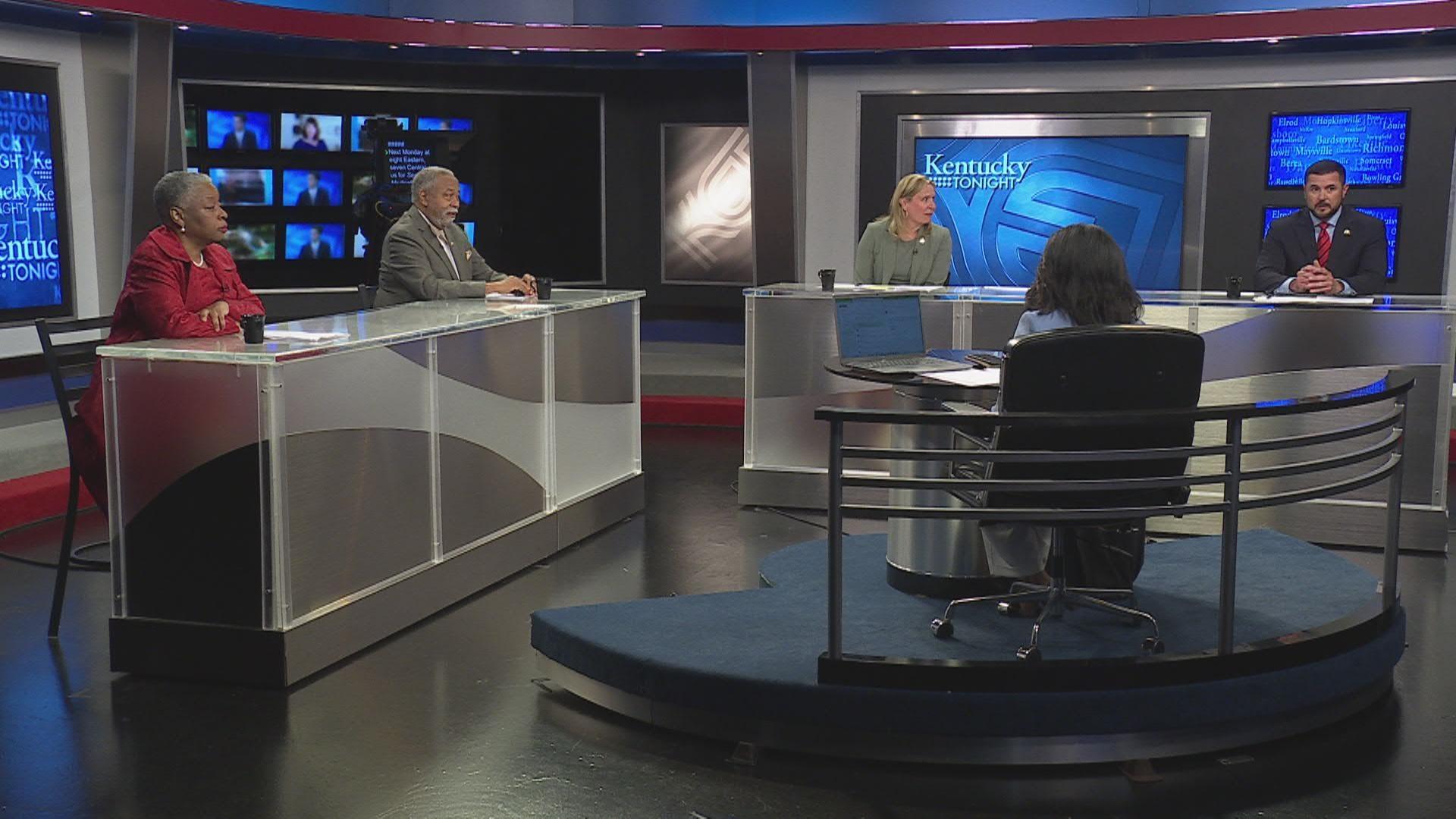
During the 2025 General Assembly session state lawmakers passed more than 100 bills out of some 1,100 measures filed this year. Now that their official work is complete, four legislators appeared on Kentucky Tonight to discuss what they and their colleagues accomplished during their 30-day session.
Sen. Amanda Mays Bledsoe of Lexington and House Speaker Pro Tem David Meade of Stanford say the most significant measure passed was House Bill 775, which gives lawmakers greater flexibility to reduce the income tax rate even if the state fails to meet existing budgetary triggers. Previous legislation allowed lawmakers to cut the rate by half a percent when certain budget metrics are met. Now they will be able to drop it by smaller increments between .01 and .04 percent.
The Republicans say this will allow the legislature to continue to deliver income tax relief even if the budgetary triggers become harder to reach in the future.
“No question the economy is on the hearts of minds of Kentuckians,” says Bledsoe, “so doing the income tax puts more money in people’s pockets to spend how they wish.”
Democrats say they remain concerned about state revenues as the income tax drops, especially given growing economic uncertainty at the national level. Louisville Sen. Gerald Neal also says there’s no research to indicate that eliminating the state income tax will result in prosperity for the commonwealth.
“I guess it’s appealing to folks if they can keep more money in their pockets. I’m not opposed to that,” says Neal. “I just hope that at the end of the day we’ll be able to meet the downturns that we are bound to meet later on in this process.”
Lawmakers also took steps to align Kentucky regulations on water quality and workplace safety with federal standards. Senate Bill 89 resets the state’s protections for waterways, groundwater, and wetlands to match federal rules. Democrats and environmental advocates worry that will result in more pollution and a degradation of precious water resources.
“People are concerned that the government is allowing businesses to pollute their water, and they want to know why it is that something that is working is being rolled back,” says House Minority Floor Leader Pamela Stevenson of Louisville.
Republicans argue the move will clarify regulations for farmers, builders, coal miners, and others, while also addressing what they say is regulatory overreach by state officials who have delayed or rejected some permit applications. Meade says lawmakers can come back and tighten regulations in the future if they find the state needs additional protections beyond what federal mandates may require.
“We haven’t relinquished any of our rights to the federal government,” says Meade. “We still retain those, it’s just saying that we’re not going to be any more stringent right now than what the federal government is.”
Meanwhile, House Bill 398 will rollback state workplace safety regulations that exceed federal standards. Meade says existing U.S. Occupational Safety and Health Administration rules are “very stringent” and “extremely safe.” He also says no Kentucky inspectors or inspection offices will be closed under HB 298. Neal says he fears OSHA may not even exist in the future given cuts being made by President Donald Trump and the federal Department of Government Efficiency.
Vetoes and Overrides
Gov. Andy Beshear rejected nearly 30 bills during the veto period prior to the end of the session, all of which lawmakers eventually overrode. After the session, the governor issued a line-item veto to a part of House Bill 622 that directs the Kentucky Department of Education to help fund the salaries of school resource officers located at private schools. Beshear said the state constitution prevents public tax dollars from going to private schools.
Meade says the $5 million the bill allocates for private schools will go to the law enforcement agency providing the SRO, not to the school itself. He says the state moneys aren’t funding education but safety and security, which he says all children deserve regardless of what school they attend.
Stevenson agrees that all students should have protection but she says many public schools still don’t have the funds they need to pay for the SROs they are required to have. She says private schools need to find a different mechanism for paying for their own security personnel.
Several of Beshear’s vetoes applied to measures that he says require additional money to implement yet were not specifically funded by the legislature. The governor points to court cases that he argues confirm the executive branch isn’t obliged to fulfill such unfunded mandates.
Meade says that’s a misreading of those cases and a misunderstanding of the budgeting process.
“If you’re not a legal mind, that sounds like a good excuse – he says, ‘They didn’t fund it, I don’t have to do it,’” says Meade. “But he is the only governor that I have served under that’s ever used that excuse and he’s used it for last five years.”
Meade and other Republican leaders say when a law is passed outside of the budget process, like the bills enacted during this session, the executive branch is expected to implement the changes using their existing funds.
While the legislature does set policy, Neal says governors must determine what the executive branch can accomplish. Stevenson adds that the legislature is only in session a few months while a governor must meet the needs of Kentuckians year-round. She also says that Beshear, as a former state attorney general, understands the court decisions.
“To say that he’s doing what he wants to do without regard to his ability to read the law, research the law, and follow precedent is misleading,” says Stevenson.
Inter-branch Relations and Legislative Transparency
Republicans continue to criticize Beshear for not being a better partner with the legislative branch. Meade says the governor has only met with lawmakers five or six times since he first took office in 2019, but he says Beshear’s father, former Gov. Steve Beshear, regularly met with legislative leaders. Bledsoe adds that it’s disheartening to reach out to Beshear’s office, like she says she’s done on artificial intelligence issues, and get complete disinterest. She says addressing the challenges facing the commonwealth will take everyone working together.
“Relationships matter,” says Bledsoe. “They matter between both chambers, they matter between both parties, and we can sit down and have tough conversations because we respect each other.”
Neal agrees that it there should be good communication between Beshear and legislators, but he says that’s been damaged by how Republican leaders have worked to undermine the governor’s authority.
“Kentucky is on a roll right now... and I think all of us have a part in that. The legislature has a part in that, the executive has a part in that,” says Neal. “So I think we’re still working well, but we do have to have respect for each other.”
The last days of the session also included several examples of bills being combined and pushed to passage, or being substantially overhauled by a committee substitute before being rushed to a vote. Republicans argue that’s normal and no different than what Democrats did when they were in power. Meade also contends Republicans only fast-track measures that have been discussed in the interim or already voted on in some form by a committee or a full chamber.
“You’re not seeing things that we’ve just pulled out of the air, that no one’s discussed, that no one’s talked about and just thrown it into bills,” says Meade.
Stevenson says whoever is in power, the public still has a right to know what’s in legislation and to voice their opinions about it. Instead, she says there were committee meetings where citizens had registered to speak on a bill but weren’t allowed to address lawmakers. Neal says discussions in the interim are very different than debates during the session, and that subtle changes in language can make a huge difference in the outcome of a final bill.
“The work we do is not simple, it’s tough,” says Neal. “We’re not always right and the fact of the matter is that we need to give room for people to come into that process. That helps us be better.”