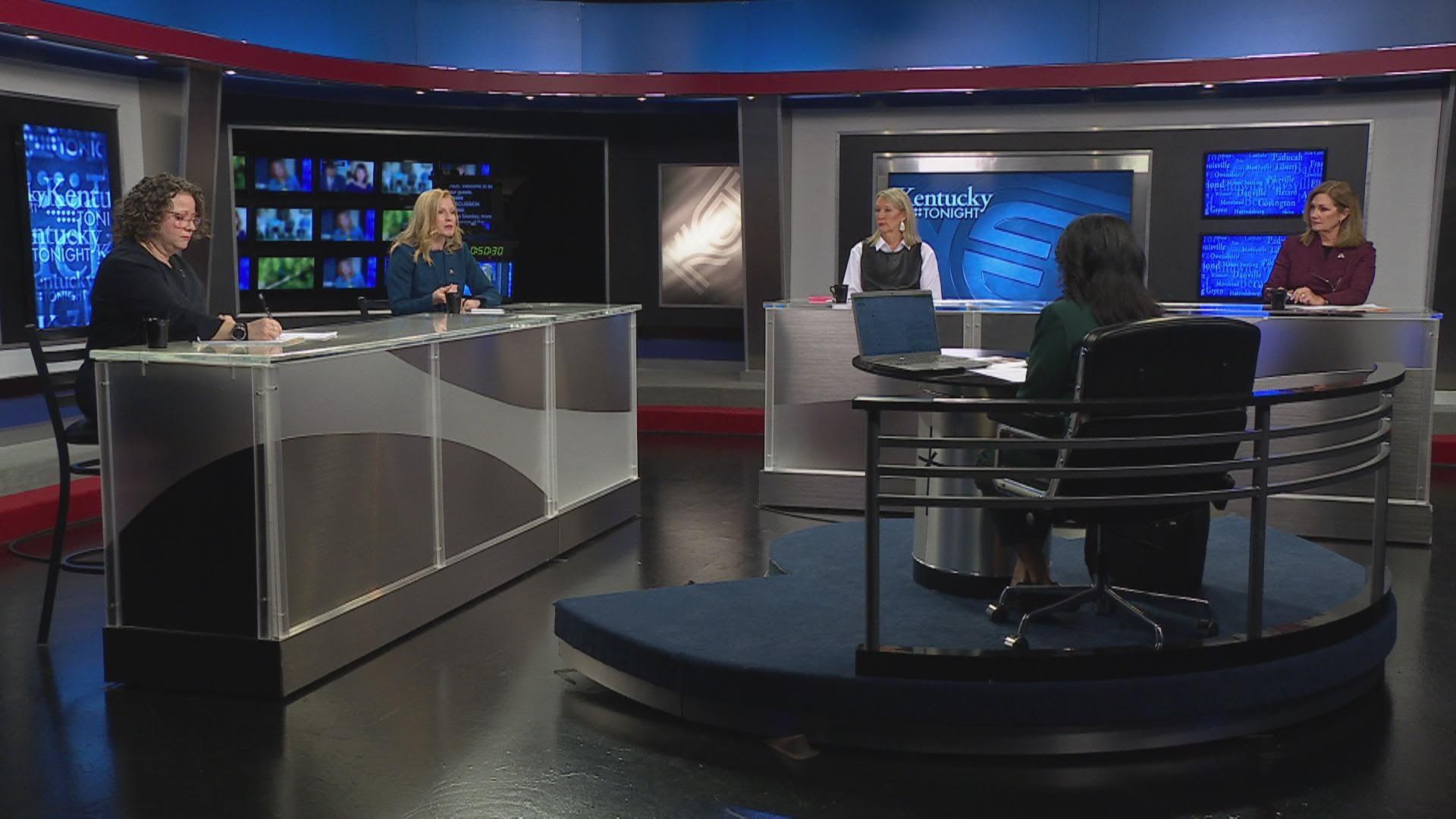
Although it’s a short, 30-day session, legislators working in the 2025 General Assembly have a long list of issues to consider that will impact families, children, and public health. Four female lawmakers appeared on Kentucky Tonight to discuss a range of such policy options from ending the sales tax on diapers, to exceptions to the state’s abortion ban, to addressing problems in the foster care system.
Media reports last summer revealed some children in state care had been temporarily housed in government offices. A subsequent review by Kentucky Auditor Allison Ball’s office found that 49 foster children from toddlers to teenagers had spent a combined 198 days sleeping in Cabinet for Health and Family Services buildings.
Rep. Kim Moser (R-Taylor Mill), who is chair of the House Health Services Committee, says the cases in question involve high acuity children who require intensive support for severe physical, behavioral, or emotional challenges. She says those needs make them harder to place in foster care.
“We need better funding,” says Moser. “This is not a new situation and for some reason we are not putting those resources behind this.”
There is also a provider issue, according to Sen. Julie Raque Adams. She says children’s homes Bellewood and Brooklawn in Louisville have cottages sitting empty because CHFS won’t assign foster kids to those facilities, nor will the cabinet provide an explanation for not doing so. That results, she says, in children being placed in government buildings, hotels, and state parks, or being sent out to four other states. Adams, a Republican from Louisville, says it costs the state Medicaid program three times as much to accommodate a child in an out-of-state facility than it would to keep them in the commonwealth.
One option before lawmakers to take pressure off the foster care system is House Bill 291. The bipartisan measure would help keep families together by allowing judges to order an alternative sentence for certain low-level offenders who are primary caregivers for a dependent child.
“It won’t apply to everybody,” says Adams. “This is for a judge to make that determination to say this person is a great candidate to have this kind of alternative sentencing.”
Allowing families to stay together when possible makes moral and fiscal sense, according to Sen. Cassie Chambers Armstrong (D-Louisville). She calls HB 291 “a great piece of legislation.”
“There’s a real cost to taking a parent out of a home and putting a child into foster care,” Armstrong says. “It’s a cost to that child and their life. It’s also a cost to the taxpayers of Kentucky.”
In some cases, a grandparent or other relative may take in a child who might otherwise go into foster care. But Rep. Adrielle Camuel (D-Lexington) says that places burdens on those family members who may already be struggling. She says every county in Kentucky has rates of so-called kinship care that are higher than the national average. She says HB 291 can help address that as well.
“We have the opportunity to make better policy to keep core families together,” says Camuel. “It’s a non-violent, low-level offense. Let’s not put this family through any more trauma. Let’s work on helping them correct mistakes.”
The Continuing Debate Over Abortion Access
Lawmakers have filed multiple bills to provide exceptions to the state’s ban on abortions. Both the House and Senate have proposals that include options like allowing the procedure for victims of rape or incest, in cases where the life of the mother is at risk, or where a fetus may be nonviable.
Moser says House Republicans have “great compassion” for victims of sexual violence, yet they remain committed to protecting the unborn. She says they are open to clarifying existing protections for mothers so that doctors know how to handle life-threatening situations such as an ectopic pregnancy or a premature rupturing of the amniotic sac.
“We want… our moms to be able to get care in Kentucky if they have a crisis pregnancy,” says Moser. “If we focus on anything right now, I would like to focus there and really think about how to strengthen our laws around those areas.”
In the Senate, Adams says she’s comfortable debating these proposals, but she adds the majority of the Republican caucus remains very pro-life and isn’t prepared to have these conversations. She worries that ambiguities in the current laws make it hard for Kentucky to attract and retain obstetricians and gynecologists, which are already in short supply in the state.
Camuel says more than 70 Kentucky counties have no OBGYN or pediatrician, which makes reproductive and maternal care difficult for many people to access. She says a problem pregnancy doesn’t just affect the life of the mother.
“We need to... take a faster approach to it to understand the full impact that this has on women, that it has on families, that it has on children,” Camuel says.
Armstrong contends that the health of Kentucky women is at risk the longer Republicans resist addressing these issues. She says doctors are worried they may lose their medical licenses or go to jail if they provide treatment that could run afoul of the current laws. While she would like to see America return to abortion access that was available before Roe v. Wade was overturned in 2022, she says Kentucky needs to at least provide exceptions for rape and incest victims and women with non-viable pregnancies.
“The voters of Kentucky… want us to be having conversations and figuring out some common-sense next steps, and I hope we can all work together on those,” says Armstrong.
Raw Milk, Fluoride, Diapers, and More
Other bills that legislators could take up between now and the end of the session on March 28 include proposals to allow retail sales of unpasteurized milk, to make fluoridation of public water supplies optional, and to test blood supplies for COVID-19 antibodies or “synthetic mRNA.”
Moser says she views the milk and fluoridation measures as being about personal choice. She agrees that fluoride has improved oral health, but she says there are other ways of getting it beyond adding it to the water supply. She also says there are real health concerns associated with raw milk, but she adds she would accept a bill to allow sales of it as long as the legislation required labelling about the risks of consuming unpasteurized milk. Finally, she says it would be too expensive to test blood supplies for COVID antibodies or synthetic mRNA.
Armstrong says she thinks these measures are more about politicizing science than promoting public health. She says children, pregnant women, and people with compromised immune systems can die from drinking raw milk. She contends fluoridated water not only promotes dental health but saves taxpayers money in dental care costs.
Another proposal that has House and Senate versions would exempt the purchase of diapers from sales taxes. Armstrong, the sponsor of Senate Bill 78, says families can spend more than $1,000 a year for diapers for just one child, which she adds is already a burden for almost half of families in America. While the exemption would cost an estimated $6 million, Armstrong says the state would more than recoup that money from other purchases parents would make with the money they saved.
The House version is sponsored by Burlington Republican T.J. Roberts. Moser says she doesn’t know how the House GOP caucus feels about the proposal, but she says it would alleviate financial pressure on young families without creating a revenue shortfall for the state.
For the fourth year Moser is sponsoring legislation to waive some prior authorization requirements that physicians must secure before performing certain procedures on their patients. She also proposes an effort to collect data on the health care workforce and to make it easier for health departments to provide health education curricula for their local schools.
In the Senate, Adams says she hopes to see passage of legislation to allow free-standing birthing centers, to require pharmaceutical companies to sell discounted drugs to qualifying hospitals, and to continue to control sales of vaping products.