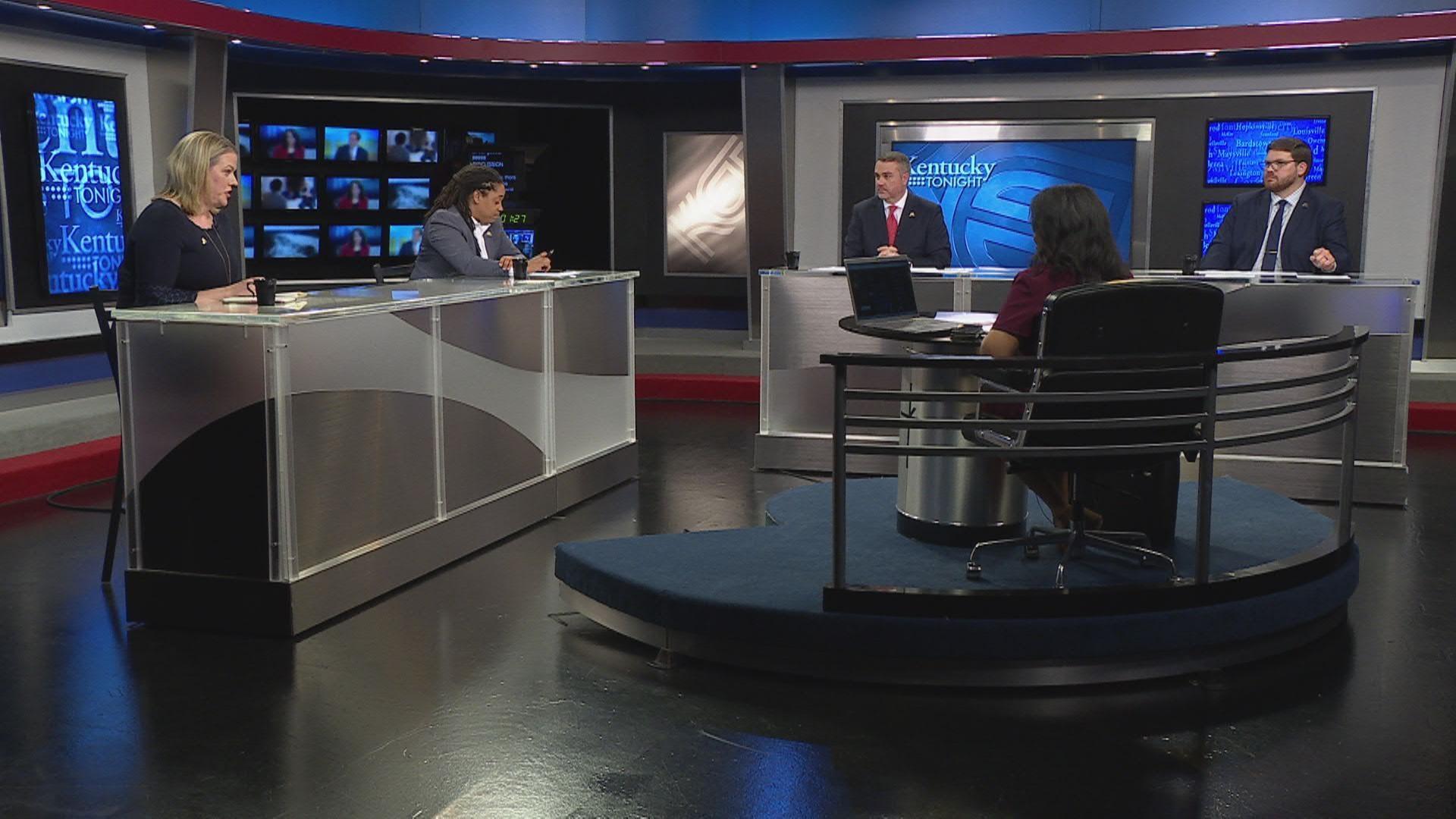
Like the legislative veterans in Frankfort, the freshman class of lawmakers serving in the 2025 General Assembly have arrived at the state capitol with their own policy priorities they hope will improve the lives of Kentuckians.
“The number-one mandate that I have from my constituents is to get something done about these utility rates because we’re paying more than anybody,” says Rep. Mitch Whitaker, an attorney and Republican from Fleming-Neon, a Letcher County hamlet of about 500 people.
He says he and others in Appalachian communities have seen their heating and electric bills jump to as much as $600 a month for even a small home. He blames the Kentucky Public Service Commission for allowing the increases.
“When you have to choose between medicine and the power, the power’s going to go off for a few days,” says Whitaker. “That’s unacceptable in the year 2025.”
Given the region’s natural resources, Whitaker is also proposing legislation to boost outdoor recreation, which he says can be a huge economic engine for eastern Kentucky.
Rep. Anne Donworth arrives in Frankfort with a background as a business owner and nonprofit executive in Lexington. The Democrat has filed legislation to provide for universal early childhood education. She says children need to be ready to learn when they enter kindergarten.
“Being able to have quality pre-school for all Kentucky four-year olds would be a huge win,” says Donworth, “not to mention daycare is incredibly expensive and if that also gives some relief to working families, then it’s a double win.”
Donworth also backs a comprehensive measure for more affordable housing and a proposal to provide exceptions to the state’s abortion ban to protect victims of rape and incest.
Sen. Craig Richardson brings a strong interest in small-town health care to his first term in the legislature.
“Our rural hospitals are in a lot of trouble,” says the Hopkinsville Republican. “We’re not talking about expanding services and expanding access to health care, we’re talking about… managing day-to-day operations just to keep the doors open.”
But with that challenge comes opportunities, according to Richardson. In addition to helping hospitals with Medicaid reimbursement rates and prescription drug prices, he says he also sees options to expand the roles of nurse practitioners, physician assistants, and even pharmacists in providing care in rural areas.
While she is new to the state Senate, Keturah Herron (D-Louisville) previously served a term in the House of Representatives. In her new seat, she says she will continue to focus on community safety, gun violence prevention, police accountability, and mental health issues. She has proposed legislation to require insurance policies to cover one mental health wellness exam a year.
“I will vote yes on a bill if I can get to about 75 to 80 percent that I agree with what’s in it,” says Herron. “But as far as any type of anti-people, anti-(diversity, equity, and inclusion), anti-LGBTQ, anything that is anti-humans and people, I am going to be absolutely against it.”
Taxes, Education Funding, and Workforce Issues
These four lawmakers and their fellow freshmen will be in the thick of ongoing policy debates in Frankfort about taxes, education, and workforce issues.
Herron and Donworth joined with several other Democrats in voting for House Bill 1, which will lower the individual income tax rate to 3.5 percent starting in 2026. Herron says many of her constituents are excited about this latest decrease to the rate, but she says she’s still worried about how the state will make up the lost revenues when it comes time to pay for vital services like education and health care. She’s also concerned about how President Donald Trump’s policies could impact the state budget.
“When we started originally talking about lowering the income tax, we did not know there was going to be an increase in tariffs,” says Herron. “Now here we are and there’s going to be a different type of tax burden on Kentuckians that’s out of our control.”
Donworth shares that concern and says the state needs to hold more money in reserve to insulate Kentuckians from that fiscal uncertainty. She also says low taxes are only part of what will attract people and businesses to relocate in Kentucky.
Whitaker says he supports the Republican plan to eliminate the state income tax and replace those revenues with more sales taxes, although he adds he would oppose taxing medicine and groceries. He contends the state income tax reduction is the best policy regardless of what happens in Washington.
“We can’t control what goes on at a national and international level as policymakers here at the state level,” says Whitaker, “but we can lower your income taxes and put more money in your pocket.”
Richardson says lawmakers must be continually mindful of ways to increase state revenues, but he says the incremental approach to tax cuts taken by the Republican supermajorities is wise and business-friendly.
Both Whitaker and Richardson say public school funding known as SEEK likely needs to be revisited, either to overhaul the formula or completely replace it.
“If we find out SEEK funding is the way to go, great. We’ll keep doing it,” says Richardson. “But if we find out it’s not the right way to work and the money’s not actually going to teachers and the children to better their education, to better this commonwealth, then I think we need to look at change.”
Regarding diversity, equity, and inclusion policies, Donworth says diversity contributes to thriving businesses and economic growth. While Republicans have criticized the policies in education and corporate America, Donworth argues the efforts may not have gone far enough.
“We’ve got a lot of work to do and until we don’t have people perpetrating violence or hatred on other people, then there’s DEI work to be done,” says Donworth.
Whitaker says he thinks DEI has been a failure, especially on the University of Kentucky campus, where he studied agricultural economics and the law. He says it’s a disservice to tell youth that they will always face systemic oppression. He also says he felt he and other eastern Kentuckians were excluded from social and academic supports that other students at UK received.
“If we’re going to have these initiatives, have them include everybody across the state of Kentucky,” says Whitaker. “Our universities need to focus on education more than indoctrination.”
The two Republicans are split on the benefits of allowing state employees to work remotely. Richardson says he wants to see data on whether remote work improves productivity over being in the office full time. Whitaker says remote work has enabled his constituents to hold state government jobs without having to relocate to Frankfort. He says remote options also allow state agencies to land workers they might not otherwise be able to attract.
Donworth says as long as the work gets done, it shouldn’t matter whether a state employee is in the office or at a remote location. She says higher pay for state workers is crucial to attracting and retaining the best people in public sector jobs. Herron agrees that state workers need pay raises, especially those veteran employees who may be making less than new hires due to so-called salary compression.