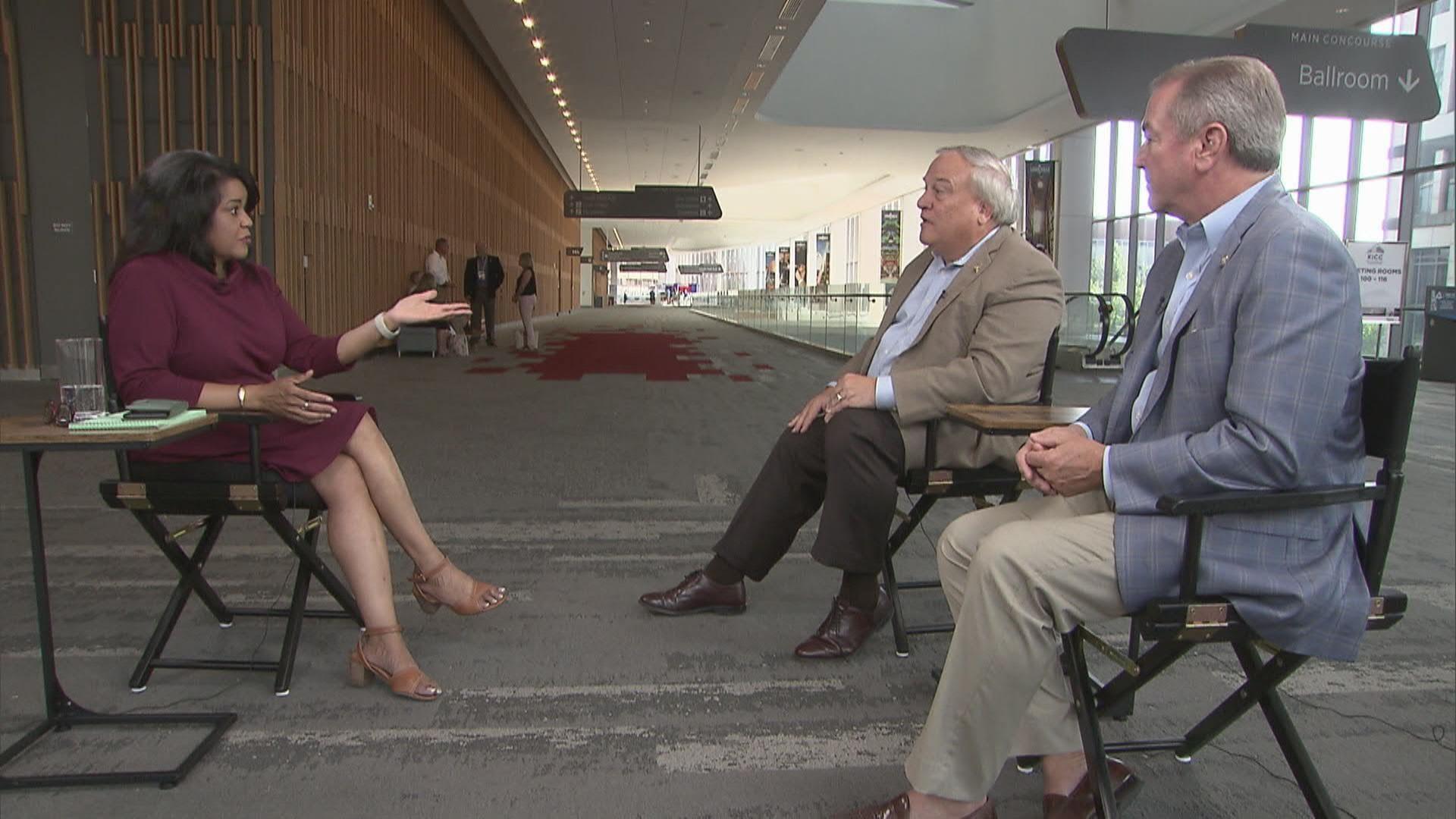
Like most occupations, even state legislators have professional organizations and conferences. One of the largest such groups, the National Conference of State Legislators, represents more than 7,300 lawmakers from every state as well as the American territories. This year marks the 50th anniversary of the organization, which convened in Louisville from Aug. 5 -7 for its annual summit.
“We like to refer to our states as the laboratories of democracy because so little gets done at the national level,” says Rhode Island state Rep. Brian Patrick Kennedy, who is president of NCSL. “Congress is incapable of not only talking to each other but being able to even get anything to pass.”
Several things make NCSL different from other legislative organizations. Kennedy says NCSL is bipartisan with equal numbers of Republicans and Democrats in leadership and serving as committee chairs. He says the group also includes more than 30,000 legislative staffers who work in state and territorial capitols to support their lawmakers.
“As legislators we couldn’t get anything done without staff,” says Kennedy.
The summit brings a significant economic impact to Louisville, which last hosted the conference back in 2010. NCSL Public Affairs Director Mick Bullock says the 5,300 attendees at this year’s gathering have booked more than 10,000 hotel-room nights in Louisville and will inject some $4.8 million into the local economy. While the summit runs Sunday through Wednesday, Bullock says many attendees will stay through the following weekend to sample more of what Kentucky has to offer.
“When your attendees (are) actually doing that, you know you’ve got a great city that is hosting the legislative summit,” says Bullock.
The View of Kentucky Lawmakers
With hundreds of sessions on topics ranging from artificial intelligence to taxation to health care innovations, the NCSL Summit provides lawmakers with the latest information on issues that face their constituents.
“NCSL is different in the fact that it brings people from every political persuasion from every corner of the country,” says Kentucky House Speaker David Osborne (R-Prospect. “It really does bring perspectives that we don’t get to see often.”
Kentucky state Rep. Cherlynn Stevenson (D-Lexington), who is the House Minority Caucus chair, also credits NCSL for being a nonpartisan source of research on potential legislation and for providing a forum for lawmakers to share what’s working – or not working – in their states.
“The collaboration that we can have with other states and other policymakers is important,” says Stevenson. “You make friends from other states and it’s an opportunity to get to see them, catch up with them, (and) talk about what bills they’re working on.”
The Kentucky General Assembly allocated $1 million to hosting this year’s summit. Senate President Robert Stivers (R-Manchester) says that was matched by an additional $2 million in private donations. He says it’s valuable for Kentucky lawmakers to connect with legislators from around the country and learn about fresh approaches to tackling issues they have in common.
“There’s different dynamics to each one, but there are similar underlying problems that you might have some type of solutions that would work one place or another,” says Stivers.
As an example, Stivers points to the legislation that will gradually eliminate Kentucky’s income tax. Unlike Kansas, which took an aggressive approach to cutting taxes there, Kentucky uses a series of revenue triggers that, if met, allow the state to cut the tax rate by a half-percent per year.
“Where did we learn not to be like Kansas? At NCSL,” says Stivers. “We listened to what happened to their budgets and how they didn’t take into consideration growth of expenditures versus growth of revenues.”
Speaker Osborne projects the state should be able to drop the tax rate to 3 percent. But he warns that increasing Medicaid and public pension costs will make it difficult to further decrease Kentucky’s rate.
“Once we get beyond that, it gets to be a heavier lift,” says Osborne. “That’s when people get antsy.”
He says lawmakers could decide to sidestep any unmet revenue triggers and continue to lower the rate below 3 percent, or they could choose to stay the current course and accept that eliminating the tax may take longer than originally projected.
Looking ahead to the 2025 General Assembly session, Osborne says lawmakers will focus on smaller, incremental measures rather than major policy reforms. He says he hopes to act on recommendations proposed by a new artificial intelligence task force as well as new bills on drug addiction treatment, child care, and workforce development.
Stivers says next year’s 30-day session will also look to ensure that moneys the legislature allocated this year for infrastructure projects and other needs are being used properly. He says lawmakers will also continue to discuss ways to tackle affordable housing and homelessness in the commonwealth.
“We’re trying to deal with it on both sides,” says Stivers, “both the legislation side (and) the humanitarian side because we know the impediments that are out there.”
Stevenson says she expects diversity, equity, and inclusion (DEI) policies at state universities will continue to be a hot topic. She says lawmakers will also closely watch the implementation of the state’s medical marijuana program, which launches in 2025.
Until then, the House Democratic caucus is dealing with allegations of misconduct by one of its members. The Legislative Research Commission is investigating Louisville Rep. Daniel Grossberg for alleged sexual misconduct and inappropriate text messaging. While that investigation continues, House Democrats voted to suspend Grossberg from their caucus. Stevenson says that means he will not have access to caucus meetings or internal communications.
“We just believe that it’s best that he take a step back right now until the investigations can conclude,” says Stevenson. “Pending the results of that investigation, at that point we will decide how to move forward again as a full caucus.”
The View of Lobbyists
It’s not just lawmakers who see the value of NCSL. Bob Babbage, who is a former Kentucky Auditor and Secretary of State as well as the founder of the lobbying firm Babbage Cofounder, says the NCSL summit is a great place to have face-to-face conversations with subject-matter experts. Far from being a vacation in a great locale, Babbage says the conference provides “continuing education” for lawmakers who need to stay abreast of the latest issues.
“We pay our legislators ridiculously low amounts,” says Babbage, “so to come to a conference is not a great big perk.”
By hosting the summit, Babbage says Kentucky lawmakers can highlight those issues on which the commonwealth is a leader. One such area, according to lobbyist Amy Wickliffe, is in bridging urban-rural divides. But she says the work on that issue is ongoing.
“We’ve got to make sure that our rural communities remain as strong as our urban centers because people want to live in those rural communities,” says Wickliffe, who is a partner with McCarthy Strategic Solutions. “We’ve got to make sure that policies that are set don’t drive people out of those rural communities.”