Political campaigns can go to great lengths to court younger voters, but the return on that investment is often unpredictable. Only about 39 percent of Americans aged 18 to 29 voted in the 2016 presidential election, according to the Center for Information and Research on Civic Learning and Engagement at Tufts University.
But in 2020, youth turnout jumped to about 50 percent.
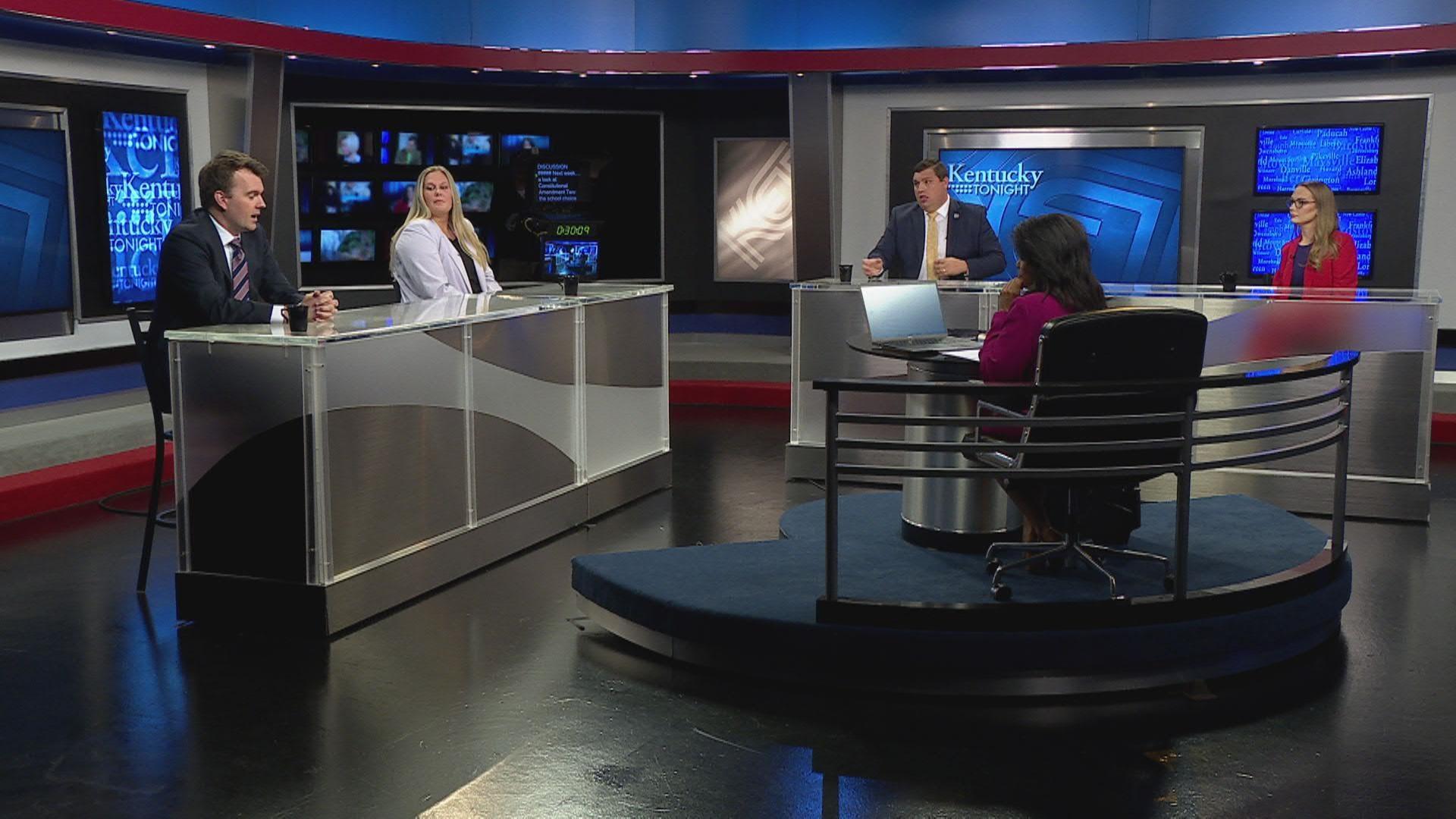
Activating younger voters in the commonwealth is the work of the Kentucky Young Democrats and the Kentucky Young Republican Federation, both of which say they define their target demographic as people aged 18 to 40. Activists say young voters are motivated to turnout by everything from economic concerns to a candidate’s character.
“Issues are what matters to young voters,” says Rick Adams, a Democrat and former candidate for the state House of Representatives. “But I think this is a unique election in the sense that temperament for office has now become an issue in this campaign.”
Adams says former President Donald Trump’s behavior is causing younger voters to worry about national security and the future of the country. He says youth don’t want a president that spreads lies or threatens fellow Americans, but one who will be stable in office.
Supporters of the Republican nominee counter that Trump’s rhetoric on the campaign trail is exaggerated. Sebastian Torres, chair of the Kentucky Young Republican Federation admits he wishes Trump would word some of his statements differently. But he says the Republican, if elected, would surround himself with advisors who would ensure a successful second term, much like he had during his first term in the White House.
“President Donald Trump ran the country for four years, through what was, frankly, an unprecedented pandemic and the wheels kept moving,” he says.
Torres contends the Democratic ticket has its own personality issues, pointing to what he says are radical policies and questionable leadership of Vice President Kamala Harris and Gov. Tim Walz. Critics of Harris often point out how she has changed positions on issues ranging from natural gas fracking to immigration. But Kentucky Young Democrats President Allison Wiseman says that just illustrates Harris’s willingness to grow as a leader.
“It is okay to evolve on your stances over time, that is something that makes you human and I think that’s (something) that makes you a strong politician,” she says. “To me that means she is listening, she is paying attention... and that’s something that I want to see in a president, and I don’t see that with the ticket on the other side.”
Wiseman adds that she also wants a president who will work with international allies, saying America thrives when it helps others around the globe. She’s also concerned about student loan assistance and says Harris understands how those debts prevent young Americans from fully participating in the economy.
Emily White, national committeewoman for the Kentucky Young Republican Federation, agrees that younger voters are keenly focused on their own pocketbooks. She says the Biden-Harris administration has failed young Americans with high inflation that she says makes the American dream unattainable. White also points to border policies that she says are flooding the nation with illegal drugs and criminals that are killing American youth.
“Contrast that to President Trump. We saw an unprecedented economic growth, jobs were rising, and wages were increasing,” White says. “We had an administration that was focus on securing the border and providing our law enforcement with the resources they need.”
Ballot Issues and State Races on Kentucky’s Ballot
Beyond the presidential race, Kentuckians will also vote on two proposed amendments to the state constitution. Amendment 1 would add language that explicitly prohibits non-U.S. citizens from voting in any local or state elections. Torres says some liberal mayors elsewhere in the country have allowed non-citizens to vote in city elections, and he fears that could happen here in the future.
“At this point it’s not my understanding that it is occurring here in Kentucky but that being said we should be ahead of the curve on these things,” says Torres. “Frankly, I think who gets to vote is such an important subject that it makes sense for it to be located within our state constitution.”
Critics of Amendment 1 say the proposal is unnecessary and merely a tactical move by Frankfort Republicans.
“You already can’t vote in an election if you are not a United States citizen,” says Wiseman. “That’s just the law.”
Instead of addressing an actual problem, Wiseman argues that Amendment 1 is simply a move to stoke anti-immigrant fears and boost GOP turnout to vote yes on Amendment 2, which would allow lawmakers to direct state tax dollars to private school educations. Supporters of that amendment disagree.
“There has been a lot of misinformation regarding this amendment,” says White. “All it does is provides the General Assembly the freedom to have discussions on educational choices. It does not take away funding, it would not enact policy if passed.”
Torres adds that the state’s reading and math scores clearly demonstrate that public schools are failing students and something must change. He says he believes rural Kentuckians who turn out for Trump will also vote yes on Amendment 2.
But Wiseman counters that the funding amendment, if passed, would be especially detrimental to public schools in rural communities. She says public dollars should only go to public schools.
“If you want to send your kid to a private school, that’s fine. You have the right to do that,” says Wiseman. “But my tax dollars should not help you pay for your child to go to a private school.”
Adams agrees that the status quo isn’t sustainable, but he blames that on Republican supermajorities in the state House and Senate that he says have deprived public schools of the funds they need to properly pay teachers and fully fund student transportation.
As for state legislative races of interest, Torres says he’s watching the 38th House district where Republican Carrie Sanders McKeehan, a special education teacher, is challenging Democratic first-term incumbent Rachel Roarx for the seat that represents a portion of southwestern Jefferson County. Torres says Roarx is vulnerable for her vote earlier this year against the Safer Kentucky Act, which, among other things, punishes homelessness.
Wiseman is confident Roarx can secure reelection, arguing that legislation won’t be an issue because she contends voters realize it won’t actually make them safer. She says she’s watching the race in House District 48 in portions of Jefferson and Oldham Counties that has incumbent Republican Ken Fleming running against Democratic challenger Kate Farrow. Wiseman says Farrow has name recognition in the area after her run for school board in Oldham County. She also says Fleming is vulnerable because of his votes on abortion.
Over in House District 88 in portions of Fayette and Scott Counties, Democratic incumbent Cherlynn Stevenson is running against Republican Vanessa Grossl, a software company executive. White says Stevenson, who is the House minority caucus chair, has not produced for the district nor proposed any strong legislation. Torres says Stevenson has also been distracted by controversies in her caucus that have prevented her from devoting attention to her constituents.
Wiseman says she’s confident in Stevenson’s ability to win reelection, pointing to her significant fundraising advantage over Grossl and door-knocking support from educators. Adams says Stevenson has been a leader for public education and reproductive health and a voice of reason within her caucus.