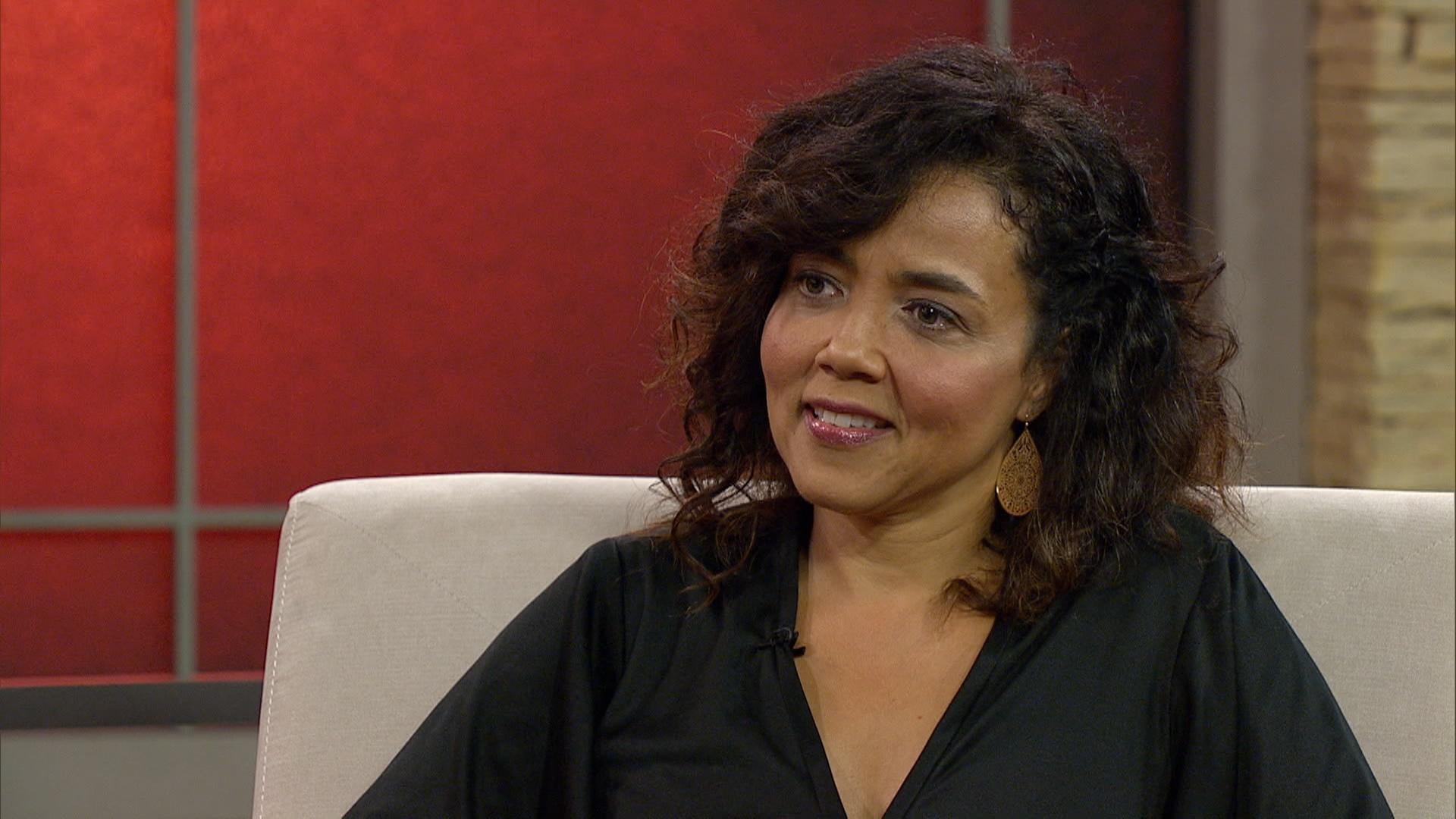


Mitzi Sinnott’s father left in the 1960s to fight in the Vietnam War before she was even born. When he returned, he was suffering from mental illness, and he left the family again when she was a young child.
Her journey as an adult to find him is told in her one-woman play, “Snapshot: A True Story of Love Interrupted by Invasion.” The Flatwoods, Ky., native recently sat down for an interview on KET’s Connections with Renee Shaw to talk about her play and her experience of growing up as the biracial daughter of a black father and white mother from central Appalachia.
Sinnott lived and worked in New York for years, establishing an after-school arts program at a school there. Sinnott’s mother had made her a photo album with pictures of her father, and through those snapshots, she began to discover him. A musician, he met Sinnott’s mother at a high school dance in Kentucky.
She was asked to take part in an anti-war rally in New York, and from that, she was inspired to create the play. In “Snapshot” Sinnott plays 15 characters, including her father. She wrote the first draft of the play in one night. In the play, she explained, everybody goes back to the past, but part of her father stayed back in Vietnam, Sinnott said.
The opening scene is her father in the barracks. “I never really read that book, ‘Black Power,’ that my dad is holding there, but I did go get it after I had written the scene. And I was like,’ whoa!’ I felt like I really did it justice. Something was channeling divine, something that I had been thinking about, and it just came,” she said.
The play also explores Sinnott’s search for her own identity. She went to a Catholic school in Ironton, Ohio, where her mother’s Irish family had attended. When she switched to a public school, some African-American students thought she was trying to pass as white and harassed her. “They walked down the hall in a line, ‘Who do you think you are?’ What, I’m just trying to go to school,” she recalled.
Looking back, Sinnott said she wished she would have stood up for herself more. The day she spoke up, she said, the harassment stopped. “I remember throwing my alto sax down, and I remember like, ‘What are you going to say?’ That kind of stuff,” she recalled.
Sinnott said her family claimed their mixed heritage. “My mom was one of the first white women in our tri-state area to claim and keep her half-black baby,” she said. “At that time, a lot of women put them up for abortions, adoptions. My mom was like, no, this is love. I’m keeping her. And so with that, everybody had to figure out how we were going to deal with that.” Sinnott believes her mother, a dancer with her own studio, is a role model for others. “Stand up for what you believe–don’t let people take that from you,” she said.
After a long search that took her across the country, Sinnott found her father in 2004, living in a shelter in downtown Honolulu. He continued to live there even after the shelter transitioned to a home for battered women and single mothers. “And the women said, and them all mainly being Polynesian and Asian, they looked at this black man with this Afro as sort of like a guardian,” she said.
Sinnott said while it was good to know that her father was cherished by the women in the shelter, it didn’t make it easier for her not to have her father in her life. “When you are aware how much your mom loved, how much your family loved, I don’t know. You’re like, I want to feel some of that, right?” she said.
When Sinnott returned to Kentucky, someone shared a memory of seeing her father after he’d gotten out of the mental hospital. “She said, ‘Girl, it was like raining, and he laid on the parking lot in a place, and just laid there and let the rain wash him,” Sinnott recalled. She believes her father was in a place of pure, raw emotion.
Since finding her father, Sinnott has found she has more respect and empathy for those with mental illness. “I think my mom thought he was in Honolulu at Don Ho’s club. He did pursue a contract for his band at Don Ho’s nightclub in Waikiki. That’s why we all went there. And I think she thought that he was doing a luau every night. …. He used to play at UK’s dances and he used to be all over the place with his band.”
Sinnott said her father did the best he could with the circumstances he had. “Mental illness — you wish that you could pull them back. I don’t know. There’s not a drug they figured out that can. … You have to come [to them} with this…surrender, and these gloves of kindness.”
Now, Sinnott travels here and abroad performing her play, as well as facilitating a workshop, “What’s Your Story?—Getting to Your Core.” Sinnott hopes to make her play into a feature film. “I would like to bring to light how we deal with the mentally ill,” she said.