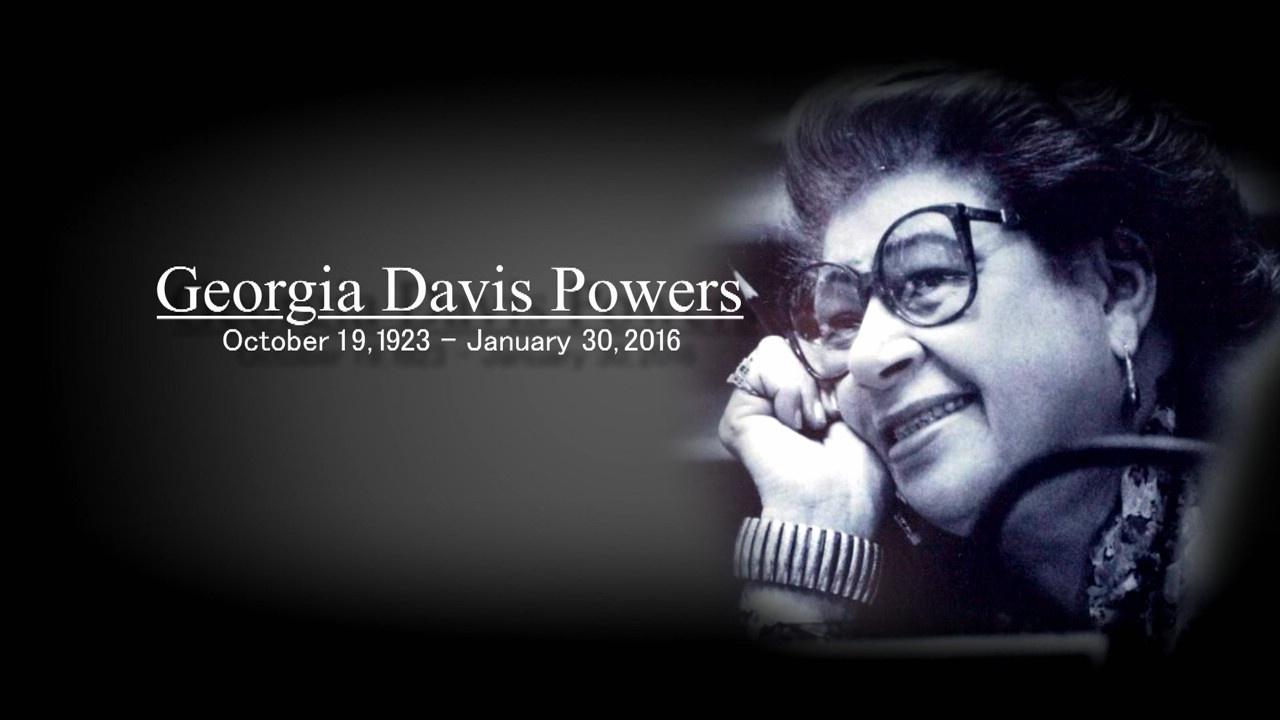


A long life lived well is how KET’s Renee Shaw describes former Sen. Georgia Davis Powers’ years of service to the commonwealth. The first woman and African American elected to the state Senate died on Jan. 30 at the age of 92.
On a special edition of Connections, Shaw paid tribute to Powers, her two decades as a lawmaker and her lifetime of activism.
Descended from slaves and born in a two-room cabin in a segregated enclave of Washington County, Powers felt the first stings of discrimination as a teenager. At 16, she got a job at a downtown Louisville lunch counter, where her boss told her she could serve black customers but she couldn’t allow them to eat there. Powers says the directive made no sense to her and, after three reprimands for disobeying her employer’s order, she was fired.
It wasn’t until middle age after she had held a series of jobs that Powers became politically active. She worked on the 1962 U.S. Senate campaign of Louisville Democrat Wilson Wyatt. Then she helped organize the 1964 civil rights march on Frankfort that featured Rev. Martin Luther King and baseball legend Jackie Robinson.
In 1966, Powers landed work as a bill clerk in the Kentucky House of Representatives. One day as she delivered a bill to a lawmaker, Powers says she encouraged him to vote for that legislation.
“He says, ‘If I voted for that bill, I’d never get re-elected,’” Powers recalls. “I said, ‘Well maybe you shouldn’t,’… I said what I need is my own seat here…because if I get a seat here, I’m going to vote for the people. And that was a prophetic statement.”
A few months later, the Senate seat for Powers’ home district in Louisville came open, and she decided to enter the contest.
A Skillful Legislator
Long-time friend and confidant Raoul Cunningham says Powers was a ferocious campaigner who was determined to win and to make a difference in the lives of Kentuckians. Cunningham worked for Powers during that 1966 race, and later became president of the Louisville NAACP.
“She stated that she was on a mission for the betterment for African Americans, women, the disabled, the handicapped, and the voiceless,” Cunningham says. “And that she was.”
Once in the state Senate, the Democrat filed legislation to prohibit discrimination in the sale or rental of housing in the commonwealth. Though a freshman Senator, she deftly maneuvered her bill through its committee and to a floor vote by trading on her support of a measure about daylight saving time. Her bill passed the chamber 27-3, and ultimately became the first statewide open-housing law enacted in the South.
“She was a skilled and focused and forceful legislator,” says Sen. Gerald Neal (D-Louisville), who succeeded Powers after she retired from the Senate in 1988. He says Powers was committed to mentoring those around her on how to participate in civic issues, and he credits her for his own political career.
“When you think of her, you think of her as a leader,” Neal says. “Now I think she’s risen to the level of icon. She’s an inspiration to a lot of people.”
Passing on a Legacy of Good Work
Powers’ work in the Senate wasn’t always easy as she navigated among her white male colleagues, and endured occasional harassment from the Ku Klux Klan. Former Louisville Sen. David Karem says he loved working with his fellow Democrat, and admired how Powers could change people’s lives.
“I see that when a person like Georgia Powers teaches dignity, teaches kindness, teaches respect, that affects me,” Karem says. “I then pass that on, and as she has affected every one of us in a positive way, it’s like that great ripple in a pond where we pass it on, we pass it on, we pass it on.”
Even in retirement, Powers continued to support the causes she believed in, saying she felt compelled to share her blessings with others. And she continued to serve as a role model for a younger generation of politicians, including Kentucky Secretary of State Alison Lundergan Grimes. She says Powers could look into someone’s soul and see the good work that they could do, and then encourage them to do it.
“Sen. Powers taught me some of the best lessons that I have learned as I have tried to serve the commonwealth,” Grimes says. “Democracy is only as strong as our must vulnerable voter. Justice is not a given, you have to fight for it. … Forgiveness is not an occasional act, it’s a constant attitude.”