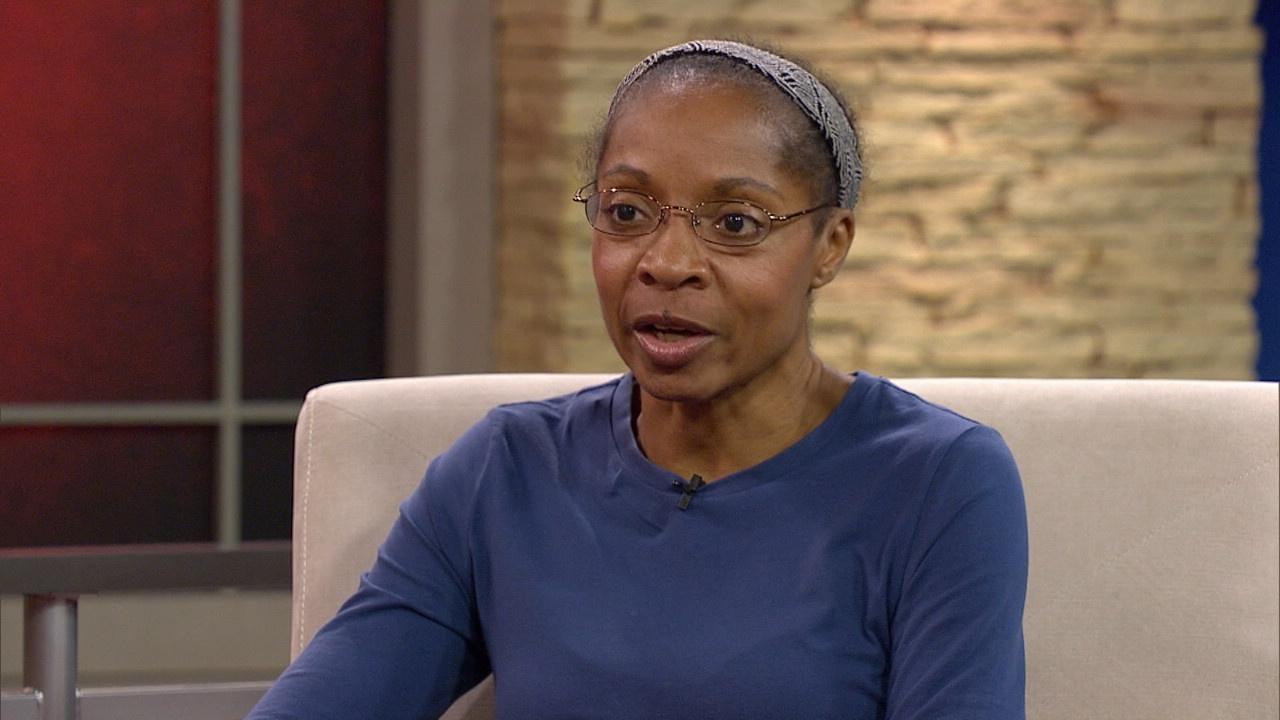


Poet Allison Joseph grew up listening to the lyrical speech of her Caribbean-born parents mixed with the fast-talking street slang of her Bronx neighborhood. As those vernaculars merged in her head, they fueled her imagination.
“There’s a music to the language we use every day,” Joseph says, “the sounds of words coming together and creating a symphony in our minds.”
Joseph weaves a range of inspirations into her poetry, which she describes as accessible and quirky. She appeared on KET’s Connections to discuss her work as a poet and creative writing professor at Southern Illinois University at Carbondale. Joseph is also editor of the Crab Orchard Review.
All too often, Joseph says, poetry is taught as an “inscrutable mystery and a riddle you can’t solve,” which she contends is a mixed blessing. It can lead people to fear they’ll never be able understand the deeper meaning of a poem. But it can also encourage readers to keep returning to a work to discover new meanings that emerge from the words.
While some poets write for dedicated fans of verse, Joseph says she prefers the work of poets like Gwendolyn Brooks who sought to expand the audience for poetry.
“It is an art created in solitude, it is an art of the individual,” Joseph explains. “But sooner or later that individual has to come into the community and declare what it is their art is all about.”
An Openness to Inspiration
Joseph says some of her poems are commissioned, like a piece she wrote in response to the death of Freddie Gray, allegedly at the hands of the Baltimore police, while other poems are spur-of-the-moment works inspired by something she sees or hears.
“There are things that people say, they just toss off casually, and I’ll say, ‘Do you know that’s the first line of a poem?” Joseph says.
That openness to inspiration is a core part of what Joseph teaches in her university classes and to the high school students who attend her summer writing workshops. She says she wants her students to embrace the possibilities of language and the fantastic things that can race through the mind of a young person.
“Part of my job is to remind people of the potential they have within themselves,” she says.
Then Joseph has her students draft their poems using pen and paper as a way to get them to slow down and focus. That low-tech approach extends to reading poetry in books. Joseph says there are several wonderful poetry websites, but she prefers seeing the words on a printed page so she can easily flip between poems and reread things that particularly interest her.
The Appeal of Complicated, Flawed Characters
Joseph’s six collections of published poetry include volumes inspired by her mother and father. The two came from different Caribbean islands and met in England, where Joseph was born. The family soon moved to Canada and later the Bronx.
Her first book focused on poems about her mother, who died of lung cancer when Joseph was a teenager. A later book explored the more conflicted relationship she had with her father after her mother’s death.
“It’s always much more interesting to write about the complicated and the flawed person, to examine them as a character,” Joseph says. “In writing poems for my father, I had to look at him less as my father and more as a character I was creating.”
Because of their island heritage and the British colonial influences, Joseph says she frequently had to translate words that her parents used into the more common language of everyday New Yorkers. She also had to endure questions from friends who wondered why she didn’t sound Caribbean, British, or even African-American.
Those queries and her love for the music of language led Joseph to write a poem called “On Being Told I Don’t Speak Like a Black Person.” Near the end of the verse, Joseph writes:
Now I realize there’s nothing
more personal than speech,
that I don’t have to defend
how I speak, how any person,
black, white, chooses to speak.
Let us speak. Let us talk
with the sound of our mothers
and fathers still reverberating
in our minds…
Let us simply speak
to one another,
listen and prize the inflections,
never assuming
how any person will sound.