Skip to Main Content

Ari Berman on Voting Rights

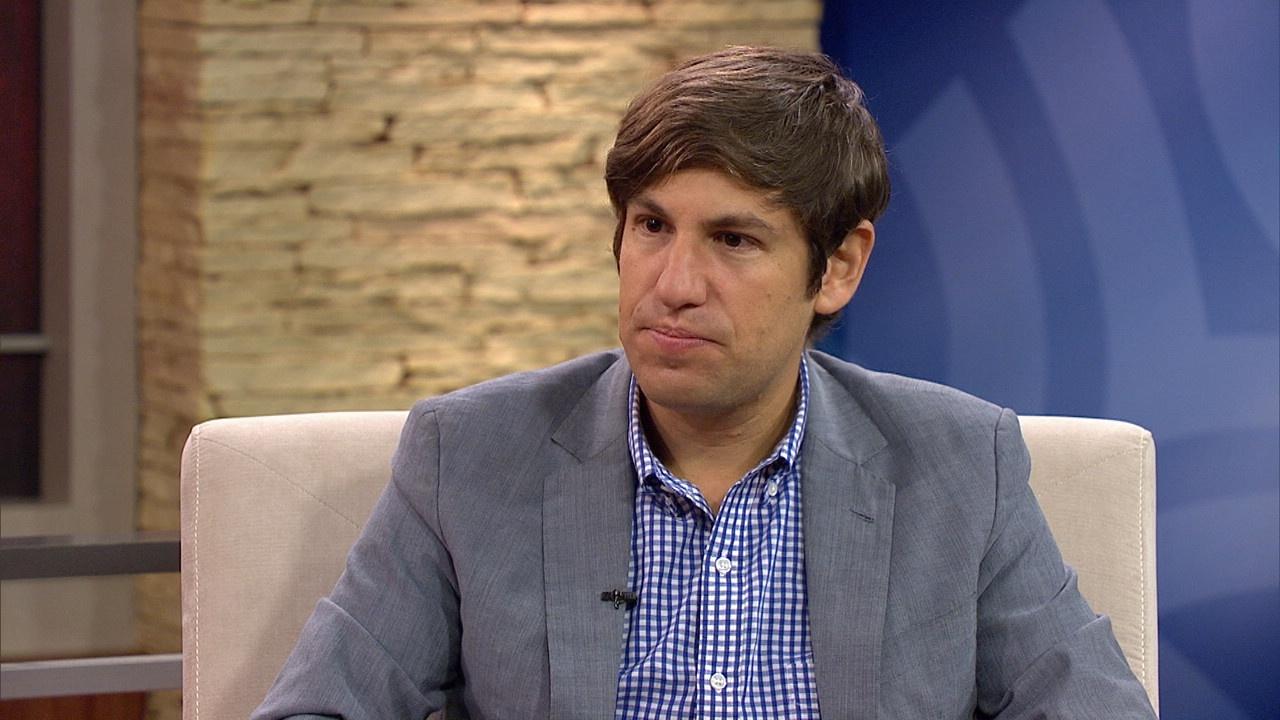
Renee's guest is journalist and author Ari Berman. Berman has written extensively about American politics, civil rights and the intersection of money and politics. The title of his new book is "Give Us the Ballot: The Modern Struggle for Voting Rights in America."
Season 11 Episode 9 Length 28:01 Premiere: 11/13/15

About

Connections

KET’s Connections features in-depth interviews with the influential, innovative and inspirational individuals who are shaping the path for Kentucky’s future.

From business leaders to entertainers to authors to celebrities, each week features an interesting and engaging guest covering a broad array of topics. Host Renee Shaw uses her extensive reporting experience to naturally blend casual conversation and hard-hitting questions to generate rich and full conversations about the issues impacting Kentucky and the world.


Tune-In

KET Sundays • 11:30 am/10:30 am
KET2 Sundays • 6/5 pm

Stream

Watch on KET’s website anytime or through the PBS Video App.

Podcast

The Connections podcast features each episode’s audio for listening.


Renee Shaw is the Director of Public Affairs and Moderator at KET, currently serving as host of KET’s weeknight public affairs program Kentucky Edition, the signature public policy discussion series Kentucky Tonight, the weekly interview series Connections, Election coverage and KET Forums.

Since 2001, Renee has been the producing force behind KET’s legislative coverage that has been recognized by the Kentucky Associated Press and the National Educational Telecommunications Association. Under her leadership, KET has expanded its portfolio of public affairs content to include a daily news and information program, Kentucky Supreme Court coverage, townhall-style forums, and multi-platform program initiatives around issues such as opioid addiction and youth mental health.  

Renee has also earned top awards from the Ohio Valley Chapter of the National Academy of Television Arts and Sciences (NATAS), with three regional Emmy awards. In 2023, she was inducted into the Silver Circle of the NATAS, one of the industry’s highest honors recognizing television professionals with distinguished service in broadcast journalism for 25 years or more.  

Already an inductee into the Kentucky Civil Rights Hall of Fame (2017), Renee expands her hall of fame status with induction into Western Kentucky University’s Hall of Distinguished Alumni in November of 2023.  

In February of 2023, Renee graced the front cover of Kentucky Living magazine with a centerfold story on her 25 years of service at KET and even longer commitment to public media journalism. 

In addition to honors from various educational, civic, and community organizations, Renee has earned top honors from the Associated Press and has twice been recognized by Mental Health America for her years-long dedication to examining issues of mental health and opioid addiction.  

In 2022, she was honored with Women Leading Kentucky’s Governor Martha Layne Collins Leadership Award recognizing her trailblazing path and inspiring dedication to elevating important issues across Kentucky.   

In 2018, she co-produced and moderated a 6-part series on youth mental health that was awarded first place in educational content by NETA, the National Educational Telecommunications Association. 

She has been honored by the AKA Beta Gamma Omega Chapter with a Coretta Scott King Spirit of Ivy Award; earned the state media award from the Kentucky Society of the Daughters of the American Revolution in 2019; named a Charles W. Anderson Laureate by the Kentucky Personnel Cabinet in 2019 honoring her significant contributions in addressing socio-economic issues; and was recognized as a “Kentucky Trailblazer” by the University of Kentucky Martin School of Public Policy and Administration during the Wendell H. Ford Lecture Series in 2019. That same year, Shaw was named by The Kentucky Gazette’s inaugural recognition of the 50 most notable women in Kentucky politics and government.  

Renee was bestowed the 2021 Berea College Service Award and was named “Unapologetic Woman of the Year” in 2021 by the Community Action Council.   

In 2015, she received the Green Dot Award for her coverage of domestic violence, sexual assault & human trafficking. In 2014, Renee was awarded the Anthony Lewis Media Award from the KY Department of Public Advocacy for her work on criminal justice reform. Two Kentucky governors, Republican Ernie Fletcher and Democrat Andy Beshear, have commissioned Renee as a Kentucky Colonel for noteworthy accomplishments and service to community, state, and nation.  

A former adjunct media writing professor at Georgetown College, Renee traveled to Cambodia in 2003 to help train emerging journalists on reporting on critical health issues as part of an exchange program at Western Kentucky University. And, she has enterprised stories for national media outlets, the PBS NewsHour and Public News Service.  

Shaw is a 2007 graduate of Leadership Kentucky, a board member of CASA of Lexington, and a longtime member of the Frankfort/Lexington Chapter of The Links Incorporated, an international, not-for-profit organization of women of color committed to volunteer service. She has served on the boards of the Kentucky Historical Society, Lexington Minority Business Expo, and the Board of Governors for the Ohio Valley Chapter of the National Academy of Television Arts and Sciences. 

Host Renee Shaw smiling in a green dress with a KET set behind her.

Ari Berman on the Struggle for Voting Rights

According to the Brennan Center for Justice, more than 400 new voting restrictions have been proposed in 49 states over the last four years. Among them, 21 states have approved legislation that limits access to the ballot.

“There’s this interesting paradox in American democracy where we always talk about how the vote is the most fundamental right,” says journalist Ari Berman, “but we’re continually restricting who gets to enjoy that right.”

Berman explores the history of voting challenges over the last 50 years in his new book, “Give Us the Ballot: The Modern Struggle for Voting Rights in America.” He appeared on KET’s Connections to discuss the efforts to control ballot access.

Revolution and Counter-Revolution
Surprisingly, the U.S. Constitution doesn’t offer Americans a blanket right to vote. Even the 15th and 19th Amendments, which gave African-Americans and women voting privileges, didn’t completely guarantee access to the ballot. That’s why Berman says the 1965 Voting Rights Act was so crucial for the nation.

“In my view [it] really saved American democracy,” says Berman. “The Voting Rights Act wasn’t just a piece of legislation that benefited one group of people, it was something that really benefited the entire country.”

The VRA struck down literacy tests, poll taxes, land ownership requirements, and other restrictions that had been used to keep African Americans, primarily in southern states, from voting since Reconstruction. It also mandated that states with a history of ballot discrimination had to seek federal approval for any proposed changes to their voting processes.

Federal authorities sent to the south after the VRA became law helped register thousands and later millions of African Americans. But as heralded as the VRA was, Berman says the results of the legislation weren’t all positive.

“The revolution of 1965 spawned an equally committed counter-revolution,” Berman says.

In addition to several constitutional challenges to the VRA, Berman says Mississippi attempted to enact laws that simply skirted the act by making it more difficult for African Americans to run for and be elected to public office. In each case, the courts upheld the VRA.

Small Manipulations Yield Big Differences
But as blacks like Barbara Jordan and Andrew Young got elected to Congress in the early 1970s, opponents began to formulate a new tactic to limit ballot access. Berman says it was based on the idea that drawing political districts to enable minorities to be elected was a form of affirmative action – it was, in effect, a quota system for electoral politics.

Berman says a leading proponent of this argument was John Roberts, then a rising young attorney who had clerked for Supreme Court Justice William Rehnquist. Roberts then worked for the U.S. Justice Department in the Reagan Administration. Berman says Roberts signed memo after memo warning that the VRA would lead to affirmative action.

Meanwhile Congress approved re-authorizations of the act in 1970, 1975, 1982, and 2006. In the process, lawmakers abolished all literacy tests, gave 18-year-olds the right to vote, and added coverage for Hispanics and other minority groups. As a result, Berman says millions of Americans were able to join the voting rolls.

Still, those in opposition to broadening the vote found ways to limit access. Berman points to a move by Florida officials ahead of the 2000 elections to purge voting rolls of felons, who had been banned from voting in that state since just after the Civil War. The problem, according to Berman, was that the list was highly inaccurate and discriminated against African Americans. He says a subsequent lawsuit by the NAACP revealed that 12,000 Floridians were wrongly purged from voting lists – a number that could’ve swung the election from Republican presidential candidate George W. Bush to Democrat Al Gore.

“Instead of realizing that this could never happen again… some elements of the Republican Party learned the unfortunate lesson that small manipulations in the electoral process could make a very big difference,” Berman says.

Five years later, then-President George Bush nominated John Roberts to be chief justice of the Supreme Court.

A Failure to Build on Success
Berman says the results of the 2008 elections spurred a whole new wave of voter restrictions.

“I don’t think it’s a coincidence that we’ve seen all these new barriers to the ballot box erected since the election of the first black president,” Berman says. “And I don’t think it was just the election of the first black president, it was the coalition that elected him.”

Berman says there were some 5 million new registered voters that year, including 2 million African Americans and 2 million Hispanics, of which 75 percent voted for Barack Obama. Instead of embracing a younger, more diverse electorate, Berman says some states worked to ensure the voting population remained dominated by old, white conservatives. The American Legislative Exchange Council (ALEC) drafted legislation to restrict voting rights that would be enacted by a number of states.

Then in 2013, in Shelby County v. Holder, the U.S. Supreme Court struck down key provisions of the Voting Rights Act, including the mandate that certain states must receive federal approval of new election procedures. Berman says that one provision blocked 3,000 discriminatory vote changes that had been proposed between 1965 and 2013.

So, instead of building on the successes of the VRA, Berman says Chief Justice Roberts and others in the majority sought to gut the act.

“The Supreme Court said that the most important part of the Voting Rights Act wasn’t needed, ironically at this time when there had been a whole new effort to restrict access to the ballot,” Berman says.

Within weeks, says Berman, states enacted voting laws that would’ve previously been ruled as discriminatory. For example, Alabama passed stricter voter identification laws while also closing offices in majority-black areas that would issue those IDs. Others states, including North Carolina, repealed a number of reforms that had allowed for early voting and same-day voter registration.

Now, as the nation heads into the 2016 election cycle, Berman says citizens in 15 states will face new restrictions that could prevent them from voting. He says the movement to democratize the vote that started in 1965 continues today.

“It’s very unnerving that 50 years after the passage of the Voting Rights Act… we’re still talking about the right to vote,” Berman says. “How has this not been settled?”

Sponsored by:

Season 11 Episodes

Businessman Phil Wilkins

S11 E43 Length 26:31 Premiere Date 08/19/16

Training Business Leaders

S11 E42 Length 26:21 Premiere Date 08/12/16

NBA Great Dominique Wilkins

S11 E41 Length 27:47 Premiere Date 08/05/16

DEA Agent Gary Tuggle

S11 E40 Length 27:47 Premiere Date 07/29/16

Addiction and Public Health Reform

S11 E39 Length 29:11 Premiere Date 07/22/16

Addiction and the Criminal Justice System

S11 E38 Length 28:21 Premiere Date 07/15/16

Addiction in Rural Communities

S11 E37 Length 29:26 Premiere Date 07/07/16

Addiction and Mental Health

S11 E36 Length 29:06 Premiere Date 07/01/16

Recovery Services for Inmates

S11 E35 Length 28:26 Premiere Date 06/24/16

Veterans Treatment Court

S11 E34 Length 28:22 Premiere Date 06/17/16

Opioid Epidemic in Northern Ky.

S11 E33 Length 27:21 Premiere Date 06/10/16

Treatment Models for Addiction

S11 E32 Length 27:51 Premiere Date 06/03/16

Jazz Vocalist Jessie Laine Powell

S11 E31 Length 28:11 Premiere Date 05/27/16

Kentucky Oral Health Coalition

S11 E30 Length 28:21 Premiere Date 05/20/16

Dr. Kishonna Gray on Gaming

S11 E29 Length 28:06 Premiere Date 05/13/16

Advocating for Victims Rights

S11 E28 Length 28:46 Premiere Date 05/06/16

Advice for Parents on Coping Techniques

S11 E27 Length 28:06 Premiere Date 04/29/16

Author and Poet Crystal Wilkinson

S11 E26 Length 28:01 Premiere Date 04/22/16

Secretary Grimes on Voting Access

S11 E25 Length 28:31 Premiere Date 04/15/16

Child Abuse and Neglect

S11 E24 Length 28:01 Premiere Date 04/08/16

Overcoming Eating Disorders

S11 E21 Length 28:59 Premiere Date 02/26/16

Lt. Gov. Jenean Hampton

S11 E19 Length 28:16 Premiere Date 02/12/16

Remembering Georgia Davis Powers

S11 E18 Length 29:31 Premiere Date 02/05/16

Giving Students a Voice

S11 E17 Length 28:01 Premiere Date 01/29/16

Addressing Youth Violence

S11 E16 Length 28:11 Premiere Date 01/22/16

Professor Wayne Lewis

S11 E15 Length 28:01 Premiere Date 01/15/16

Ed. Commissioner Stephen Pruitt

S11 E14 Length 28:06 Premiere Date 01/08/16

State Sen. Julie Raque Adams

S11 E13 Length 28:31 Premiere Date 01/01/16

Kentucky First Lady Jane Beshear

S11 E11 Length 28:57 Premiere Date 12/11/15

Miss Kentucky Clark Davis

S11 E10 Length 29:03 Premiere Date 11/20/15

Ari Berman on Voting Rights

S11 E9 Length 28:01 Premiere Date 11/13/15

Poet Allison Joseph

S11 E8 Length 28:01 Premiere Date 11/06/15

Journalist Dorothy Gilliam

S11 E7 Length 28:41 Premiere Date 10/30/15

Author Jacinda Townsend

S11 E6 Length 28:01 Premiere Date 10/09/15

Kellie Blair Hardt

S11 E5 Length 28:16 Premiere Date 10/02/15

Childhood Cancer

S11 E4 Length 28:01 Premiere Date 09/25/15

Kentucky African-American Encyclopedia

S11 E3 Length 28:11 Premiere Date 09/18/15

Manny Caulk

S11 E2 Length 28:09 Premiere Date 09/11/15

25th Anniversary of the Americans with Disabilities Act

S11 E1 Length 28:31 Premiere Date 09/03/15

See All Episodes

caret down

TV Schedules

Upcoming

No upcoming airdates

Recent

No recent airdates

Explore KET