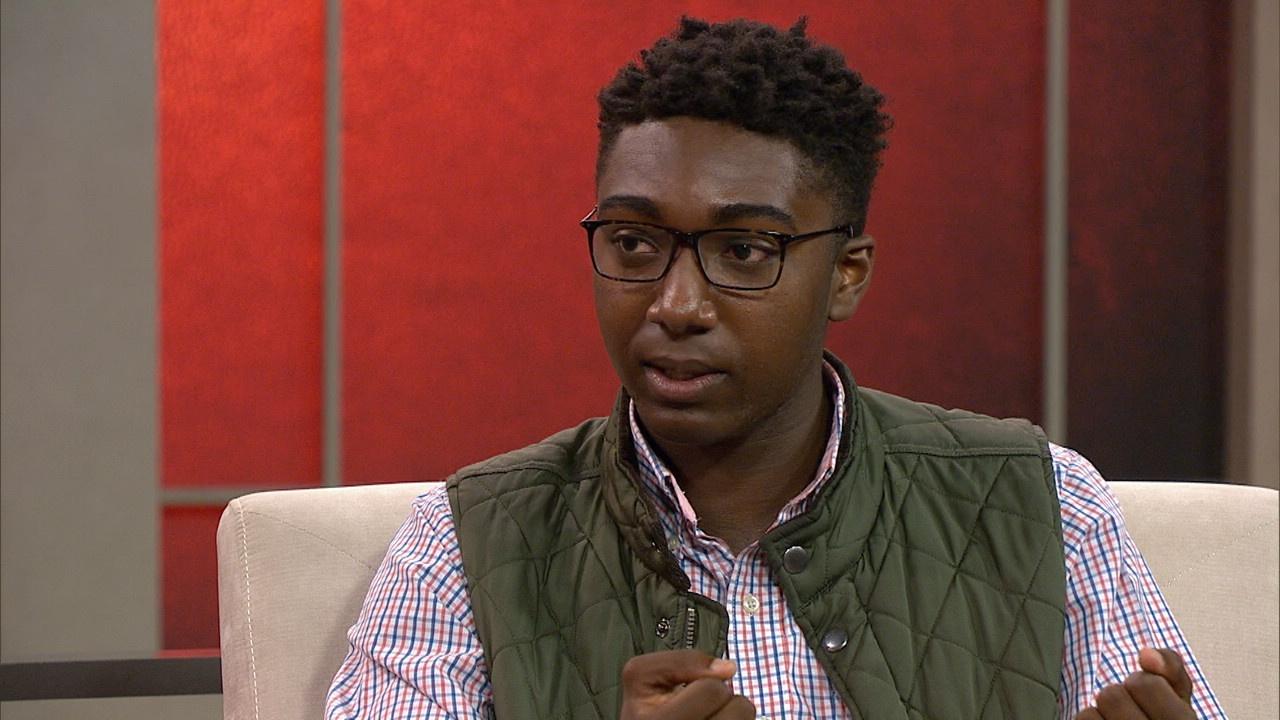


What’s one thing that Andrew Brennen can’t stand about education policy in Kentucky and across America?
“Schools teach students to think critically about everything except school itself, “Brennen says, “and it’s crazy!”
While attending Lexington’s Paul Laurence Dunbar High School, Brennen co-founded the Student Voice Team at the Prichard Committee for Academic Excellence in 2012. His goal was to give students a role in shaping public education policy and a part in school management discussions happening in the commonwealth.
Brennen is now taking a break from his studies at the University of North Carolina to expand his activism to a larger stage as the national field director for Student Voice. The for-students, by-students nonprofit organization is spearheading a social movement to integrate young people into the global education conversation. He took a few minutes from his work to appear on KET’s Connections with Renee Shaw.
During his time as the director of the Student Voice initiative in Kentucky, Brennen and his fellow team members conducted surveys and roundtable discussions in schools across the state to collect input from students, teachers, and administrators. He says it took some work to get young people to open up and think critically about their school experiences, but when they did, Brennen says the results were astounding.
“When it comes to education in Kentucky, we’ve made a lot of great strides over the past few years,” Brennen says. “But there still exists a disconnect between the ways students in classroom experience school and the ways teachers and administrators in those same buildings experience school.”
For example, in one small school they surveyed, more than 200 students said bullying was a problem, yet none of the teachers or administrators even mentioned bullying in their responses.
Since they spend 35 hours a week in school, Brennen argues students have valuable perspectives on what works and doesn’t work in public education. And since students are the greatest stakeholders in the successful outcome of education policy, Brennen says they should be more active in helping to shape those decisions.
Challenges for Student Lobbyists
Last year the Student Voice Team promoted a bill in the Kentucky General Assembly to allow school districts to include a student as a non-voting member of a superintendent selection committee. Brennen says it’s ironic that Student Voice members from around the state had to miss school so they could go to Frankfort to lobby for the legislation.
“All these decisions about what school and classrooms are going to be like happen while the people who are most effected are stuck in the classroom,” Brennen says. “It’s almost like there’s an intention behind leaving their voices out.”
To compensate for what they lack in time and access to professional lobbyists, the students employ social media to mobilize each other and make their cases to decision makers. Brennen says politicians shouldn’t underestimate the power of young people with big ideas and small computer screens.
“With the advent of social media, with the flattening of power structures, people are able to engage and question and criticize institutions in ways that were never possible before,” says Brennen.
House Bill 236 about superintendent selection ultimately failed in the 2015 session. Brennen says the team may try to revive the legislation this year, but the group has another key issue they want to advance.
“This is the year for leaders in Frankfort to keep the Powerball promise,” Brennen says.
Restoring Funds for Need-Based Scholarships
When the Kentucky Lottery was approved in 1988, the revenues were targeted to support scholarships for students in the commonwealth. But when economic times grew tough, lawmakers swept some of those revenues into the state’s General Fund. While money for merit-based scholarships have remained intact, Brennen says $30 million a year has been diverted from need-based scholarships.
“I think it might be because the students who are receiving need-based scholarships are not the students who are going to show up in Frankfort, are not the students whose parents are going to show up in Frankfort and call legislators and make a fuss about it,” Brennen says.
If the state can raise the educational attainment levels of low-income students, Brennen says the commonwealth can realize hundreds of millions in economic gains. He says that’s because young people with more schooling tend to earn higher incomes, so they need less public assistance and can generate more tax revenues. Better-educated individuals also tend to be healthier, so they have lower medical costs, according to Brennen.
He also points out that students from wealthier families are often better prepared for their higher education experiences. That’s why Brennen advocates for more access to counseling and other resources to help lower-income students make better choices about which classes to take in middle and high school, on financial aid and tuition assistance, and how to navigate college life.
Despite the public pension debts facing the commonwealth, Brennen hopes Gov. Matt Bevin and legislators will commit to maintaining the lottery funding for need-based scholarships.
“We’re talking about supporting Kentucky citizens to be successful in the 21st century economy,” Brennen says. “So lets put the money where our mouth is.”
KET’s education coverage is part of American Graduate: Let’s Make it Happen, a public media initiative made possible by the Corporation for Public Broadcasting.