Skip to Main Content

WKU President Timothy Caboni

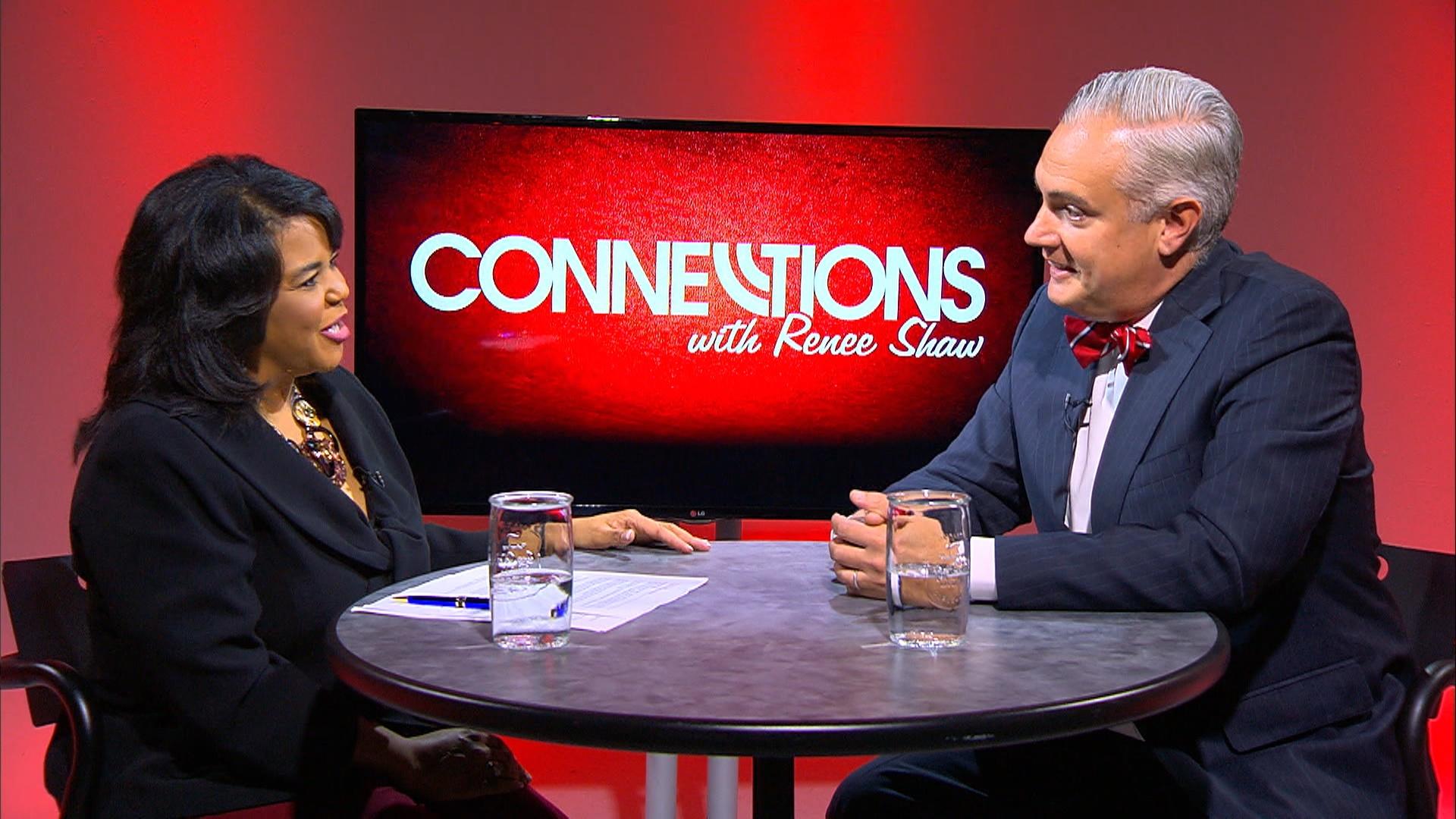
Dr. Timothy Caboni, president of Western Kentucky University, talks about his freshman year as the 10th president of WKU, as well as goals and challenges for the institution.
Season 14 Episode 3 Length 28:40 Premiere: 09/21/18

About

Connections

KET’s Connections features in-depth interviews with the influential, innovative and inspirational individuals who are shaping the path for Kentucky’s future.

From business leaders to entertainers to authors to celebrities, each week features an interesting and engaging guest covering a broad array of topics. Host Renee Shaw uses her extensive reporting experience to naturally blend casual conversation and hard-hitting questions to generate rich and full conversations about the issues impacting Kentucky and the world.


Tune-In

KET Sundays • 11:30 am/10:30 am
KET2 Sundays • 6/5 pm

Stream

Watch on KET’s website anytime or through the PBS Video App.

Podcast

The Connections podcast features each episode’s audio for listening.


Renee Shaw is the Director of Public Affairs and Moderator at KET, currently serving as host of KET’s weeknight public affairs program Kentucky Edition, the signature public policy discussion series Kentucky Tonight, the weekly interview series Connections, Election coverage and KET Forums.

Since 2001, Renee has been the producing force behind KET’s legislative coverage that has been recognized by the Kentucky Associated Press and the National Educational Telecommunications Association. Under her leadership, KET has expanded its portfolio of public affairs content to include a daily news and information program, Kentucky Supreme Court coverage, townhall-style forums, and multi-platform program initiatives around issues such as opioid addiction and youth mental health.  

Renee has also earned top awards from the Ohio Valley Chapter of the National Academy of Television Arts and Sciences (NATAS), with three regional Emmy awards. In 2023, she was inducted into the Silver Circle of the NATAS, one of the industry’s highest honors recognizing television professionals with distinguished service in broadcast journalism for 25 years or more.  

Already an inductee into the Kentucky Civil Rights Hall of Fame (2017), Renee expands her hall of fame status with induction into Western Kentucky University’s Hall of Distinguished Alumni in November of 2023.  

In February of 2023, Renee graced the front cover of Kentucky Living magazine with a centerfold story on her 25 years of service at KET and even longer commitment to public media journalism. 

In addition to honors from various educational, civic, and community organizations, Renee has earned top honors from the Associated Press and has twice been recognized by Mental Health America for her years-long dedication to examining issues of mental health and opioid addiction.  

In 2022, she was honored with Women Leading Kentucky’s Governor Martha Layne Collins Leadership Award recognizing her trailblazing path and inspiring dedication to elevating important issues across Kentucky.   

In 2018, she co-produced and moderated a 6-part series on youth mental health that was awarded first place in educational content by NETA, the National Educational Telecommunications Association. 

She has been honored by the AKA Beta Gamma Omega Chapter with a Coretta Scott King Spirit of Ivy Award; earned the state media award from the Kentucky Society of the Daughters of the American Revolution in 2019; named a Charles W. Anderson Laureate by the Kentucky Personnel Cabinet in 2019 honoring her significant contributions in addressing socio-economic issues; and was recognized as a “Kentucky Trailblazer” by the University of Kentucky Martin School of Public Policy and Administration during the Wendell H. Ford Lecture Series in 2019. That same year, Shaw was named by The Kentucky Gazette’s inaugural recognition of the 50 most notable women in Kentucky politics and government.  

Renee was bestowed the 2021 Berea College Service Award and was named “Unapologetic Woman of the Year” in 2021 by the Community Action Council.   

In 2015, she received the Green Dot Award for her coverage of domestic violence, sexual assault & human trafficking. In 2014, Renee was awarded the Anthony Lewis Media Award from the KY Department of Public Advocacy for her work on criminal justice reform. Two Kentucky governors, Republican Ernie Fletcher and Democrat Andy Beshear, have commissioned Renee as a Kentucky Colonel for noteworthy accomplishments and service to community, state, and nation.  

A former adjunct media writing professor at Georgetown College, Renee traveled to Cambodia in 2003 to help train emerging journalists on reporting on critical health issues as part of an exchange program at Western Kentucky University. And, she has enterprised stories for national media outlets, the PBS NewsHour and Public News Service.  

Shaw is a 2007 graduate of Leadership Kentucky, a board member of CASA of Lexington, and a longtime member of the Frankfort/Lexington Chapter of The Links Incorporated, an international, not-for-profit organization of women of color committed to volunteer service. She has served on the boards of the Kentucky Historical Society, Lexington Minority Business Expo, and the Board of Governors for the Ohio Valley Chapter of the National Academy of Television Arts and Sciences. 

Host Renee Shaw smiling in a green dress with a KET set behind her.

Western Kentucky University President Timothy Caboni

It’s been a tough decade for Kentucky’s public universities, as they’ve had to deal with multiple cuts to state higher education funding, tuition increases, administration shakeups, and staff and faculty downsizings.

Through it all, Western Kentucky University President Timothy Caboni is pleased to report that enrollment at his school in Bowling Green, Ky., has remained steady at around 20,000 students. Caboni attributes that success to being what he calls a “Goldilocks university.”

“We’re not too big, we’re not too small, we’re just right,” he says. “You can find your place, you have faculty that will wrap their arms around you and care deeply about your success, and get you to graduation. At the same time we offer everything you can imagine that a university offers, and if we don’t have it, we’ll create it with you.”

Caboni, who is in his second year as president of WKU, appeared on KET’s Connections to discuss his plans for the school and the challenges facing higher education in the commonwealth.

Caboni is no stranger to Bowling Green. He got his master’s degree in corporate and organizational communications from Western in 1994. After that, he served as an associate dean at Vanderbilt University and a vice chancellor at the University of Kansas before being named WKU’s 10th president in 2017.

During his first year on the job, Caboni led a strategic planning process that involved hundreds of people across the campus.

“It doesn’t matter what my vision is for the campus,” he says. “What matters is what we aspire to together as a community.”

The resulting 10-year plan, called Climbing to Greater Heights, focuses on improving student success. That includes embracing WKU’s role of being an applied research university rather than a so-called “research one” school like the Universities of Kentucky and Louisville.

“Research universities are wonderful things, and we don’t need another one of those in the state of Kentucky,” says Caboni. “We want to be the state’s applied research university… We want every one of our students, as soon as they’re ready in their freshman [or] sophomore years, to work alongside a faculty member on a project that is connected to their career path and also connected to the real world.”

Ensuring Students Are Ready for University Work
But attracting and retaining the best students isn’t easy in an era of tighter budgets and higher tuitions. Caboni says WKU used to receive about half of its funding from the state. Now it’s only 17 percent.

“That means we have to find other ways to help young people and their families afford to have access and to be successful at Western Kentucky University,” he says.

The school will provide more financial aid for students, says Caboni, and it will also retool its admissions policies to focus on those students who have the best chances for success in college.

“There was a cohort of young people that we were admitting that really were not ready to do work at a four-year institution,” he says. “We have to be honest with those students, with their schools, and with their families that they’re not ready to be here.”

For example, out of a group of 100 freshmen that entered WKU in the fall, Caboni says 80 of them had dropped out by the start of the spring semester. And they left school with an average student loan debt of $4,000.

“That’s wrong,” he says.

Instead, Caboni wants to help students like that get into a community college where they stand a greater chance of success. When they complete their education there, they can transfer to WKU for their junior and senior years and pay a tuition that is comparable to what they were paying at the community college.

The university is also launching a comprehensive advising program that not only helps new students navigate their academic activities, but will also help them with financial aid issues, health concerns, and integrating socially into campus life. Next year, WKU will launch a five-week summer academy for incoming freshmen that need extra help acclimating to the college environment. Those students will get to move into their dorm rooms early, work with mentors and faculty navigators, and take two courses, all for a $500 fee.

“This allows us to help them get over those first humps that they face in a very hands-on way with all the support that they need,” Caboni says.

Adjusting to a New State Funding Mechanism
WKU and other state universities not only face lower overall state funding, but a portion of their public support is now being allocated based on how the schools perform on several key metrics. Those factors include the number of degrees awarded, the type of degree produced (such as science and technology versus liberal arts), course credit hours completed by students, and whether the school is closing achievement gaps between various student groups. Caboni says this outcomes-based funding means that the public universities and community colleges in the commonwealth will, in essence, compete against each other for state support.

“It’s reasonable for the taxpayers of Kentucky to expect us to do certain things for the money they invest in our public institutions,” says Caboni.

Presidents at some of the state’s regional universities have argued that outcomes-based funding favors the larger schools in the commonwealth. Caboni says using aggregate numbers for degree attainment and other student measures does favor some institutions. But over time, the metrics will evolve to compare an individual school’s performance against an average for the entire state system.

Caboni says he’s embraces the competitive nature of outcomes-based funding because he believes WKU can win.

“What we have to focus in on is, how do you align internal allocations with those outcome metrics,” he says. “So [we’re] thinking about how we reward not just deans but also department chairs with dollars when you have more students who enroll, more course taking, how students persist and how they graduate. If we are able to align our internal resource allocation with those external metrics, we’re going to be fine.”

Supporting Surrounding Communities
Still, a budget shortfall forced WKU to cut some 150 faculty and staff positions earlier this year. Caboni says university officials simply have to do more with less and be creative in fostering new partnerships. One example is a new medical school campus that WKU is hosting in collaboration with the University of Kentucky College of Medicine.

“That’s a great win, not for UK or for WKU,” Caboni says. “That’s a great win for Bowling Green and south central Kentucky to produce new primary care physicians.”

Caboni is keenly aware of WKU’s role in supporting surrounding communities. The school’s new strategic plan includes a section devoted to nurturing the quality of life in the region.

“We know we are linked to the success of the economy of south central Kentucky,” he says. “We can’t only focus on Warren County. We have to elevate all 27 counties in our service region.

“Without us, the future is tough for those places,” Caboni adds.

Caboni says WKU can cooperate and collaborate on attracting new businesses and investments to the region. And it can prepare students to fill some of the thousands of jobs that are currently open those communities.

“With the desperate workforce needs that we have as a state, we have an obligation as a public institution to provide that educated workforce,” says Caboni.

The school has launched a pilot program that will enable individuals who have an associate’s degree in health care, information technology, business, or manufacturing fields to earn a bachelor’s degree through online study. The total price for students is $7,500.

“That is the cheapest per-credit tuition of any public four-year institution in the state,” says Caboni. “So we’re really working hard to help those folks who are in the workplace and who need a bachelor’s degree to move ahead in their career get that.”

Sponsored by:

Season 14 Episodes

The 'I Was Here' Project

S14 E36 Length 27:42 Premiere Date 08/04/19

Mike Runyon and Sherita Miller; Wendy Kobler

S14 E35 Length 26:57 Premiere Date 07/28/19

Filmmaker Lynn Novick

S14 E33 Length 28:27 Premiere Date 07/14/19

Brent Hutchinson; Christine Thompson - Education

S14 E32 Length 27:37 Premiere Date 07/07/19

Lieutenant Governor Jenean Hampton - Youth Mental Health

S14 E31 Length 26:32 Premiere Date 06/02/19

Julie Cerel - Youth Suicide Prevention

S14 E29 Length 26:32 Premiere Date 05/19/19

Dale Suttles - Sunrise Children's Services

S14 E28 Length 27:33 Premiere Date 05/12/19

Education in Rural Eastern Kentucky

S14 E27 Length 28:13 Premiere Date 05/05/19

Joshua A. Douglas - Voting Rights Reform

S14 E25 Length 26:32 Premiere Date 04/21/19

Jay Box - Ky. Community & Technical College System

S14 E24 Length 26:32 Premiere Date 04/14/19

Author and Life Coach Colene Elridge

S14 E23 Length 26:19 Premiere Date 04/07/19

FIRST STEP Act - Criminal Justice Reform

S14 E22 Length 27:44 Premiere Date 03/31/19

Cheryl A. Oldham

S14 E21 Length 26:38 Premiere Date 02/22/19

Linda Hampton - Early Childhood

S14 E20 Length 29:47 Premiere Date 02/15/19

Donald Mason

S14 E19 Length 26:34 Premiere Date 02/08/19

Community Action Council; First 5 Lex

S14 E18 Length 28:53 Premiere Date 02/01/19

Seamus Carey

S14 E17 Length 26:57 Premiere Date 01/25/19

Michael Benson

S14 E16 Length 27:32 Premiere Date 01/18/19

Dr. Aaron Thompson

S14 E14 Length 28:13 Premiere Date 01/11/19

Mary Todd Lincoln and Lincoln Lexington Walking Tour

S14 E13 Length 28:55 Premiere Date 12/14/18

Youth Suicide

S14 E12 Length 29:22 Premiere Date 12/07/18

Jean Schumm and Amanda Gale

S14 E11 Length 28:22 Premiere Date 11/16/18

M. Christopher Brown II

S14 E10 Length 28:02 Premiere Date 11/09/18

Frank Harris

S14 E9 Length 25:17 Premiere Date 11/02/18

U.S. Rep. Andy Barr

S14 E8 Length 29:16 Premiere Date 10/26/18

Amy McGrath

S14 E7 Length 29:02 Premiere Date 10/19/18

Kevin Chapman - Youth Mental Health

S14 E6 Length 28:47 Premiere Date 10/12/18

Carol Cecil; Resa Gonzalez - Youth Mental Health

S14 E5 Length 26:03 Premiere Date 10/05/18

Joe Bargione - Youth Mental Health

S14 E4 Length 28:57 Premiere Date 09/28/18

WKU President Timothy Caboni

S14 E3 Length 28:40 Premiere Date 09/21/18

Dr. Neeli Bendapudi

S14 E1 Length 28:47 Premiere Date 09/14/18

See All Episodes

caret down

TV Schedules

Upcoming

No upcoming airdates

Recent

No recent airdates

Explore KET