Skip to Main Content
Watch 2026 Impeachment Committee

Joshua A. Douglas - Voting Rights Reform

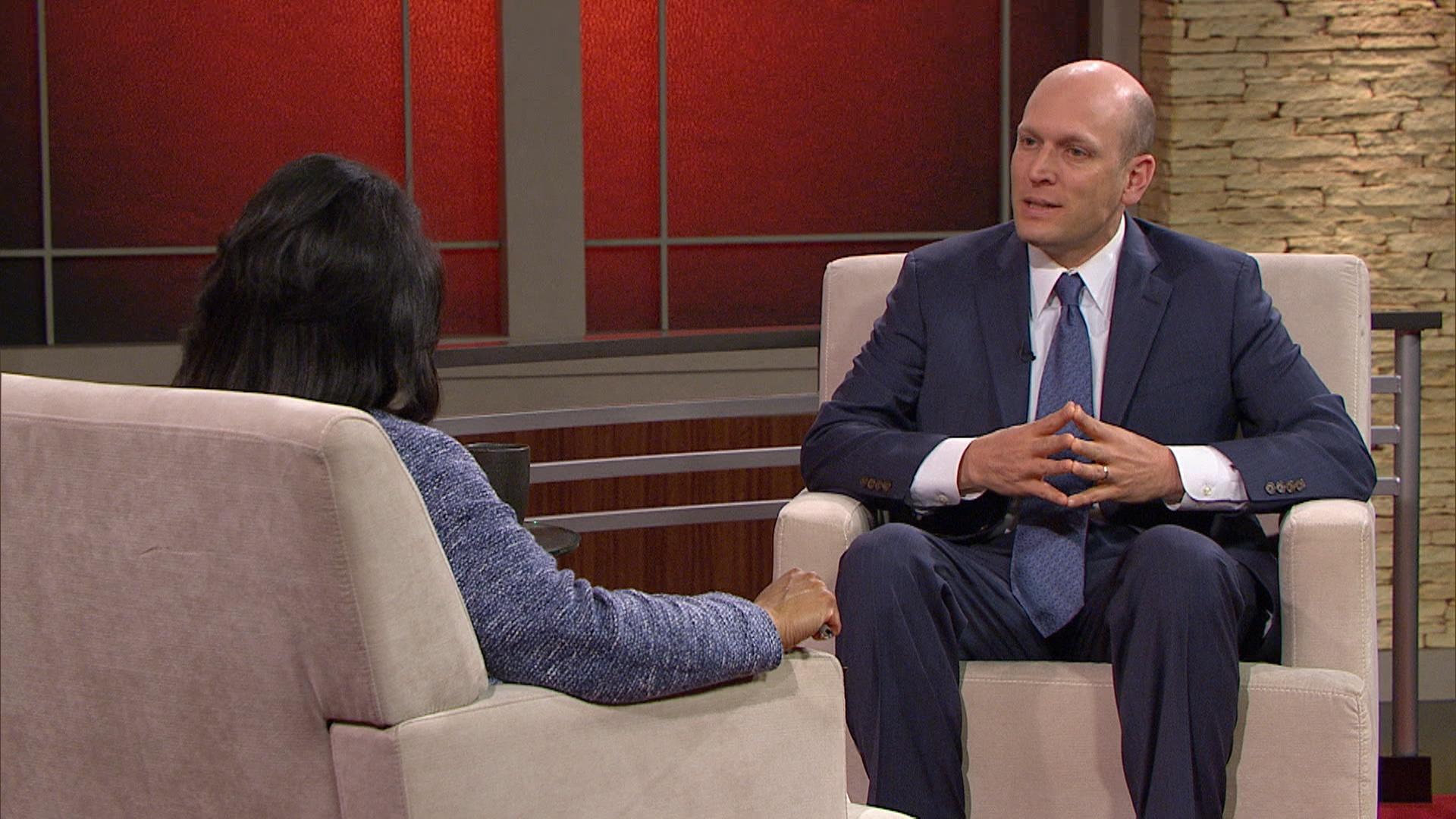
Renee discusses voting rights reform initiatives with Joshua A. Douglas, University of Kentucky College of Law Professor and author of Vote for US: How to Take Back Our Elections and Change the Future of Voting.
Season 14 Episode 25 Length 26:32 Premiere: 04/21/19

About

Connections

KET’s Connections features in-depth interviews with the influential, innovative and inspirational individuals who are shaping the path for Kentucky’s future.

From business leaders to entertainers to authors to celebrities, each week features an interesting and engaging guest covering a broad array of topics. Host Renee Shaw uses her extensive reporting experience to naturally blend casual conversation and hard-hitting questions to generate rich and full conversations about the issues impacting Kentucky and the world.


Tune-In

KET Sundays • 11:30 am/10:30 am
KET2 Sundays • 6/5 pm

Stream

Watch on KET’s website anytime or through the PBS Video App.

Podcast

The Connections podcast features each episode’s audio for listening.


Renee Shaw is the Director of Public Affairs and Moderator at KET, currently serving as host of KET’s weeknight public affairs program Kentucky Edition, the signature public policy discussion series Kentucky Tonight, the weekly interview series Connections, Election coverage and KET Forums.

Since 2001, Renee has been the producing force behind KET’s legislative coverage that has been recognized by the Kentucky Associated Press and the National Educational Telecommunications Association. Under her leadership, KET has expanded its portfolio of public affairs content to include a daily news and information program, Kentucky Supreme Court coverage, townhall-style forums, and multi-platform program initiatives around issues such as opioid addiction and youth mental health.  

Renee has also earned top awards from the Ohio Valley Chapter of the National Academy of Television Arts and Sciences (NATAS), with three regional Emmy awards. In 2023, she was inducted into the Silver Circle of the NATAS, one of the industry’s highest honors recognizing television professionals with distinguished service in broadcast journalism for 25 years or more.  

Already an inductee into the Kentucky Civil Rights Hall of Fame (2017), Renee expands her hall of fame status with induction into Western Kentucky University’s Hall of Distinguished Alumni in November of 2023.  

In February of 2023, Renee graced the front cover of Kentucky Living magazine with a centerfold story on her 25 years of service at KET and even longer commitment to public media journalism. 

In addition to honors from various educational, civic, and community organizations, Renee has earned top honors from the Associated Press and has twice been recognized by Mental Health America for her years-long dedication to examining issues of mental health and opioid addiction.  

In 2022, she was honored with Women Leading Kentucky’s Governor Martha Layne Collins Leadership Award recognizing her trailblazing path and inspiring dedication to elevating important issues across Kentucky.   

In 2018, she co-produced and moderated a 6-part series on youth mental health that was awarded first place in educational content by NETA, the National Educational Telecommunications Association. 

She has been honored by the AKA Beta Gamma Omega Chapter with a Coretta Scott King Spirit of Ivy Award; earned the state media award from the Kentucky Society of the Daughters of the American Revolution in 2019; named a Charles W. Anderson Laureate by the Kentucky Personnel Cabinet in 2019 honoring her significant contributions in addressing socio-economic issues; and was recognized as a “Kentucky Trailblazer” by the University of Kentucky Martin School of Public Policy and Administration during the Wendell H. Ford Lecture Series in 2019. That same year, Shaw was named by The Kentucky Gazette’s inaugural recognition of the 50 most notable women in Kentucky politics and government.  

Renee was bestowed the 2021 Berea College Service Award and was named “Unapologetic Woman of the Year” in 2021 by the Community Action Council.   

In 2015, she received the Green Dot Award for her coverage of domestic violence, sexual assault & human trafficking. In 2014, Renee was awarded the Anthony Lewis Media Award from the KY Department of Public Advocacy for her work on criminal justice reform. Two Kentucky governors, Republican Ernie Fletcher and Democrat Andy Beshear, have commissioned Renee as a Kentucky Colonel for noteworthy accomplishments and service to community, state, and nation.  

A former adjunct media writing professor at Georgetown College, Renee traveled to Cambodia in 2003 to help train emerging journalists on reporting on critical health issues as part of an exchange program at Western Kentucky University. And, she has enterprised stories for national media outlets, the PBS NewsHour and Public News Service.  

Shaw is a 2007 graduate of Leadership Kentucky, a board member of CASA of Lexington, and a longtime member of the Frankfort/Lexington Chapter of The Links Incorporated, an international, not-for-profit organization of women of color committed to volunteer service. She has served on the boards of the Kentucky Historical Society, Lexington Minority Business Expo, and the Board of Governors for the Ohio Valley Chapter of the National Academy of Television Arts and Sciences. 

Host Renee Shaw smiling in a green dress with a KET set behind her.

Encouraging Trends in Voting Rights Reform

A thriving democracy depends on having engaged citizens.

But what if many of them don’t even bother to vote? About 61 percent of eligible Americans voted in the 2016 presidential election; only about 50 percent voted in the 2018 midterms.

And in the 2015 governor’s race in the commonwealth, about 31 percent of registered voters cast a ballot. That means even fewer people picked the actual winners.

“About 16 percent of eligible Kentuckians chose our elected officials statewide,” says voting rights expert Joshua Douglas. “That’s just not good enough.”

Douglas is a professor at the University of Kentucky College of Law and author of the new book “Vote for US: How to Take Back Our Elections and Change the Future of Voting.” He appeared on KET’s Connections to share ways to increase voter participation in America.

When people talk about voting issues, the discussion often focuses on concerns about voter suppression or election fraud. But from his research into these issues, Douglas says the news isn’t all doom and gloom.

“There’s a lot of good news on the ground in communities all over the country, where people are working to promote positive reforms,” he says, “ways to make it easier to participate and more inclusive and bring more people into the political process.”

In his book, Douglas highlights a range of efforts to expand voting rights and voter participation.

“Change is possible and it’s not from entrenched politicians or the elite, it’s from everyday Americans,” says the professor. “All of us can do it in our communities, it’s already happening, and so I hope people are inspired by those stories.”

Second Chances for Felons
Kentucky and Iowa are the worst states in the nation for felon disenfranchisement, according to Douglas. But the testimony of a Covington man helped start to turn that tide in the commonwealth.

West Powell was 18 years old when he received a felony conviction for stealing a car radio from a salvage yard. Douglas says after Powell served his time, he got his life back on track, starting a business and a family.

In many states, Powell’s voting rights would have been restored after he completed his sentence for such a crime. But not in Kentucky.

Nearly 30 years later, Powell got to tell the story of his conviction and his successful reentry into society to state lawmakers who were debating a felony expungement measure. His testimony helped inspire legislators to pass a bipartisan bill in 2016 that gives certain low-level, non-violent felony offenders a process to have their criminal records expunged and their voting rights restored.

“Kentucky’s worst-in-the-country felony disenfranchisement law got a little bit better because someone like West Powell was willing to speak up,” he says.

Building the Youth Vote
Douglas says one of the best ways to foster politically active adults is to get them engaged when they are young. He says civics education in K-12 schools should be revamped to move beyond the fundamentals of government and passing legislation. He says some social studies classes are now learning something called “action civics,” which encourages students to work on a problem in their communities.

For example, Douglas tells of a class at a Washington, D.C., magnet school that successfully lobbied for free public transportation for students as a way to reduce tardiness.

“Those kids are never going to forget the importance of engaging in one’s democracy,” he says.

Other municipalities have coupled an emphasis on civics with a lower voting age. Douglas says several Maryland communities as well as Berkeley, Calif., have lowed the voting age to 16 for some local elections. Early results show that those younger teens turn out at twice the rate of 18- to 24-year olds.

“So if we can get 16- and 17-year olds to vote in the local elections on issues that really matter to them,” says Douglas, “[like] school board or local policies regarding climate change, then they have a much greater likelihood of becoming habitual voters.”

But Douglas says Kentucky statutes prevent cities and counties from adopting their own election laws, so local teen voting experiments like the ones in Maryland and California couldn’t happen here.

Other Voting Reforms
The ability to register to vote when you get a driver’s license has been available in most states for years. Now 17 states will automatically register you to vote when you apply for a new license or renew an existing one. Douglas contends that makes it easier for states to maintain accurate voter rolls by eliminating people who have moved to another jurisdiction or have died.

Other states are exploring ways to make the voting process more convenient. Some offer longer voting hours, or the opportunity to vote on the Saturday before Election Day. Other places allow early voting in person or by mail before Election Day without an excuse. Douglas says that doesn’t result in dramatically higher turnout, but it does make easier for those already inclined to vote.

Turnout is higher, through, among locales using voting centers and allowing vote by mail, according to the professor. Colorado pioneered the idea of voting centers, whereby a person can vote at any specially designated location in their county, whether it’s in their home precinct or not. Once the voter checks in, they receive a ballot that contains the contests for their home address. Douglas says all the voting centers are electronically connected so a person can only vote once. He says this gives working people more flexibility where they cast their ballots. Despite the upfront costs, Douglas says voting centers would ultimately save taxpayer dollars.

“You no longer have to have multiple precincts, you no longer have to pay as many poll workers, so actually it leads to reduced costs in the long term and higher turnout as people understand the convenience of the vote-center model,” he says.

Four states now offer a vote-by-mail option (also called vote at home) in which every voter automatically receives a ballot in the mail, whether they request it or not.

“So they have the time to research issues,” Douglas says, “and then either mail the ballot in or drop it off at a secure drop box. That’s a form of early voting that actually costs less and the voters love it.”

Reforms Seen by Some as a ‘Power Grab’
Opponents of such voting reforms fear they could benefit one party over another or lead to greater voter fraud.  In January, Congressional Democrats proposed legislation to regulate campaign finance, end partisan gerrymandering, mandate national automatic voter registration, make Election Day a holiday for federal employees, and other reforms.

Senate Majority Leader Mitch McConnell (R-Kentucky) responded by calling the legislation a “power grab” that should be titled the “Democrat Politician Protection Act.”

Douglas contends voter fraud is vastly overstated, and usually only occurs in local elections on the rare occasions that it does happen. As for politicians who fear voting reforms might advantage their opponents, Douglas says those candidates should focus on earning the votes of people who are new to the process.

“I don’t think we should think about these types of reforms with respect to the political implications,” he says. “Let the best ideas and the best candidates win.”

Douglas concedes not all reforms will be implemented, especially something as dramatic as the mandatory voting law that Australia has. (Failure to cast a ballot there results in a $20 fine.)

“I don’t think we need to implement something like that,” he says, “but if we adopt many or all of the reforms that are already working in places around the country, I think we can get to much higher voter participation and a democracy that we’ll really be proud of.”

If Kentucky can implement even a few of these reforms, Douglas says the commonwealth will foster a larger, more engaged electorate in the years ahead.

Related Content:

Election Laws and Protecting Voting Rights

The Electoral College’s Impact on U.S. Politics

Sponsored by:

Season 14 Episodes

The 'I Was Here' Project

S14 E36 Length 27:42 Premiere Date 08/04/19

Mike Runyon and Sherita Miller; Wendy Kobler

S14 E35 Length 26:57 Premiere Date 07/28/19

Filmmaker Lynn Novick

S14 E33 Length 28:27 Premiere Date 07/14/19

Brent Hutchinson; Christine Thompson - Education

S14 E32 Length 27:37 Premiere Date 07/07/19

Lieutenant Governor Jenean Hampton - Youth Mental Health

S14 E31 Length 26:32 Premiere Date 06/02/19

Julie Cerel - Youth Suicide Prevention

S14 E29 Length 26:32 Premiere Date 05/19/19

Dale Suttles - Sunrise Children's Services

S14 E28 Length 27:33 Premiere Date 05/12/19

Education in Rural Eastern Kentucky

S14 E27 Length 28:13 Premiere Date 05/05/19

Joshua A. Douglas - Voting Rights Reform

S14 E25 Length 26:32 Premiere Date 04/21/19

Jay Box - Ky. Community & Technical College System

S14 E24 Length 26:32 Premiere Date 04/14/19

Author and Life Coach Colene Elridge

S14 E23 Length 26:19 Premiere Date 04/07/19

FIRST STEP Act - Criminal Justice Reform

S14 E22 Length 27:44 Premiere Date 03/31/19

Cheryl A. Oldham

S14 E21 Length 26:38 Premiere Date 02/22/19

Linda Hampton - Early Childhood

S14 E20 Length 29:47 Premiere Date 02/15/19

Donald Mason

S14 E19 Length 26:34 Premiere Date 02/08/19

Community Action Council; First 5 Lex

S14 E18 Length 28:53 Premiere Date 02/01/19

Seamus Carey

S14 E17 Length 26:57 Premiere Date 01/25/19

Michael Benson

S14 E16 Length 27:32 Premiere Date 01/18/19

Dr. Aaron Thompson

S14 E14 Length 28:13 Premiere Date 01/11/19

Mary Todd Lincoln and Lincoln Lexington Walking Tour

S14 E13 Length 28:55 Premiere Date 12/14/18

Youth Suicide

S14 E12 Length 29:22 Premiere Date 12/07/18

Jean Schumm and Amanda Gale

S14 E11 Length 28:22 Premiere Date 11/16/18

M. Christopher Brown II

S14 E10 Length 28:02 Premiere Date 11/09/18

Frank Harris

S14 E9 Length 25:17 Premiere Date 11/02/18

U.S. Rep. Andy Barr

S14 E8 Length 29:16 Premiere Date 10/26/18

Amy McGrath

S14 E7 Length 29:02 Premiere Date 10/19/18

Kevin Chapman - Youth Mental Health

S14 E6 Length 28:47 Premiere Date 10/12/18

Carol Cecil; Resa Gonzalez - Youth Mental Health

S14 E5 Length 26:03 Premiere Date 10/05/18

Joe Bargione - Youth Mental Health

S14 E4 Length 28:57 Premiere Date 09/28/18

WKU President Timothy Caboni

S14 E3 Length 28:40 Premiere Date 09/21/18

Dr. Neeli Bendapudi

S14 E1 Length 28:47 Premiere Date 09/14/18

See All Episodes

caret down

TV Schedules

Upcoming

No upcoming airdates

Recent

No recent airdates

Explore KET