Skip to Main Content
Watch 2026 Impeachment Committee

Filmmaker Lynn Novick

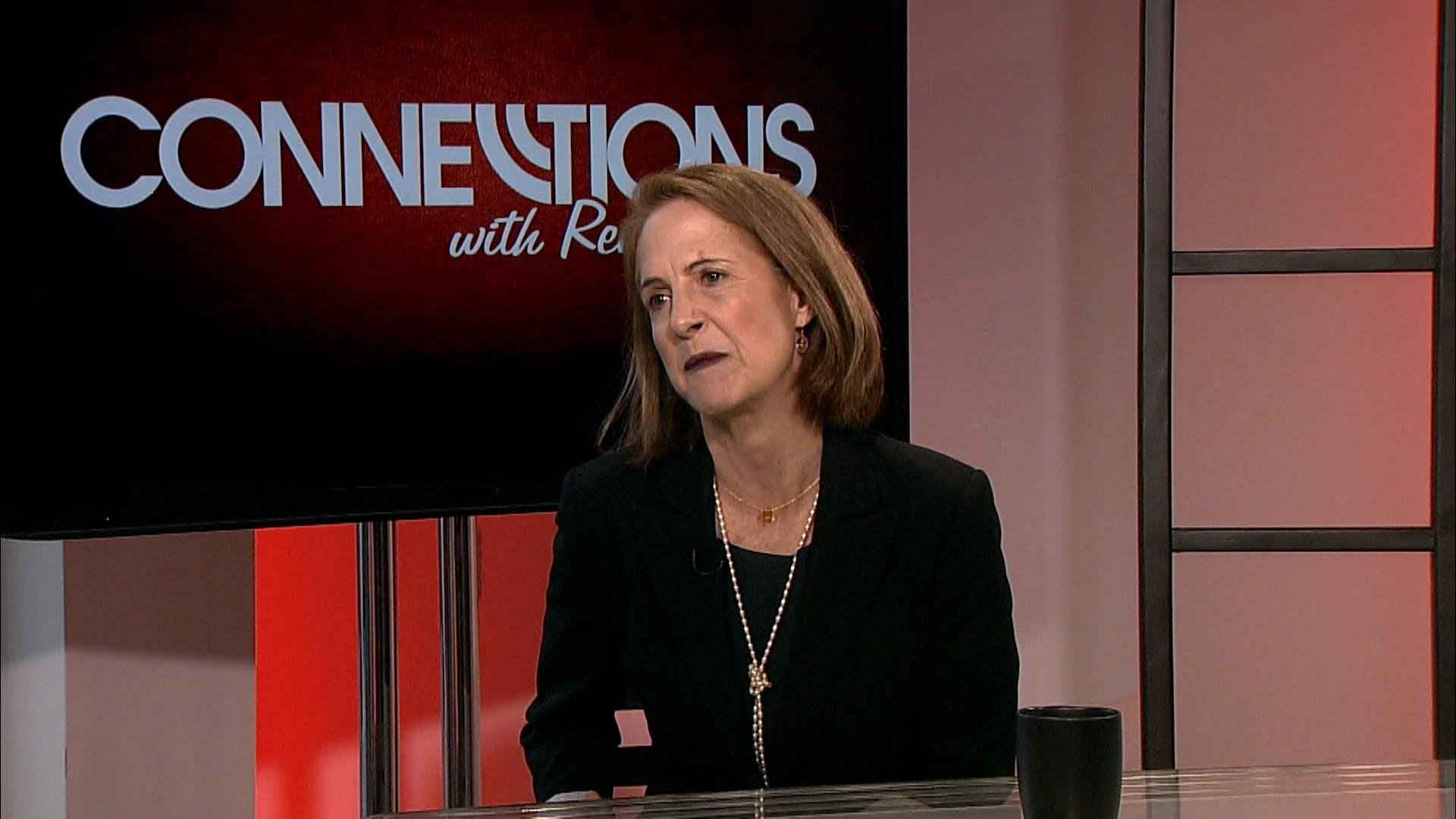
Renee speaks with Peabody Award-winning filmmaker Lynn Novick about the PBS documentary series College Behind Bars that explores the transformative power of higher education for the incarcerated.
Season 14 Episode 33 Length 28:27 Premiere: 07/14/19

About

Connections

KET’s Connections features in-depth interviews with the influential, innovative and inspirational individuals who are shaping the path for Kentucky’s future.

From business leaders to entertainers to authors to celebrities, each week features an interesting and engaging guest covering a broad array of topics. Host Renee Shaw uses her extensive reporting experience to naturally blend casual conversation and hard-hitting questions to generate rich and full conversations about the issues impacting Kentucky and the world.


Tune-In

KET Sundays • 11:30 am/10:30 am
KET2 Sundays • 6/5 pm

Stream

Watch on KET’s website anytime or through the PBS Video App.

Podcast

The Connections podcast features each episode’s audio for listening.


Renee Shaw is the Director of Public Affairs and Moderator at KET, currently serving as host of KET’s weeknight public affairs program Kentucky Edition, the signature public policy discussion series Kentucky Tonight, the weekly interview series Connections, Election coverage and KET Forums.

Since 2001, Renee has been the producing force behind KET’s legislative coverage that has been recognized by the Kentucky Associated Press and the National Educational Telecommunications Association. Under her leadership, KET has expanded its portfolio of public affairs content to include a daily news and information program, Kentucky Supreme Court coverage, townhall-style forums, and multi-platform program initiatives around issues such as opioid addiction and youth mental health.  

Renee has also earned top awards from the Ohio Valley Chapter of the National Academy of Television Arts and Sciences (NATAS), with three regional Emmy awards. In 2023, she was inducted into the Silver Circle of the NATAS, one of the industry’s highest honors recognizing television professionals with distinguished service in broadcast journalism for 25 years or more.  

Already an inductee into the Kentucky Civil Rights Hall of Fame (2017), Renee expands her hall of fame status with induction into Western Kentucky University’s Hall of Distinguished Alumni in November of 2023.  

In February of 2023, Renee graced the front cover of Kentucky Living magazine with a centerfold story on her 25 years of service at KET and even longer commitment to public media journalism. 

In addition to honors from various educational, civic, and community organizations, Renee has earned top honors from the Associated Press and has twice been recognized by Mental Health America for her years-long dedication to examining issues of mental health and opioid addiction.  

In 2022, she was honored with Women Leading Kentucky’s Governor Martha Layne Collins Leadership Award recognizing her trailblazing path and inspiring dedication to elevating important issues across Kentucky.   

In 2018, she co-produced and moderated a 6-part series on youth mental health that was awarded first place in educational content by NETA, the National Educational Telecommunications Association. 

She has been honored by the AKA Beta Gamma Omega Chapter with a Coretta Scott King Spirit of Ivy Award; earned the state media award from the Kentucky Society of the Daughters of the American Revolution in 2019; named a Charles W. Anderson Laureate by the Kentucky Personnel Cabinet in 2019 honoring her significant contributions in addressing socio-economic issues; and was recognized as a “Kentucky Trailblazer” by the University of Kentucky Martin School of Public Policy and Administration during the Wendell H. Ford Lecture Series in 2019. That same year, Shaw was named by The Kentucky Gazette’s inaugural recognition of the 50 most notable women in Kentucky politics and government.  

Renee was bestowed the 2021 Berea College Service Award and was named “Unapologetic Woman of the Year” in 2021 by the Community Action Council.   

In 2015, she received the Green Dot Award for her coverage of domestic violence, sexual assault & human trafficking. In 2014, Renee was awarded the Anthony Lewis Media Award from the KY Department of Public Advocacy for her work on criminal justice reform. Two Kentucky governors, Republican Ernie Fletcher and Democrat Andy Beshear, have commissioned Renee as a Kentucky Colonel for noteworthy accomplishments and service to community, state, and nation.  

A former adjunct media writing professor at Georgetown College, Renee traveled to Cambodia in 2003 to help train emerging journalists on reporting on critical health issues as part of an exchange program at Western Kentucky University. And, she has enterprised stories for national media outlets, the PBS NewsHour and Public News Service.  

Shaw is a 2007 graduate of Leadership Kentucky, a board member of CASA of Lexington, and a longtime member of the Frankfort/Lexington Chapter of The Links Incorporated, an international, not-for-profit organization of women of color committed to volunteer service. She has served on the boards of the Kentucky Historical Society, Lexington Minority Business Expo, and the Board of Governors for the Ohio Valley Chapter of the National Academy of Television Arts and Sciences. 

Host Renee Shaw smiling in a green dress with a KET set behind her.

Filmmaker Lynn Novick on How Education in Prison Transforms Lives

As state and federal lawmakers debate how to address jail overcrowding, spiraling incarceration costs, and other criminal justice reforms, a forthcoming PBS documentary considers a more fundamental question: What is prison for? Is it simply a place to warehouse those who have broken the law, or is it a place to rehabilitate offenders and enable them to reenter society as productive citizens.

College Behind Bars explores that issue through the lens of the Bard Prison Initiative (BPI), a program that offers free college classes in six New York state prisons for men and women. The documentary, which premieres this fall on KET, is produced and directed by Lynn Novick and executive produced by Ken Burns, the team that has created many acclaimed historical documentaries for PBS.

Novick appeared on KET’s Connections with Renee Shaw to preview her documentary. The program also included two BPI graduates featured in the film.

Novick’s production credits include sweeping documentaries about the Civil War, World War II, and the Vietnam War, as well as histories of baseball and jazz, But with College Behind Bars, she tackles a contemporary political and social issue: the nature of incarceration.

“If we do have prisons,” Novick says, “we should be using that opportunity to get the people that are there a chance to transform themselves and to leave prison in a better position to become members of society.”

These issues began to occupy Novick in 2012 after she and long-time colleague Sarah Botstein visited a BPI class in a maximum-security prison to discuss their documentary about prohibition. They found a group of students hungry for a thoughtful discussion about that period American history.

That’s when she and Botstein decided to make College Behind Bars. With their production team, they spent four years filming classes and interviewing students, their family members, teachers, BPI administrators, and prison officials. They whittled down the 400 hours of material they collected into a two-part, four-hour documentary for PBS.

“It’s a very hard process of distilling and focusing over time,” Novick says, “and then wrestling the material to the ground with our editors. That was a several year process.”

Making College Classes in Prison a Reality

Novick hopes her film will foster public dialogue about criminal justice reform and the role education can play in rehabilitating individuals in prison. Up until 1994, college classes were commonly available in many American prisons. But the federal crime bill that passed that year banned inmates from receiving federal Pell Grants to help them pay for those classes. When inmates could no longer afford their tuition, those learning opportunities disappeared.

The Bard Prison Initiative was the brainchild of a Bard College student, who worked with his classmates to convince school administrators, New York correctional officials, and donors to create BPI. The tuition-free program launched in 2001 and now serves about 300 full-time student-inmates each year. They can select from more than 165 academic courses taught by college professors and visiting lecturers.

“I continue to be impressed every day with the level of sophistication and engagement with the material, and the seriousness of purpose that the students have,” says Novick.

Since 2001, BPI has awarded nearly 550 tuition-free degrees. The initiative also provides transitional services for alumni upon their release to help them adjust to life on the outside. The result is that BPI graduates have a 2.5 percent recidivism rate. The average recidivism rate in the United States is almost 68 percent within three years of release.

’Amazing Things Can Happen’

Novick is traveling the nation to preview the film and attend town-hall forums about criminal justice reform. She stopped in Louisville in June for a KET event featuring Kentucky Justice and Public Safety Cabinet Secretary John Tilley and Education and Workforce Development Cabinet Secretary Derrick Ramsey. Two BPI graduates featured in the documentary accompanied her on the Louisville trip: Tamika Graham and Salih Israil.

“I want the outside world to see what takes place behind bars and the struggles that you endure, especially while trying to get an education,” says Graham, who got an associate degree in liberal arts through BPI. She’s now working as a criminal justice reform advocating and taking classes to complete her bachelor’s degree.

Israil got a language and literature degree from BPI and then took additional courses in computer science. Now he operates his own information technology and data solutions business.

“Every chance I get I want to share what [BPI] meant for me, and what it could mean for anyone else who gets the opportunity,” says Israil, “particularly for men and women who are incarcerated who otherwise didn’t have that opportunity.”

In one critical scene in the documentary, Graham’s mother visits her in prison. They end up in a heated exchange with the mother asking why Graham should get a free education in prison while she has to pay to put her other children who aren’t incarcerated through traditional college.

Graham says her mother is actually proud of her for being able to get a degree while incarcerated. She says she was determined to derive some benefit from her prison experience.

“I made a mistake. I’m not going to allow that mistake to dictate the rest of my future,” says Graham. “I’m not going to allow that mistake to dictate who I am, and I’ll be darned if I leave out of here with nothing. There was just no way that I was going to sit behind bars and not gain anything.”

Graham says many people like her mother don’t want tax dollars paying to educate inmates. But she’s quick to point out that BPI receives no government funding, but instead operates largely on donations and foundation grants.

“The tax-paying dollars are going to all the things that’s wrong in a prison… the disrespect, the inhumane treatment, the unhygienic environment, the toxic environment,” Graham says. “It’s not going towards anything that’s going to help someone not return” to prison.

Israil says he grew up thinking that sitting in a classroom was punishment. He says some of that feeling came from living in a neighborhood that had the worst schools. That’s what made having free access to a quality education so transformative, he says.

“What BPI has done,” says Israil, “is when you allow someone to think beyond where they’re at, you give them the opportunity to think beyond where they’re at, amazing things can happen.”

’People Are Capable of Change’

Novick says she’s grateful to Graham, Israil and the other BPI students who allowed the production crew to film them in prison, and in some cases after their release.

“All the students that we engaged with for this project feel it’s very important for the world to understand what this educational opportunity has meant for them,” says Novick. “It would be a way to share their story and their experiences and hopefully that would show the rest of the world why this is important and we should be doing more of it.”

Novick says BPI provides a lesson about the tyranny of low expectations that Americans place on some people in society. She contends we shouldn’t assume that some individuals aren’t capable of academic accomplishment just because of where they come from, how they were raised, or the crime they committed.

“People are capable of change,” she says. “But if we don’t give people the tools and the access to the information and the resources to do that, then we’re not holding true to our ideals as Americans.”

College Behind Bars airs the November on KET and PBS stations nationwide. watch a preview of the documentary below.


Sponsored by:

Season 14 Episodes

The 'I Was Here' Project

S14 E36 Length 27:42 Premiere Date 08/04/19

Mike Runyon and Sherita Miller; Wendy Kobler

S14 E35 Length 26:57 Premiere Date 07/28/19

Filmmaker Lynn Novick

S14 E33 Length 28:27 Premiere Date 07/14/19

Brent Hutchinson; Christine Thompson - Education

S14 E32 Length 27:37 Premiere Date 07/07/19

Lieutenant Governor Jenean Hampton - Youth Mental Health

S14 E31 Length 26:32 Premiere Date 06/02/19

Julie Cerel - Youth Suicide Prevention

S14 E29 Length 26:32 Premiere Date 05/19/19

Dale Suttles - Sunrise Children's Services

S14 E28 Length 27:33 Premiere Date 05/12/19

Education in Rural Eastern Kentucky

S14 E27 Length 28:13 Premiere Date 05/05/19

Joshua A. Douglas - Voting Rights Reform

S14 E25 Length 26:32 Premiere Date 04/21/19

Jay Box - Ky. Community & Technical College System

S14 E24 Length 26:32 Premiere Date 04/14/19

Author and Life Coach Colene Elridge

S14 E23 Length 26:19 Premiere Date 04/07/19

FIRST STEP Act - Criminal Justice Reform

S14 E22 Length 27:44 Premiere Date 03/31/19

Cheryl A. Oldham

S14 E21 Length 26:38 Premiere Date 02/22/19

Linda Hampton - Early Childhood

S14 E20 Length 29:47 Premiere Date 02/15/19

Donald Mason

S14 E19 Length 26:34 Premiere Date 02/08/19

Community Action Council; First 5 Lex

S14 E18 Length 28:53 Premiere Date 02/01/19

Seamus Carey

S14 E17 Length 26:57 Premiere Date 01/25/19

Michael Benson

S14 E16 Length 27:32 Premiere Date 01/18/19

Dr. Aaron Thompson

S14 E14 Length 28:13 Premiere Date 01/11/19

Mary Todd Lincoln and Lincoln Lexington Walking Tour

S14 E13 Length 28:55 Premiere Date 12/14/18

Youth Suicide

S14 E12 Length 29:22 Premiere Date 12/07/18

Jean Schumm and Amanda Gale

S14 E11 Length 28:22 Premiere Date 11/16/18

M. Christopher Brown II

S14 E10 Length 28:02 Premiere Date 11/09/18

Frank Harris

S14 E9 Length 25:17 Premiere Date 11/02/18

U.S. Rep. Andy Barr

S14 E8 Length 29:16 Premiere Date 10/26/18

Amy McGrath

S14 E7 Length 29:02 Premiere Date 10/19/18

Kevin Chapman - Youth Mental Health

S14 E6 Length 28:47 Premiere Date 10/12/18

Carol Cecil; Resa Gonzalez - Youth Mental Health

S14 E5 Length 26:03 Premiere Date 10/05/18

Joe Bargione - Youth Mental Health

S14 E4 Length 28:57 Premiere Date 09/28/18

WKU President Timothy Caboni

S14 E3 Length 28:40 Premiere Date 09/21/18

Dr. Neeli Bendapudi

S14 E1 Length 28:47 Premiere Date 09/14/18

See All Episodes

caret down

TV Schedules

Upcoming

No upcoming airdates

Recent

No recent airdates

Explore KET