

She was the first Black woman elected to Congress and the first African American to seek a major party’s nomination for president. She was a trailblazer who relished disrupting the status quo, and in an age of incredible social and political upheaval, she found ways to bridge divides and build coalitions.
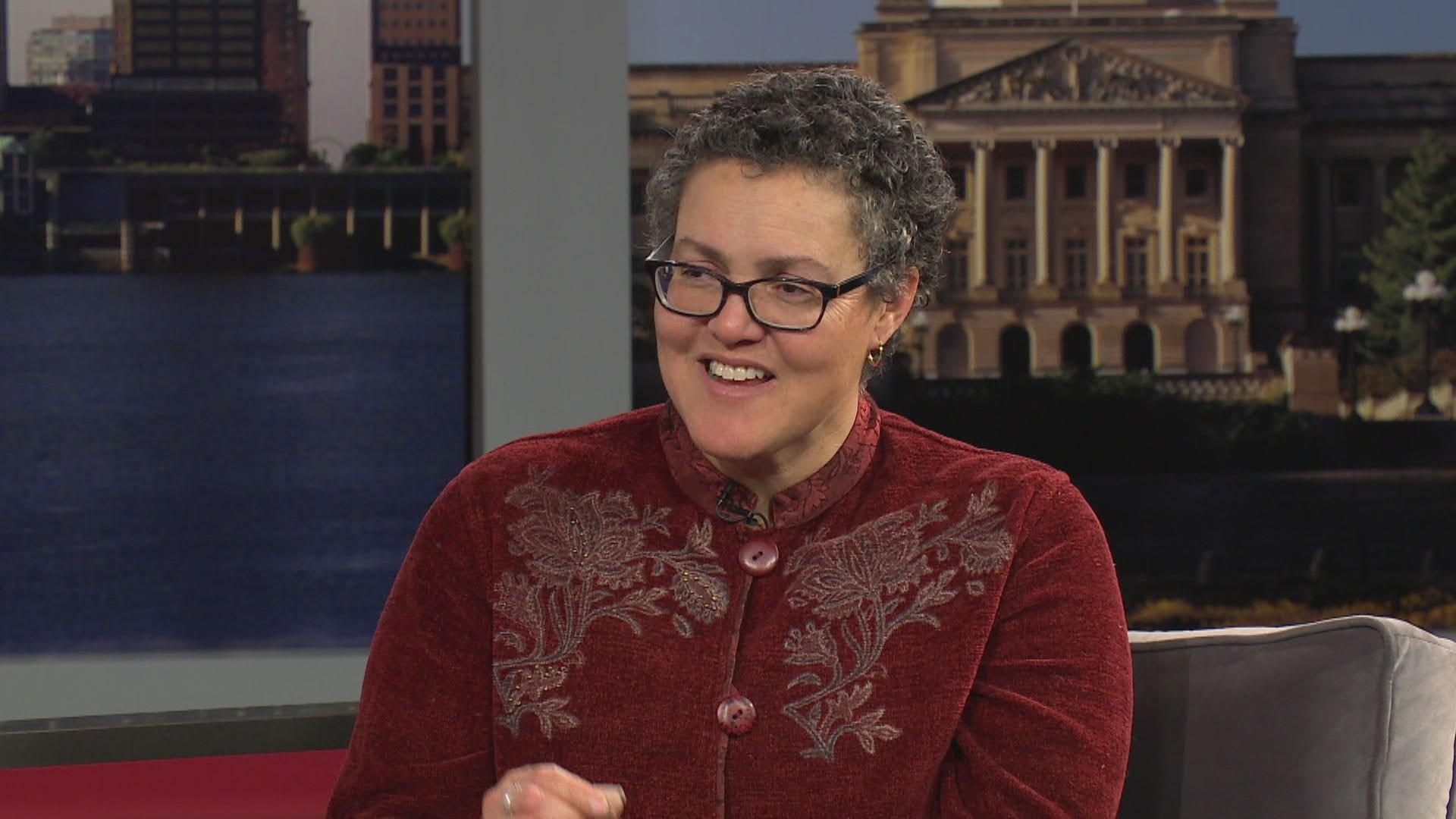
That was the impact and the legacy of Shirley Chisholm, who served in the U.S. House of Representatives from New York from 1969 to 1983. She is also the subject of a new biography written by University of Kentucky Professor of History Anastasia Curwood, who describes Chisholm as a champion of Black feminist power politics.
“This is a term that I made up,” says Curwood. “It’s a combination of Black power, Black feminism, and politics, and she was at the intersection of all of those things.”
For Chisholm, that meant she wanted self-determination and equal power for everybody, especially marginalized Americans living in poverty, people of color, youth, and LGBTQ individuals.
“She really thought that to make democracy work for everybody that the government had responsibility to share power equally,” says Curwood.
Cooperation without Compromise
Chisholm was born in Brooklyn to working-class parents who had immigrated from Barbados. Curwood says as a child, Chisholm was steeped in the politics of her father who revered both President Franklin D. Roosevelt and controversial political activist Marcus Garvey. After college, she worked in child care and child welfare before running for the New York state assembly in 1964.
In Albany, Chisholm proved to be a tireless worker, says Curwood. One issue she championed was to legislation to make abortion more accessible to women. In the process, Curwood says Chisholm honed her talent for bringing lawmakers with disparate points of view together.
“She knew how to get people to cooperate with her, yet she didn’t compromise,” says Curwood.
In 1968, Chisholm made history when she won a seat in Congress to represent the Bedford–Stuyvesant area of Brooklyn. Although she served one the largest Black neighborhoods of New York City, Curwood says Chisholm saw herself as representing African Americans across the nation. But some of them were suspicious of the fast-talking, strong-willed New Yorker.
“Some felt like she hadn’t paid her dues,” says Curwood. “She didn’t come up through some of the big civil rights organizations. She wasn’t southern, she came from the north and she had a supreme self-confidence that sometimes rubbed people the wrong way.”
That brash style undermined Chisholm’s presidential bid in 1972. Curwood says the congresswoman wasn’t seeking the Democratic Party nomination so much as she was working to build a coalition of people to challenge the party’s power structure. If Chisholm could accumulate a critical mass of delegates, Curwood says, then they could force the nominee to pick a female running mate and select a Black man to serve as what was then known as the U.S. Department of Health, Education, and Welfare.
But none of that came to pass.
“The coalition fell apart,” says Curwood. “There was a notable group of Black politicians who were men who actively worked against her in pulling that coalition together.”
Curwood says Chisholm was savvy enough and pragmatic enough to know what would happen at the 1972 Democratic National Convention. But she says the congresswoman was disappointed that more people didn’t understand her motives for the coalition.
“Everybody said she wants to be a power broker, she’s crazy, she’s got an ego,” says Curwood. “She felt that others imputed motives to her that really she didn’t have and that frustrated her.”
Finding Solutions and Possibilities in History
With the rise of the Christian right, the election of Ronald Reagan to the presidency, and what she saw as the failure of liberal politics, Chisholm decided to retire from Congress at the end of her seventh term in Washington. She spent the rest of her life as a college professor, political organizer, and speaker.
Curwood says she hopes her students today will see Chisholm’s life and work in politics as guided by curiosity and a sense of what’s possible. By studying the history of Chisholm’s time, Curwood says students can learn how the congresswoman achieved many of her goals despite the deep racism and sexism she faced.
“You can learn solutions from history,” she says. “I do tell my students, ‘Find out what the history is, where the lay of the land is, and then figure out where it is that you can push.’”
A native of Massachusetts, Curwood studied history at Bryn Mawr College and Princeton University. In addition to her teaching duties at UK, she is also director of the Commonwealth Institute for Black Studies, which Curwood says explores African American and Africana culture from “Appalachia to Zimbabwe.”
“When you put that perspective at the center, you start to see different things and you start to ask different questions,” she says.
Curwood’s first book explored marriages among middle-class African Americans between World War I and World War II. Part of her interest in writing about Chisholm stems from the fact that her mother served as a state treasurer for the congresswoman’s presidential campaign, and her father was a journalist who covered that campaign.
“I did grow up with the idea that Black women could run for president,” says Curwood. “I even considered a run for president myself when I was in about third or fourth grade, but I decided against it... I didn’t really think I’d like the job.”