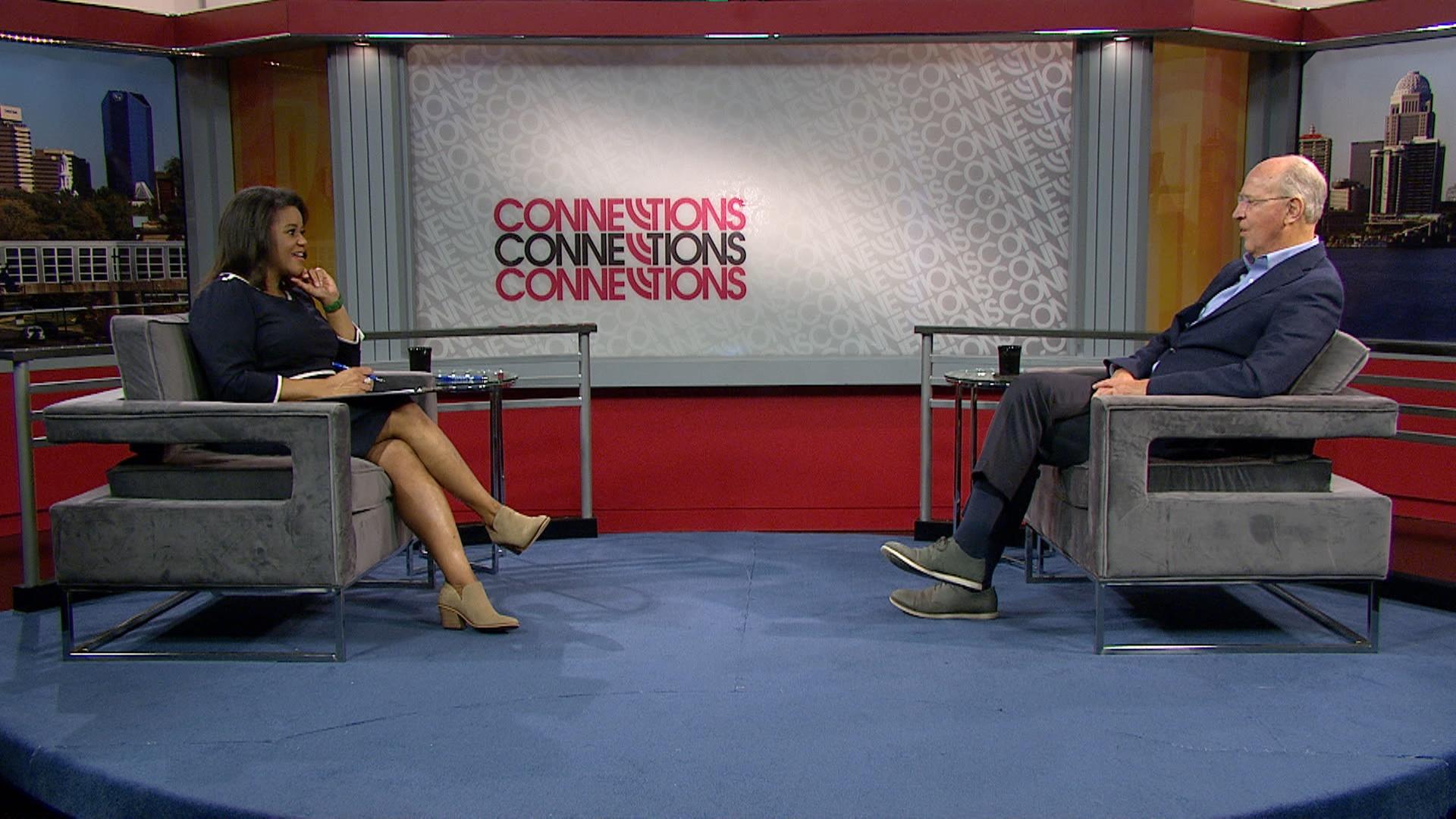


Although he’s been gone from KET for about six years, Bill Goodman is still associated with the statewide network in the eyes of many viewers. The founding host of Kentucky Tonight can still be seen on reruns of bookclub@KET, which air on KET-2 and KET-KY. Even now, Goodman says, not a week goes by that he doesn’t get a compliment for some program he did on KET.
“I’ve gotten to the point that I don’t even take the time to explain it anymore,” he says. “I just nod and say, ‘thank you,’ and I appreciate it very much that they remember the work that I did.”
Goodman spent 20 years at KET, anchoring legislative and election coverage, Fancy Farm broadcasts, and hosting the interview program One to One. But even as he stepped down from TV work, the Glasgow native wasn’t ready to stop serving the commonwealth. He joined Kentucky Humanities as executive director to oversee the agency’s literacy initiatives, popular Chautauqua speakers’ series, annual book festival, and more.
“I’d like to work on raising the profile of Kentucky Humanities,” says Goodman. “I want people in Kentucky to be more aware of what we do and the work that we’ve been doing for 50 years.”
Bringing the Humanities to All Kentuckians
As an affiliate of the National Endowment for the Humanities, the Kentucky agency is one of 56 humanities councils formed in each American state and territory. Based in Lexington, Kentucky Humanities is funded by private donations as well as support from the National Endowment. Although the state council has operated since 1972, Goodman admits many people still don’t fully understand what the humanities are and why they are important to promote.
“The humanities is what makes us all human,” he says. “It is the art, it is music, it’s philosophy, it’s history, it’s all those things that create the human being that we are born with and that we grow up to be.”
Even in marking its half century of service, Kentucky Humanities sought to celebrate with the entire state. Goodman says the anniversary year kicked-off with a virtual discussion featuring PBS NewsHour commentator David Brooks exploring democracy and an informed citizenry. Subsequent events featured Kentucky Poet Laureate Crystal Wilkinson and former U.S. Poet Laureate Joy Harjo; musicians Sam Bush and Michael Jonathan discussing the importance of bluegrass music; four renowned chefs examining the intersection of foodways and culture; Louisville a cappella group Linkin’ Bridge and scholar Aminata Cairo discussing diversity in song and storytelling; and retired NASA astronaut Story Musgrave reflecting on the future of humanity in space.
“We have such a wonderful state and... we wanted to give back a little bit after 50 years,” he says. “It was our time to say thanks for being supporters of Kentucky Humanities.”
These special events complemented the ongoing work of Kentucky Humanities, including its annual book festival, which draws thousands of readers and book lovers each fall. This year’s edition in Lexington featured some 140 authors including Kentucky natives Wendell Berry, Barbara Kingsolver, and Frank X Walker, as well as three Pulitzer Prize winners: historians Jon Meacham and David Blight, and novelist Geraldine Brooks. Brooks’ latest book, Horse, explores the legacy of slavery and racism in America through the story of a real-life Thoroughbred legend named Lexington.
“She is just a nice, comfortable person to be around,” says Goodman. “A beautiful human being and loves people and wants to answer every question and sign every book.”
The agency continues to offer its Chautauqua series in which scholars perform historically accurate dramatizations of important Kentuckians from Daniel Boone and Henry Clay to Jean Ritchie and Nancy Green, who rose to national fame as pancake icon Aunt Jemima. Kentucky Humanities also sponsors important literacy initiatives: Prime Time encourages parents and children to read together, and New Books for New Readers provides adult literacy students with books written at the 4th grade reading level.
One of agency’s newest ventures is a daily audio feature called Think History in which Goodman highlights important people and events throughout the state’s history. The two-minute segments are broadcast on public radio stations around the commonwealth, and available as a podcast.
“There are some amazing stories in Kentucky that are just now being told, and we’re so privileged to do that,” says Goodman. “They’re fun because they’re educational and they’re short.”
Much Still to Accomplish
Although he left formal journalism behind when retired from KET, Goodman says he’s happy to be able to continue to tell important and interesting stories through his work at Kentucky Humanities, which includes a weekly interview podcast, Think Humanities.
“I think once you’re in journalism and in reporting,” he says, “you always have that curiosity.”
Goodman was inducted into the Kentucky Journalism Hall of Fame in 2013. Before his time at KET, he served as news director at CBS television affiliates in Nashville and Houston, and he ran his family’s candy distribution business in Glasgow after the death of his father.
As he looks to the future, Goodman, who is in his 70s, says he still has much he wants to accomplish. One item on his personal to-do list is to complete a biography of one of his cousins, the internationally recognized abstract artist Joe Downing.
“I’m not quite finished at Kentucky Humanities, there are a few other things I want to do there,” says Goodman. “Then I have some projects that I would like to do after I leave there, God willing and the creek don’t rise.”