Skip to Main Content

Restoring American Democracy

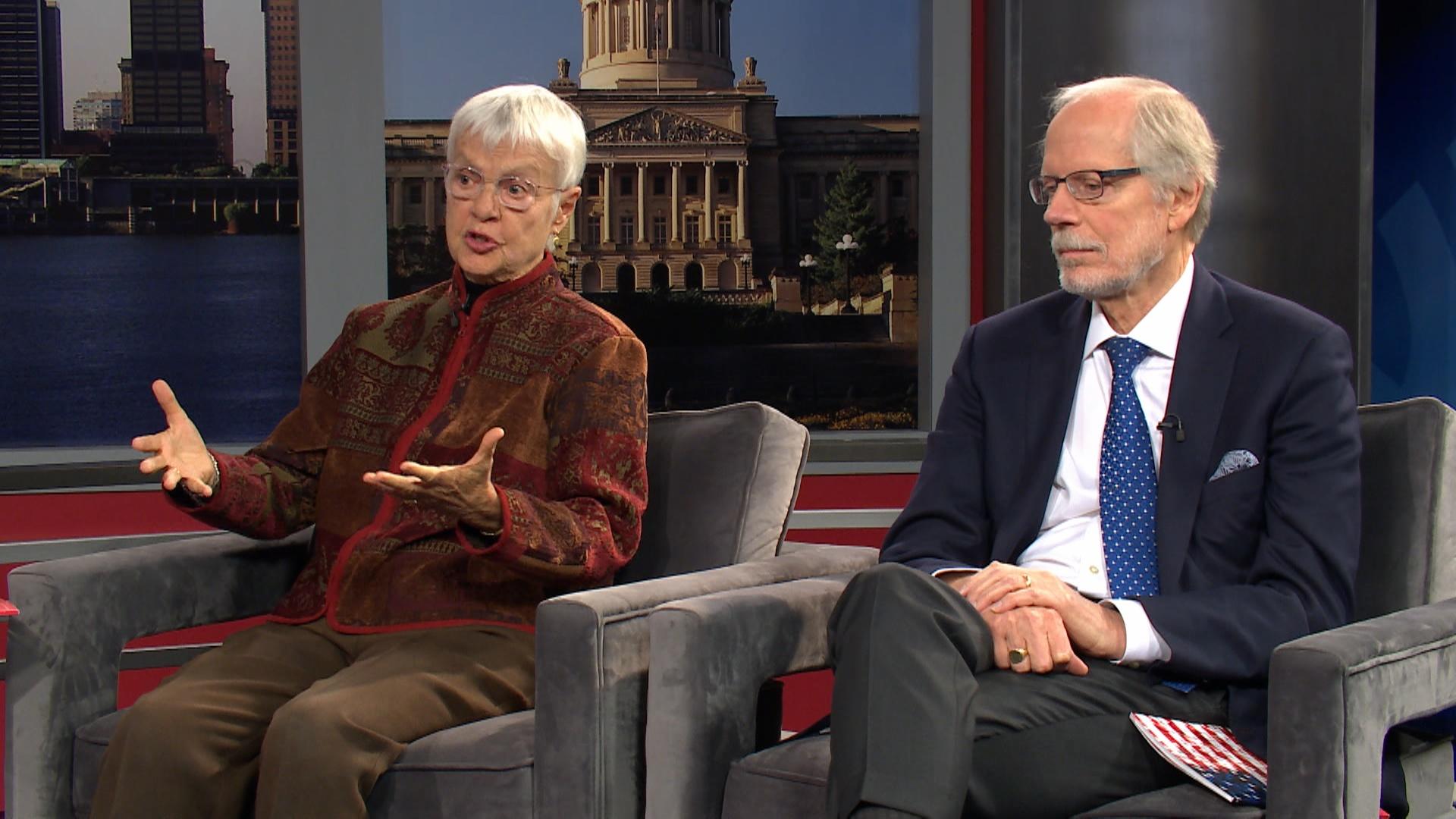
Carolyn Lukensmeyer and Stephen B. Heintz of the Commission on the Practice of Democratic Citizenship talk about the organization's bipartisan report, Our Common Purpose: Reinventing American Democracy for the 21st Century, which includes six strategies and 31 recommendations to help the country emerge a more resilient democracy by 2026, the nation's 250th anniversary.
Season 18 Episode 9 Length 26:33 Premiere: 11/06/22

About

Connections

KET’s Connections features in-depth interviews with the influential, innovative and inspirational individuals who are shaping the path for Kentucky’s future.

From business leaders to entertainers to authors to celebrities, each week features an interesting and engaging guest covering a broad array of topics. Host Renee Shaw uses her extensive reporting experience to naturally blend casual conversation and hard-hitting questions to generate rich and full conversations about the issues impacting Kentucky and the world.


Tune-In

KET Sundays • 11:30 am/10:30 am
KET2 Sundays • 6/5 pm

Stream

Watch on KET’s website anytime or through the PBS Video App.

Podcast

The Connections podcast features each episode’s audio for listening.


Renee Shaw is the Director of Public Affairs and Moderator at KET, currently serving as host of KET’s weeknight public affairs program Kentucky Edition, the signature public policy discussion series Kentucky Tonight, the weekly interview series Connections, Election coverage and KET Forums.

Since 2001, Renee has been the producing force behind KET’s legislative coverage that has been recognized by the Kentucky Associated Press and the National Educational Telecommunications Association. Under her leadership, KET has expanded its portfolio of public affairs content to include a daily news and information program, Kentucky Supreme Court coverage, townhall-style forums, and multi-platform program initiatives around issues such as opioid addiction and youth mental health.  

Renee has also earned top awards from the Ohio Valley Chapter of the National Academy of Television Arts and Sciences (NATAS), with three regional Emmy awards. In 2023, she was inducted into the Silver Circle of the NATAS, one of the industry’s highest honors recognizing television professionals with distinguished service in broadcast journalism for 25 years or more.  

Already an inductee into the Kentucky Civil Rights Hall of Fame (2017), Renee expands her hall of fame status with induction into Western Kentucky University’s Hall of Distinguished Alumni in November of 2023.  

In February of 2023, Renee graced the front cover of Kentucky Living magazine with a centerfold story on her 25 years of service at KET and even longer commitment to public media journalism. 

In addition to honors from various educational, civic, and community organizations, Renee has earned top honors from the Associated Press and has twice been recognized by Mental Health America for her years-long dedication to examining issues of mental health and opioid addiction.  

In 2022, she was honored with Women Leading Kentucky’s Governor Martha Layne Collins Leadership Award recognizing her trailblazing path and inspiring dedication to elevating important issues across Kentucky.   

In 2018, she co-produced and moderated a 6-part series on youth mental health that was awarded first place in educational content by NETA, the National Educational Telecommunications Association. 

She has been honored by the AKA Beta Gamma Omega Chapter with a Coretta Scott King Spirit of Ivy Award; earned the state media award from the Kentucky Society of the Daughters of the American Revolution in 2019; named a Charles W. Anderson Laureate by the Kentucky Personnel Cabinet in 2019 honoring her significant contributions in addressing socio-economic issues; and was recognized as a “Kentucky Trailblazer” by the University of Kentucky Martin School of Public Policy and Administration during the Wendell H. Ford Lecture Series in 2019. That same year, Shaw was named by The Kentucky Gazette’s inaugural recognition of the 50 most notable women in Kentucky politics and government.  

Renee was bestowed the 2021 Berea College Service Award and was named “Unapologetic Woman of the Year” in 2021 by the Community Action Council.   

In 2015, she received the Green Dot Award for her coverage of domestic violence, sexual assault & human trafficking. In 2014, Renee was awarded the Anthony Lewis Media Award from the KY Department of Public Advocacy for her work on criminal justice reform. Two Kentucky governors, Republican Ernie Fletcher and Democrat Andy Beshear, have commissioned Renee as a Kentucky Colonel for noteworthy accomplishments and service to community, state, and nation.  

A former adjunct media writing professor at Georgetown College, Renee traveled to Cambodia in 2003 to help train emerging journalists on reporting on critical health issues as part of an exchange program at Western Kentucky University. And, she has enterprised stories for national media outlets, the PBS NewsHour and Public News Service.  

Shaw is a 2007 graduate of Leadership Kentucky, a board member of CASA of Lexington, and a longtime member of the Frankfort/Lexington Chapter of The Links Incorporated, an international, not-for-profit organization of women of color committed to volunteer service. She has served on the boards of the Kentucky Historical Society, Lexington Minority Business Expo, and the Board of Governors for the Ohio Valley Chapter of the National Academy of Television Arts and Sciences. 

Host Renee Shaw smiling in a green dress with a KET set behind her.

Authors of New Report Share Plan to Engage American Citizens and Reform Elections

In 2026, Americans will mark the 250th anniversary of the birth of the nation. But given the partisan chaos rumbling through our civic life, some wonder just how strong the democratic foundation of the United States will be when that historic milestone arrives.

The nation can have a healthy political system, argue the authors of a new report called Our Common Purpose: Reinventing American Democracy for the 21st Century. But ensuring that will take a dedicated effort by people across the political spectrum to enact important reforms, says Stephen Heintz, a co-chair of the Commission on the Practice of Democratic Citizenship and co-author of the report. He says that this work is a continuation of what Americans have been doing since 1776.

“That’s what democracy is,” says Heintz. “It’s got to be a constant process of iteration and striving to become a more perfect union.”

The Roots and Impacts of Civic Division

The commission is an initiative of the American Academy of Arts and Sciences, a non-partisan organization founded in 1780 by John Adams. The group hosted some 50 listening sessions across America starting in 2018, travelling from Los Angeles, to Lexington, to Annapolis, Md., to talk with people from all walks of life. Heintz says the commission discovered a common theme in these conversations.

“What we heard from them consistently was that they are deeply worried about the quality of our democracy,” he says, “and deeply hopeful that working together we can build the effective and resilient and inclusive democracy that we need for this century.”

Although Americans have been focused on recent turmoil surrounding the 2020 presidential election and the Jan. 6, 2021, insurrection at the U.S. Capitol, Heintz argues that civility in public life has been eroding for 40 years. Now, he contends, the nation is facing a crisis point.

“People don’t think the system is working for them and so they are becoming democracy drop-outs,” says Heintz. “That is how a crisis can actually develop when democratic citizens opt out of their democracy, we leave the democracy to others who will manipulate it for their own good, their own benefit.”

The division among Americans is partially the fault of the media, according to commission member Carolyn Lukensmeyer, a former executive director of the National Institute for Civil Discourse. She says some outlets have built their business models on stoking political divisiveness that attracts viewers and drives social media clicks. She also points to ongoing efforts by election deniers to undermine the integrity of the balloting process.

“The fundamental essence of how self-governance occurs in the United States is my vote – I have to believe that the vote that I make is the vote that is registered and turns into who is in office,” Lukensmeyer says.

But in the current elections nationwide, there are about 300 candidates running for office who deny that President Joe Biden legitimately won in 2020. Lukensmeyer says those candidates are fueling questions about the value of voting going forward.

“This is both turning off Americans from their participation and frightening Americans about whether or not their vote will be registered as they are wanted,” she says.

Both parties are to blame for the problems facing democracy, says Lukensmeyer. But she says restoring our civic and political institutions won’t happen with the help of those on the far right or far left. She contends the political fringes represent only about 20 to 25 percent of Americans. The goal, she contends, is to work with those in the middle that want to be engaged in positive change.

“If we’re going to rebuild the country at this fundamental level, we need to appeal to this very large group of Americans who do have angst about the country, and who actually want to do something, but very often... they don’t know how to get connected in their community to make a difference,” she says.

“They want to believe in it but they don’t feel that it’s working, so they’re losing a sense of their own purpose in our democracy,” adds Heintz. “But they’re the people who can be motivated because they want it to work and they want very much to be part of it.”

Sometimes that means connecting people to organizations and opportunities that already exist where they live. But in other areas, such as small towns and rural communities, that means helping to seed and grow organizations that can do the work of strengthening democracy. Lukensmeyer says the goal is to help people discern the issues that are important to them, connect them to groups involved in those issues, and then offer them recommendations based on the commission’s findings.

Recommendations for Revitalizing American Democracy

The commission’s 75-page report outlines 31 options for strengthening democracy that cover areas like empowering voters, achieving equality in representation, improving media and social media engagement, and fostering responsive government institutions. Specific recommendations that the commission hope can be enacted by 2026 include:

— Institute ranked-choice voting for federal and state elections. Under this system, people mark their top three or more preferences in a specific race, not just one candidate. If a candidate gets a majority of the top-rank votes, they are the winner. If no one tops 50 percent, the candidate with the least votes is eliminated and that voter’s second-choice picks are tabulated. The process continues until a candidate wins a majority of votes. Maine and Alaska already use ranked-choice voting for state and federal election, and New York City has adopted it for primary and special elections for local offices.

“I really believe if you can do it in New York, we can do it anywhere,” says Heintz.

— Enact other voting reforms such as moving election day to Veterans Day (since many people already have that day off from work), providing automatic restoration of voting rights for felony convicts upon their release from prison, and allowing same-day voter registration and universal automatic voter registration.

— Enlarge the U.S. House of Representatives, amend the Constitution to allow for more regulation of campaign contributions, and create citizen-led commissions to conduct legislative redistricting.

“What we’ve seen in the states that have experimented with independent redistricting commissions is a much better process, and much fairer outcomes, and more competitive districts,” says Heintz. “You get more competition in the democracy, which is very healthy.”

— Set an 18-year term limit for U.S. Supreme Court justices.

— Invest in civic education for children and adults.

— Use proceeds from a digital advertising tax to support local public media and investigative journalism.

“Each one of [the recommendations] individually is important and useful, but in combination they become something powerful,” says Heintz.

Sponsored by:

Season 18 Episodes

Lyle Roelofs - President of Berea College

S18 E34 Length 27:25 Premiere Date 06/25/23

Angelique Johnson

S18 E33 Length 26:46 Premiere Date 06/18/23

Willie Carver and Colton Ryan

S18 E32 Length 27:31 Premiere Date 06/01/23

Matt Jones - Kentucky Sports Radio

S18 E31 Length 26:32 Premiere Date 05/21/23

KSU Interim President Dr. Ronald Johnson

S18 E30 Length 26:56 Premiere Date 05/14/23

Treating Depression and Anxiety

S18 E29 Length 26:31 Premiere Date 05/07/23

Kentucky Center for Grieving Children and Families

S18 E28 Length 26:32 Premiere Date 04/30/23

Louisville Orchestra: Playing with Yo-Yo Ma at Mammoth Cave

S18 E27 Length 26:51 Premiere Date 04/23/23

Jim Embry - Sustainable Communities Network

S18 E26 Length 26:32 Premiere Date 04/16/23

Helping to End Child Abuse and Neglect in Kentucky

S18 E25 Length 26:32 Premiere Date 04/09/23

Preventing and Treating Kidney Disease

S18 E24 Length 26:38 Premiere Date 04/01/23

Scholar and Author Anastasia Curwood

S18 E23 Length 26:34 Premiere Date 03/26/23

Jayne Moore Waldrop; Toa Green

S18 E22 Length 26:32 Premiere Date 03/19/23

Central Kentucky Chefs - Samantha Fore and Isaiah Screetch

S18 E21 Length 26:31 Premiere Date 02/26/23

Affrilachian Poet Frank X Walker

S18 E20 Length 27:30 Premiere Date 02/19/23

Aaron Thompson - Kentucky Council on Postsecondary Education

S18 E19 Length 26:40 Premiere Date 02/12/23

Dr. Monalisa Tailor - Kentucky Medical Association

S18 E18 Length 26:36 Premiere Date 02/05/23

Devine Carama - ONE Lexington

S18 E17 Length 26:31 Premiere Date 01/29/23

Congressman John Yarmuth

S18 E16 Length 26:31 Premiere Date 01/22/23

Former State Rep. Joni Jenkins

S18 E15 Length 26:31 Premiere Date 01/15/23

Lexington Mayor Linda Gorton

S18 E14 Length 27:31 Premiere Date 01/08/23

James Comer and Morgan McGarvey

S18 E13 Length 26:31 Premiere Date 12/18/22

Poet and Playwright Constance Alexander

S18 E12 Length 28:03 Premiere Date 12/11/22

Author Emily Bingham

S18 E11 Length 27:15 Premiere Date 11/20/22

Bill Goodman - Kentucky Humanities

S18 E10 Length 26:33 Premiere Date 11/13/22

Restoring American Democracy

S18 E9 Length 26:33 Premiere Date 11/06/22

Breast Cancer

S18 E8 Length 26:45 Premiere Date 10/30/22

Secretary of State Michael Adams on Election Issues

S18 E7 Length 26:32 Premiere Date 10/23/22

University of Kentucky President Eli Capilouto

S18 E6 Length 27:08 Premiere Date 10/16/22

Darlene Thomas - GreenHouse17

S18 E5 Length 26:57 Premiere Date 10/09/22

Bob Jackson - Murray State University

S18 E4 Length 26:31 Premiere Date 10/02/22

David Adkins - The Council of State Governments

S18 E3 Length 27:41 Premiere Date 09/25/22

Melynda Jamison - CASA of Lexington

S18 E2 Length 26:32 Premiere Date 09/18/22

State Treasurer Allison Ball

S18 E1 Length 26:32 Premiere Date 09/11/22

See All Episodes

caret down

TV Schedules

Upcoming

No upcoming airdates

Recent

No recent airdates

Explore KET