Skip to Main Content

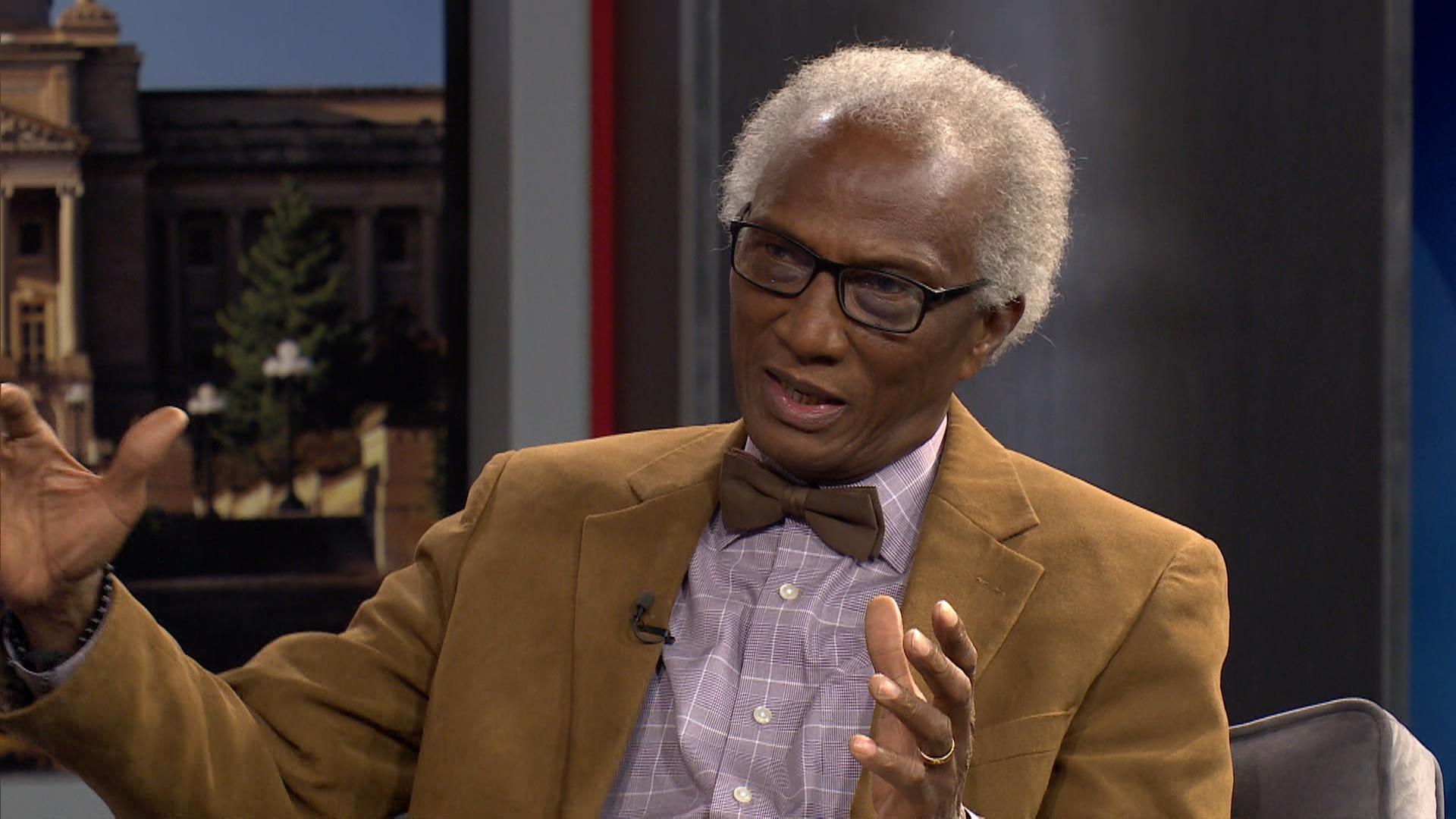
William Turner on Black Life in Appalachia

Host Renee Shaw talks with scholar, sociologist and author William Turner about his new book "Harlan Renaissance: Stories of Black Life in Appalachian Coal Towns" which chronicles the area's vibrant Black communities during coal's final post-war boom years.
Season 17 Episode 13 Length 27:54 Premiere: 11/21/21

About

Connections

KET’s Connections features in-depth interviews with the influential, innovative and inspirational individuals who are shaping the path for Kentucky’s future.

From business leaders to entertainers to authors to celebrities, each week features an interesting and engaging guest covering a broad array of topics. Host Renee Shaw uses her extensive reporting experience to naturally blend casual conversation and hard-hitting questions to generate rich and full conversations about the issues impacting Kentucky and the world.


Tune-In

KET Sundays • 11:30 am/10:30 am
KET2 Sundays • 6/5 pm

Stream

Watch on KET’s website anytime or through the PBS Video App.

Podcast

The Connections podcast features each episode’s audio for listening.


Renee Shaw is the Director of Public Affairs and Moderator at KET, currently serving as host of KET’s weeknight public affairs program Kentucky Edition, the signature public policy discussion series Kentucky Tonight, the weekly interview series Connections, Election coverage and KET Forums.

Since 2001, Renee has been the producing force behind KET’s legislative coverage that has been recognized by the Kentucky Associated Press and the National Educational Telecommunications Association. Under her leadership, KET has expanded its portfolio of public affairs content to include a daily news and information program, Kentucky Supreme Court coverage, townhall-style forums, and multi-platform program initiatives around issues such as opioid addiction and youth mental health.  

Renee has also earned top awards from the Ohio Valley Chapter of the National Academy of Television Arts and Sciences (NATAS), with three regional Emmy awards. In 2023, she was inducted into the Silver Circle of the NATAS, one of the industry’s highest honors recognizing television professionals with distinguished service in broadcast journalism for 25 years or more.  

Already an inductee into the Kentucky Civil Rights Hall of Fame (2017), Renee expands her hall of fame status with induction into Western Kentucky University’s Hall of Distinguished Alumni in November of 2023.  

In February of 2023, Renee graced the front cover of Kentucky Living magazine with a centerfold story on her 25 years of service at KET and even longer commitment to public media journalism. 

In addition to honors from various educational, civic, and community organizations, Renee has earned top honors from the Associated Press and has twice been recognized by Mental Health America for her years-long dedication to examining issues of mental health and opioid addiction.  

In 2022, she was honored with Women Leading Kentucky’s Governor Martha Layne Collins Leadership Award recognizing her trailblazing path and inspiring dedication to elevating important issues across Kentucky.   

In 2018, she co-produced and moderated a 6-part series on youth mental health that was awarded first place in educational content by NETA, the National Educational Telecommunications Association. 

She has been honored by the AKA Beta Gamma Omega Chapter with a Coretta Scott King Spirit of Ivy Award; earned the state media award from the Kentucky Society of the Daughters of the American Revolution in 2019; named a Charles W. Anderson Laureate by the Kentucky Personnel Cabinet in 2019 honoring her significant contributions in addressing socio-economic issues; and was recognized as a “Kentucky Trailblazer” by the University of Kentucky Martin School of Public Policy and Administration during the Wendell H. Ford Lecture Series in 2019. That same year, Shaw was named by The Kentucky Gazette’s inaugural recognition of the 50 most notable women in Kentucky politics and government.  

Renee was bestowed the 2021 Berea College Service Award and was named “Unapologetic Woman of the Year” in 2021 by the Community Action Council.   

In 2015, she received the Green Dot Award for her coverage of domestic violence, sexual assault & human trafficking. In 2014, Renee was awarded the Anthony Lewis Media Award from the KY Department of Public Advocacy for her work on criminal justice reform. Two Kentucky governors, Republican Ernie Fletcher and Democrat Andy Beshear, have commissioned Renee as a Kentucky Colonel for noteworthy accomplishments and service to community, state, and nation.  

A former adjunct media writing professor at Georgetown College, Renee traveled to Cambodia in 2003 to help train emerging journalists on reporting on critical health issues as part of an exchange program at Western Kentucky University. And, she has enterprised stories for national media outlets, the PBS NewsHour and Public News Service.  

Shaw is a 2007 graduate of Leadership Kentucky, a board member of CASA of Lexington, and a longtime member of the Frankfort/Lexington Chapter of The Links Incorporated, an international, not-for-profit organization of women of color committed to volunteer service. She has served on the boards of the Kentucky Historical Society, Lexington Minority Business Expo, and the Board of Governors for the Ohio Valley Chapter of the National Academy of Television Arts and Sciences. 

Host Renee Shaw smiling in a green dress with a KET set behind her.

New Book Details the History and Contributions of African Americans in Eastern Kentucky

Alex Haley, the Pulitzer Prize-winning author of “Roots,” once said nobody knew more about Black life and culture in the mountains of the American South than William Turner.

The acclaimed sociologist and retired professor was born in Harlan County, Kentucky and has studied his region for 50 years. But even with his experience and Haley’s encouragement, writing about Black families of the coalfields was not easy.

“It took me a long, long time,” says Turner. “I started on that book 30 years ago.”

The result of his labors is “The Harlan Renaissance: Stories of Black Life in Appalachian Coal Towns,” published this fall by West Virginia University Press. Turner says his book explores an important aspect of the movement of Black southerners from the rural south to the industrial north in the early part of the 20th century.

“It’s all a part of a mass migration of people that’s very important to American history,” he says. “My book helps to fill that page, particularly about Black people in the Appalachian south, in southern West Virginia, eastern Kentucky, east Tennessee, and southwest Virginia.”

The Diversity of the Kentucky Coalfields

Telling this story is something of a professional and personal passion for Turner. He’s long grown tired of people, including some historians, who think the history of the eastern Kentuckians belongs to white, Scotch-Irish immigrants.

“My first thought was how dare you ignore the existence of my great-grandmothers… who were born into slavery in the 1850s in the heart of southwest Virginia,” says Turner. “Just because you just discovered them didn’t mean they hadn’t been there.”

Turner says his lineage continues through paternal and maternal grandmothers who were sharecroppers. His parents raised 10 children on his father’s coal mining wages working for U.S. Steel. When the company denied Blacks foreman positions at its mines, Turner says his father joined with other African American miners to sue for the ability to hold those jobs.

Turner’s dad only had a third-grade education, while his mother completed tenth grade. Yet the Turner children and grandchildren went on to earn undergraduate and graduate degrees from the likes of Spelman and Morehouse Colleges, MIT, Stanford, and Columbia.

The Harlan County of Turner’s youth was a highly diverse place. He says the residents represented 38 different nationalities during the 1950s. For that reason, Turner says he didn’t experience racism until he left the coalfields. The first shock came when he moved into Haggin Hall at the University of Kentucky in 1966.

“There were only three African Americans in that dorm,” says Turner. “I was going, where are the Black people around here?”

In time, Turner would discover that many Appalachians like him had left the mountains to take on the wider world.

“I heard [attorney and author] Harry Caudill say one time that people from eastern Kentucky came and took over central Kentucky and they never fired a shot,” he says. “Blacks and whites out of that area came with a certain value system, a certain resiliency that says I don’t know what’s out here in this world but there’s nobody in this world that can convince me that I can’t do what anybody can do.”

An ‘Industrial-Strength Optimist’

After getting his undergraduate at UK, Turner went on to get his doctorate in sociology and anthropology at Notre Dame. His teaching career included stops at UK, Kentucky State University, Berea College, Winston-Salem State University, and Prairie View A&M University. Yet he never lost touch with his coalfield roots or the label of being “Appalachian.” He says the region and its residents have become a convenient point of contrast for people from other places who are trying to elevate themselves.

“Appalachia became America’s other,” says Turner. “We’re really no different than anybody else except for this unique geo-physical space, so give us a break.”

The similarities extend to the impacts of changing socio-economic conditions. Turner says the nation watched as the decline of the coal industry resulted in high unemployment and high rates of substance abuse across central Appalachia. He says a similar fate now faces working class families in many urban centers.

“People in Chicago and in Detroit and in America’s inner cities are trying to adjust to joblessness and the globalization of the economy, which left a lot of people behind,” he says.

Although some politicians have sought to drive wedges between Americans along lines of race and class, Turner says there are still opportunities to bring people together for the good of the nation.

“I’m an industrial-strength optimist because I think that ultimately, despite this nadir we’re at right now, I believe that we will emerge as a country and still be able to say we’re a beacon light to the world when it comes to democracy,” he says.

A key part of fostering that change, according to Turner, is a thorough knowledge of history. He says when Americans learn what has happened in this country, and why that happened, we can avoid repeating the same mistakes. He says that includes learning about the nation’s legacy of racism.

“Anybody who doesn’t think race is a critical matter in America is in deep into self-denial,” he says.

That’s one reason why Turner says he wanted to document the experiences of African Americans in eastern Kentucky. He says their story is as important as the story of other Blacks who left the deep South for cities in the north and northeast during the Great Migration of the early 20th century.

“I hope that school students in the state of Kentucky at least will become familiar with Harlan, Kentucky, because it represented the epitome of the migration of Blacks out of Alabama,” says Turner. “In the same period people were going in to Harlem, thousands and thousands of African Americans came to Harlan County.”

Sponsored by:

Season 17 Episodes

Lyle Roelofs - Berea College

S17 E32 Length 27:49 Premiere Date 06/26/22

Engaging Fathers; Improving Financial Literacy

S17 E31 Length 28:01 Premiere Date 06/19/22

Delanor Manson - Kentucky Nurses Association

S17 E30 Length 27:26 Premiere Date 06/12/22

School Safety in Kentucky

S17 E29 Length 29:06 Premiere Date 06/05/22

Gun Safety Advocate Whitney Austin

S17 E28 Length 27:32 Premiere Date 05/29/22

Ben Chandler - Foundation for a Healthy Kentucky

S17 E27 Length 27:51 Premiere Date 05/22/22

Advancing Mental Health Awareness in Kentucky

S17 E26 Length 27:01 Premiere Date 05/15/22

Kentucky Secretary of State Michael Adams

S17 E25 Length 27:36 Premiere Date 05/08/22

Brigitte Blom - Prichard Committee for Academic Excellence

S17 E24 Length 28:02 Premiere Date 05/01/22

Jill Seyfred - Prevent Child Abuse Kentucky

S17 E23 Length 27:17 Premiere Date 04/18/22

Child Abuse Prevention in Kentucky

S17 E22 Length 28:03 Premiere Date 04/10/22

Kidney Health: Prevention, Treatment, and Organ Donation

S17 E21 Length 26:53 Premiere Date 04/03/22

Reporter Jonathan Bullington

S17 E20 Length 28:07 Premiere Date 02/27/22

Nikki Lanier - Harper Slade

S17 E19 Length 28:01 Premiere Date 02/20/22

WFPL's Stephanie Wolf and Jess Clark

S17 E18 Length 27:51 Premiere Date 02/13/22

Felicia C. Smith - National Center for Families Learning

S17 E17 Length 27:33 Premiere Date 02/06/22

Tom Shelton - Henry Clay Center

S17 E16 Length 27:33 Premiere Date 01/23/22

Cabinet for Health and Family Services Sec. Eric Friedlander

S17 E15 Length 28:10 Premiere Date 01/09/22

Exploring Solutions to the Healthcare Worker Shortage

S17 E14 Length 27:01 Premiere Date 12/12/21

William Turner on Black Life in Appalachia

S17 E13 Length 27:54 Premiere Date 11/21/21

Kentucky Poet Laureate Crystal Wilkinson

S17 E12 Length 27:43 Premiere Date 11/14/21

Addressing Needs of Kentuckians with Disabilities

S17 E11 Length 27:36 Premiere Date 11/07/21

Chelsea Ellis-Hogan

S17 E9 Length 27:11 Premiere Date 10/31/21

2021 Kentucky Book Festival

S17 E8 Length 28:12 Premiere Date 10/24/21

Devine Carama

S17 E7 Length 27:41 Premiere Date 10/17/21

Rufus Friday

S17 E6 Length 27:56 Premiere Date 10/10/21

Aaron Thompson

S17 E5 Length 28:04 Premiere Date 10/03/21

Whitney Austin - Reducing Gun Violence

S17 E4 Length 27:01 Premiere Date 09/26/21

Filmmaker Sarah Burns

S17 E3 Length 28:11 Premiere Date 09/19/21

Charlene Buckles and Dan Wu

S17 E2 Length 27:23 Premiere Date 09/12/21

See All Episodes

caret down

TV Schedules

Upcoming

No upcoming airdates

Recent

No recent airdates

Explore KET