Skip to Main Content

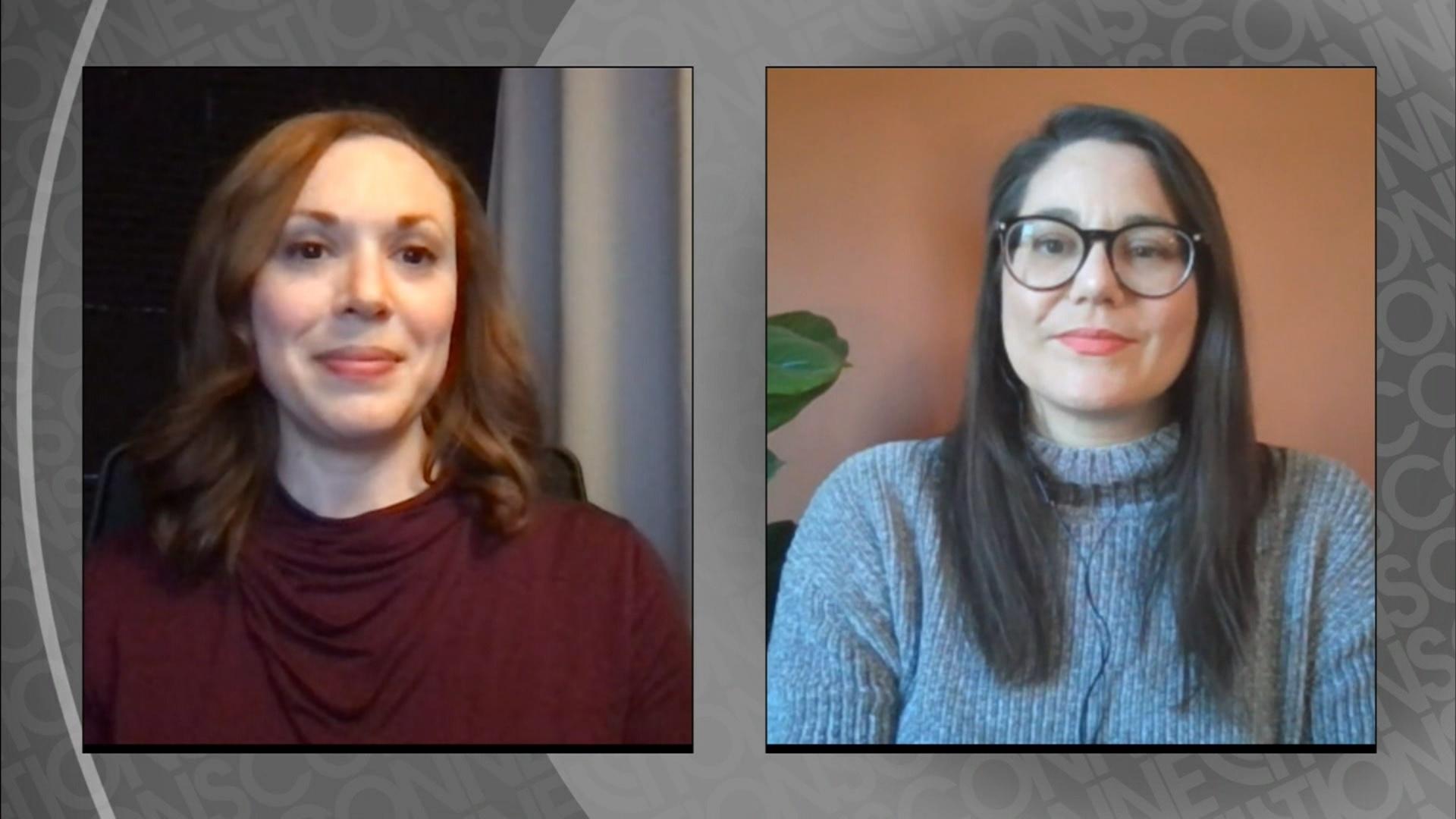
WFPL's Stephanie Wolf and Jess Clark

Renee Shaw talks with journalists who produced "A Critical Moment," a radio documentary about teaching race in America from WFPL News in Louisville. WFPL's Arts & Culture Reporter Stephanie Wolf investigated how the Holocaust is covered in German classrooms. And, WFPL's Education and Learning Reporter Jess Clark examined how race is covered in Kentucky classrooms.
Season 17 Episode 18 Length 27:51 Premiere: 02/13/22

About

Connections

KET’s Connections features in-depth interviews with the influential, innovative and inspirational individuals who are shaping the path for Kentucky’s future.

From business leaders to entertainers to authors to celebrities, each week features an interesting and engaging guest covering a broad array of topics. Host Renee Shaw uses her extensive reporting experience to naturally blend casual conversation and hard-hitting questions to generate rich and full conversations about the issues impacting Kentucky and the world.


Tune-In

KET Sundays • 11:30 am/10:30 am
KET2 Sundays • 6/5 pm

Stream

Watch on KET’s website anytime or through the PBS Video App.

Podcast

The Connections podcast features each episode’s audio for listening.


Renee Shaw is the Director of Public Affairs and Moderator at KET, currently serving as host of KET’s weeknight public affairs program Kentucky Edition, the signature public policy discussion series Kentucky Tonight, the weekly interview series Connections, Election coverage and KET Forums.

Since 2001, Renee has been the producing force behind KET’s legislative coverage that has been recognized by the Kentucky Associated Press and the National Educational Telecommunications Association. Under her leadership, KET has expanded its portfolio of public affairs content to include a daily news and information program, Kentucky Supreme Court coverage, townhall-style forums, and multi-platform program initiatives around issues such as opioid addiction and youth mental health.  

Renee has also earned top awards from the Ohio Valley Chapter of the National Academy of Television Arts and Sciences (NATAS), with three regional Emmy awards. In 2023, she was inducted into the Silver Circle of the NATAS, one of the industry’s highest honors recognizing television professionals with distinguished service in broadcast journalism for 25 years or more.  

Already an inductee into the Kentucky Civil Rights Hall of Fame (2017), Renee expands her hall of fame status with induction into Western Kentucky University’s Hall of Distinguished Alumni in November of 2023.  

In February of 2023, Renee graced the front cover of Kentucky Living magazine with a centerfold story on her 25 years of service at KET and even longer commitment to public media journalism. 

In addition to honors from various educational, civic, and community organizations, Renee has earned top honors from the Associated Press and has twice been recognized by Mental Health America for her years-long dedication to examining issues of mental health and opioid addiction.  

In 2022, she was honored with Women Leading Kentucky’s Governor Martha Layne Collins Leadership Award recognizing her trailblazing path and inspiring dedication to elevating important issues across Kentucky.   

In 2018, she co-produced and moderated a 6-part series on youth mental health that was awarded first place in educational content by NETA, the National Educational Telecommunications Association. 

She has been honored by the AKA Beta Gamma Omega Chapter with a Coretta Scott King Spirit of Ivy Award; earned the state media award from the Kentucky Society of the Daughters of the American Revolution in 2019; named a Charles W. Anderson Laureate by the Kentucky Personnel Cabinet in 2019 honoring her significant contributions in addressing socio-economic issues; and was recognized as a “Kentucky Trailblazer” by the University of Kentucky Martin School of Public Policy and Administration during the Wendell H. Ford Lecture Series in 2019. That same year, Shaw was named by The Kentucky Gazette’s inaugural recognition of the 50 most notable women in Kentucky politics and government.  

Renee was bestowed the 2021 Berea College Service Award and was named “Unapologetic Woman of the Year” in 2021 by the Community Action Council.   

In 2015, she received the Green Dot Award for her coverage of domestic violence, sexual assault & human trafficking. In 2014, Renee was awarded the Anthony Lewis Media Award from the KY Department of Public Advocacy for her work on criminal justice reform. Two Kentucky governors, Republican Ernie Fletcher and Democrat Andy Beshear, have commissioned Renee as a Kentucky Colonel for noteworthy accomplishments and service to community, state, and nation.  

A former adjunct media writing professor at Georgetown College, Renee traveled to Cambodia in 2003 to help train emerging journalists on reporting on critical health issues as part of an exchange program at Western Kentucky University. And, she has enterprised stories for national media outlets, the PBS NewsHour and Public News Service.  

Shaw is a 2007 graduate of Leadership Kentucky, a board member of CASA of Lexington, and a longtime member of the Frankfort/Lexington Chapter of The Links Incorporated, an international, not-for-profit organization of women of color committed to volunteer service. She has served on the boards of the Kentucky Historical Society, Lexington Minority Business Expo, and the Board of Governors for the Ohio Valley Chapter of the National Academy of Television Arts and Sciences. 

Host Renee Shaw smiling in a green dress with a KET set behind her.

Public Radio Documentary Explores Teaching Race in Germany and America

In the early summer of 2021, just about the time Stephanie Wolf learned she’d been awarded a two-month journalism fellowship in Germany, the Louisville public radio reporter noticed a curious thing happening here at home. At school board meetings and state legislatures, there was an intensifying debate about what students should be taught about slavery and racism in the United States.

Wolf thought it would be interesting to use her time in Germany to explore how students there learn about the Holocaust and compare that to how Kentucky schools teach about the history and legacy of slavery. She pitched the idea to one her colleagues at WFPL-FM, education report Jess Clark, who had recently covered a Jefferson County school board meeting that was disrupted by people angry about the teaching of Critical Race Theory.

The two reporters decided to collaborate on a documentary called A Critical Moment, which explores how Germany and America teach students about painful aspects of their nations’ pasts. The program aired on WFPL in January and is available to stream on the station’s website.

Wolf interviewed German students, teachers, and education officials about why the Holocaust is a mandatory part of the curriculum there, while Clark talked to their counterparts here about the current debate over how slavery, segregation and racism should be taught in Kentucky schools.

A Backlash to Critical Race Theory

Critical Race Theory is an academic concept that explores how the legacy of racism in America has shaped people, institutions, and public policy. Although the theory has been around for 40 years, it surfaced in national headlines following the social justice protests of 2020. Clark says the controversy over CRT has been driven largely by conservative media outlets. That coverage, she says, incited parents to go to school board meetings to voice their concerns about how topics like slavery and systemic racism could make children feel uncomfortable and leave them ashamed of their country.

Despite the uproar, CRT is generally meant for college-level studies and rarely taught in public elementary and secondary schools.

“People say that they’re worried about Critical Race Theory,” says Clark. “But what they’re worried about when you get to the heart of it is these… equity and inclusion initiatives, anti-racist trainings, and then sometimes even just history that muddles this myth that we have about American exceptionalism.”

In the documentary, Clark talked with historian Adam Laats, who studies conservative activism in American schools. He says the controversy points to differing views about how history should be taught. One position is that students should learn about the bad things in our nation’s past so they can understand the forces that created them and be prepared to prevent them from occurring again in the future. The other approach, according to Laats, is to teach history that creates a positive national identity in the minds of young people.

“For many conservatives, the purpose of public education is to praise the history of the United States, to exemplify the greatness of the nation so that students will be inspired to be good citizens,” says Clark.

Following similar actions in other state legislatures, Kentucky lawmakers pre-filed several bills last summer and fall about the teaching of subjects that they say could promote divisions among students based on race, sex, or religion. Proponents argue the bills would allow students to learn the basic facts of U.S. history without engendering discomfort or shame and without leading young people to believe that America is an inherently racist nation.

But the Kentucky youth that Clark talked with for the documentary say they want to know the entire, unvarnished story of America.

“As one student said, ‘You can’t just learn about the good without knowing about the bad, you have to know about everything,’” Clark says. “You have to learn the good with the bad to understand the greatness of America.”

Teaching About the Holocaust in Germany

During her time in Germany, Wolf accompanied a group of high school students on a field trip to Dachau last September. Wolf says the mandatory Holocaust curricula in Germany requires some kind of memorial visit, but the state of Bavaria, where she stayed, specifies that high school students must tour a former concentration camp.

“They do not sugarcoat this at all,” says Wolf. “They were very frank about what occurred on the very ground that they were standing.”

As the tour began, Wolf says the students behaved like typical teenagers, more focused on each other than the presentation by tour guides. But their mood suddenly changed when they got to the crematorium where the Nazis killed tens of thousands of Jews, homosexuals, Jehovah’s Witnesses, and others. The tour included photographs taken by American soldiers who liberated the camp in 1945 depicting piles of dead, naked bodies.

“It made this very real for them, and nobody said a word as we walked through the crematorium,” says Wolf.

There are some far-right politicians in Germany who argue there is too much emphasis placed on Holocaust education, according to Wolf. But she says that sentiment is still on the fringes. She quotes a German education ministry official in Berlin who contends important teachable moments can occur when students feel uncomfortable.

“He pushed back against this idea that learning about their past atrocities is anti-German or somehow tarnishing the legacy of the country,” says Wolf. “He felt that the German thing to do – or even the patriotic thing to do – was to face the past.”

The students that Wolf met at Dachau also seemed to grasp the importance of the experience.

“We just have to look back at the mistakes that our country has made,” says a 14-year-old boy in the documentary. “We have to face them and hope that something like this really never happens again.”

“I’m uncomfortable,” says a 15-year girl, “but I think it’s okay.”

The journalists acknowledge that the Holocaust and slavery are not an apples-to-apples comparison. Clark explored the differences between the two with Nikole Hannah-Jones, The New York Times Magazine reporter who created the 1619 Project about the history and legacy of slavery. Clark says former President Donald Trump labelled the project un-American, while Kentucky Senator Mitch McConnell called on the U.S. Department of Education to abandon curricula that includes the 1619 Project and other materials that he says make history politicized and divisive.

Hannah-Jones agrees there are shortcomings in trying to compare teaching about the Holocaust to instruction on slavery and racism. She points out that the Holocaust represents a few years out of Germany’s long history. For the United States, though, history has unfolded over a much shorter period.

“You can look at the history of Nazi Germany and the Holocaust and still have thousands of years of Germanic history to be proud of,” recounts Clark. “If you were to set aside the part of history in which Black people were being enslaved, in which Native People were being forced from their land and killed, that’s the majority of American history.”

Because racial oppression is so deeply engrained in the nation’s relatively brief history, Clark says that makes it difficult to separate out and challenging for some people to confront.

Sponsored by:

Season 17 Episodes

Lyle Roelofs - Berea College

S17 E32 Length 27:49 Premiere Date 06/26/22

Engaging Fathers; Improving Financial Literacy

S17 E31 Length 28:01 Premiere Date 06/19/22

Delanor Manson - Kentucky Nurses Association

S17 E30 Length 27:26 Premiere Date 06/12/22

School Safety in Kentucky

S17 E29 Length 29:06 Premiere Date 06/05/22

Gun Safety Advocate Whitney Austin

S17 E28 Length 27:32 Premiere Date 05/29/22

Ben Chandler - Foundation for a Healthy Kentucky

S17 E27 Length 27:51 Premiere Date 05/22/22

Advancing Mental Health Awareness in Kentucky

S17 E26 Length 27:01 Premiere Date 05/15/22

Kentucky Secretary of State Michael Adams

S17 E25 Length 27:36 Premiere Date 05/08/22

Brigitte Blom - Prichard Committee for Academic Excellence

S17 E24 Length 28:02 Premiere Date 05/01/22

Jill Seyfred - Prevent Child Abuse Kentucky

S17 E23 Length 27:17 Premiere Date 04/18/22

Child Abuse Prevention in Kentucky

S17 E22 Length 28:03 Premiere Date 04/10/22

Kidney Health: Prevention, Treatment, and Organ Donation

S17 E21 Length 26:53 Premiere Date 04/03/22

Reporter Jonathan Bullington

S17 E20 Length 28:07 Premiere Date 02/27/22

Nikki Lanier - Harper Slade

S17 E19 Length 28:01 Premiere Date 02/20/22

WFPL's Stephanie Wolf and Jess Clark

S17 E18 Length 27:51 Premiere Date 02/13/22

Felicia C. Smith - National Center for Families Learning

S17 E17 Length 27:33 Premiere Date 02/06/22

Tom Shelton - Henry Clay Center

S17 E16 Length 27:33 Premiere Date 01/23/22

Cabinet for Health and Family Services Sec. Eric Friedlander

S17 E15 Length 28:10 Premiere Date 01/09/22

Exploring Solutions to the Healthcare Worker Shortage

S17 E14 Length 27:01 Premiere Date 12/12/21

William Turner on Black Life in Appalachia

S17 E13 Length 27:54 Premiere Date 11/21/21

Kentucky Poet Laureate Crystal Wilkinson

S17 E12 Length 27:43 Premiere Date 11/14/21

Addressing Needs of Kentuckians with Disabilities

S17 E11 Length 27:36 Premiere Date 11/07/21

Chelsea Ellis-Hogan

S17 E9 Length 27:11 Premiere Date 10/31/21

2021 Kentucky Book Festival

S17 E8 Length 28:12 Premiere Date 10/24/21

Devine Carama

S17 E7 Length 27:41 Premiere Date 10/17/21

Rufus Friday

S17 E6 Length 27:56 Premiere Date 10/10/21

Aaron Thompson

S17 E5 Length 28:04 Premiere Date 10/03/21

Whitney Austin - Reducing Gun Violence

S17 E4 Length 27:01 Premiere Date 09/26/21

Filmmaker Sarah Burns

S17 E3 Length 28:11 Premiere Date 09/19/21

Charlene Buckles and Dan Wu

S17 E2 Length 27:23 Premiere Date 09/12/21

See All Episodes

caret down

TV Schedules

Upcoming

No upcoming airdates

Recent

No recent airdates

Explore KET