Skip to Main Content
Watch 2026 Impeachment Committee

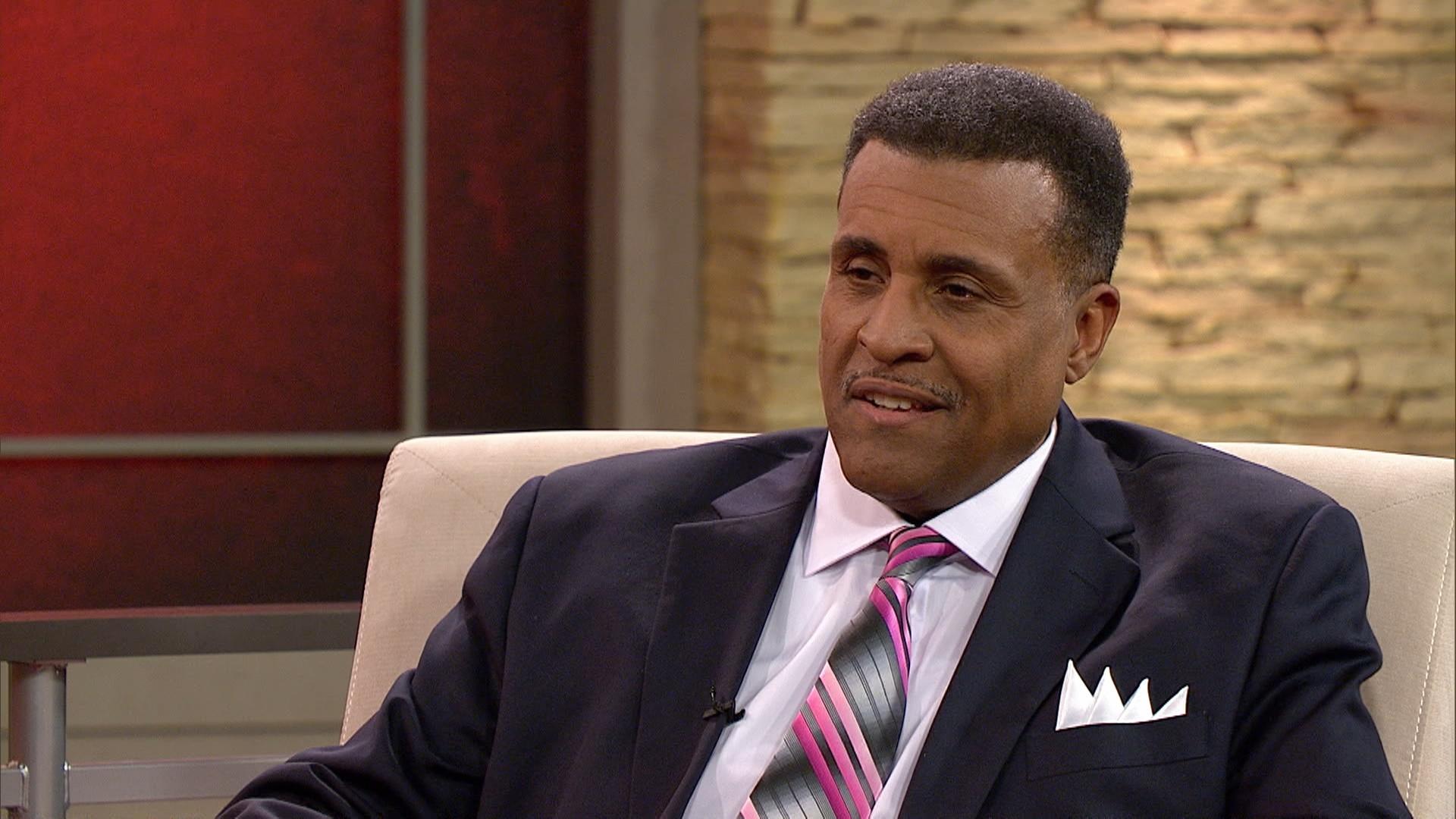
Gerald Smith

Dr. Gerald Smith, a history professor at the University of Kentucky and co-editor of The Kentucky African American Encyclopedia, joins Renee to discuss race relations in honor of Black History Month. Topics include activism around removing Confederate statues, the status of black leadership in Kentucky, and the needed response from the faith-based community in eradicating racism.
Season 13 Episode 20 Length 28:12 Premiere: 02/09/18

About

Connections

KET’s Connections features in-depth interviews with the influential, innovative and inspirational individuals who are shaping the path for Kentucky’s future.

From business leaders to entertainers to authors to celebrities, each week features an interesting and engaging guest covering a broad array of topics. Host Renee Shaw uses her extensive reporting experience to naturally blend casual conversation and hard-hitting questions to generate rich and full conversations about the issues impacting Kentucky and the world.


Tune-In

KET Sundays • 11:30 am/10:30 am
KET2 Sundays • 6/5 pm

Stream

Watch on KET’s website anytime or through the PBS Video App.

Podcast

The Connections podcast features each episode’s audio for listening.


Renee Shaw is the Director of Public Affairs and Moderator at KET, currently serving as host of KET’s weeknight public affairs program Kentucky Edition, the signature public policy discussion series Kentucky Tonight, the weekly interview series Connections, Election coverage and KET Forums.

Since 2001, Renee has been the producing force behind KET’s legislative coverage that has been recognized by the Kentucky Associated Press and the National Educational Telecommunications Association. Under her leadership, KET has expanded its portfolio of public affairs content to include a daily news and information program, Kentucky Supreme Court coverage, townhall-style forums, and multi-platform program initiatives around issues such as opioid addiction and youth mental health.  

Renee has also earned top awards from the Ohio Valley Chapter of the National Academy of Television Arts and Sciences (NATAS), with three regional Emmy awards. In 2023, she was inducted into the Silver Circle of the NATAS, one of the industry’s highest honors recognizing television professionals with distinguished service in broadcast journalism for 25 years or more.  

Already an inductee into the Kentucky Civil Rights Hall of Fame (2017), Renee expands her hall of fame status with induction into Western Kentucky University’s Hall of Distinguished Alumni in November of 2023.  

In February of 2023, Renee graced the front cover of Kentucky Living magazine with a centerfold story on her 25 years of service at KET and even longer commitment to public media journalism. 

In addition to honors from various educational, civic, and community organizations, Renee has earned top honors from the Associated Press and has twice been recognized by Mental Health America for her years-long dedication to examining issues of mental health and opioid addiction.  

In 2022, she was honored with Women Leading Kentucky’s Governor Martha Layne Collins Leadership Award recognizing her trailblazing path and inspiring dedication to elevating important issues across Kentucky.   

In 2018, she co-produced and moderated a 6-part series on youth mental health that was awarded first place in educational content by NETA, the National Educational Telecommunications Association. 

She has been honored by the AKA Beta Gamma Omega Chapter with a Coretta Scott King Spirit of Ivy Award; earned the state media award from the Kentucky Society of the Daughters of the American Revolution in 2019; named a Charles W. Anderson Laureate by the Kentucky Personnel Cabinet in 2019 honoring her significant contributions in addressing socio-economic issues; and was recognized as a “Kentucky Trailblazer” by the University of Kentucky Martin School of Public Policy and Administration during the Wendell H. Ford Lecture Series in 2019. That same year, Shaw was named by The Kentucky Gazette’s inaugural recognition of the 50 most notable women in Kentucky politics and government.  

Renee was bestowed the 2021 Berea College Service Award and was named “Unapologetic Woman of the Year” in 2021 by the Community Action Council.   

In 2015, she received the Green Dot Award for her coverage of domestic violence, sexual assault & human trafficking. In 2014, Renee was awarded the Anthony Lewis Media Award from the KY Department of Public Advocacy for her work on criminal justice reform. Two Kentucky governors, Republican Ernie Fletcher and Democrat Andy Beshear, have commissioned Renee as a Kentucky Colonel for noteworthy accomplishments and service to community, state, and nation.  

A former adjunct media writing professor at Georgetown College, Renee traveled to Cambodia in 2003 to help train emerging journalists on reporting on critical health issues as part of an exchange program at Western Kentucky University. And, she has enterprised stories for national media outlets, the PBS NewsHour and Public News Service.  

Shaw is a 2007 graduate of Leadership Kentucky, a board member of CASA of Lexington, and a longtime member of the Frankfort/Lexington Chapter of The Links Incorporated, an international, not-for-profit organization of women of color committed to volunteer service. She has served on the boards of the Kentucky Historical Society, Lexington Minority Business Expo, and the Board of Governors for the Ohio Valley Chapter of the National Academy of Television Arts and Sciences. 

Host Renee Shaw smiling in a green dress with a KET set behind her.

Dr. Gerald Smith on Race Relations in Kentucky

For 30 years Gerald Smith has taught his students about the civil rights movement and race relations in America. In his lectures and his four books, Smith shares the stories of the men and women who came together in the 1950s and ‘60s to combat discrimination at polling places and at work, in housing and public accommodations.

Now in the face of a new wave of racial violence and lingering issues of police brutality, generational poverty, and mass incarcerations that disproportionately affect African Americans, Smith wonders when new leaders will emerge to unite Americans around a modern civil rights movement.

“I’m tired of the conversations, we need action,” Smith says. “We need people who are willing to come forward with the kind of courage to make change.”

Smith is a professor of history at the University of Kentucky and co-editor of The Kentucky African American Encyclopedia. He appeared on KET’s Connections in a special conversation for Black History Month to discuss racial activism past and present.


Even with the progress for equality made by earlier generations, Smith says blacks in Kentucky remain marginalized.

“You see us primarily on the football and basketball fields,” Smith says. “But when it comes to sitting on boards or in administrative positions, you see very few African Americans… What does that say about Kentucky, but more importantly, what does that say about African Americans?”

In the 1960s, blacks in Louisville, Lexington, Paducah, and other Kentucky cities united to fight for fair housing and open public accommodations. But once activists secured some gains in those areas, Smith says the movement slowly fell apart. He says the leaders of that generation failed to engage younger people in the fight or even explain to them why joining the NAACP or other civil rights organizations was important.

“With integration, we surrendered a lot in terms of the African American community,” Smith says. “We integrated to a point that we integrated ourselves right out history.”

At the same time, conservative Republicans took the White House, where Smith says they focused on “law and order” criminal justice policies and scaling back civil rights. Without visible leaders and strong organizations, Smith says blacks have difficulty effectively challenging racism today, even on local issues like development practices that put landfills and sewage treatment plants in poor and minority neighborhoods.

“We’re really not extending the kind of voice necessary to say, ‘No, we’re not going to take that.’”

Blacks in Church and in Sports
Smith, who is also a Baptist minister, puts part of the blame on black churches. He contends many pastors are reluctant to address race and social activism from the pulpit, opting instead to focus on messages of salvation. Smith says faith leaders like Martin Luther King Jr., who were so prominent in the civil rights movement, and the practice of prayer are missing from today’s activist groups like Black Lives Matter.

“But at the same time, I don’t want to romanticize the 1950s and ‘60s, because not everybody was with King,” Smith says. “Not only was he upset about the segregation he saw in white churches, but he was also quite critical of black clergy who refused to get involved.”

If King were alive today, Smith says he believes the civil rights icon would be an advisor to Black Lives Matter as well as advocating for other social causes, including the rights of Dreamers and other immigrants.

“The evils that he talked about on the eve of his death remain with us because we continue to bury our heads in the sand: militarism, racism, and materialism,” says Smith.

In addition to lecturing on King and the civil rights movement, Smith also teaches a class at UK about race and sports. He questions why, in 2018, athletics is still seen as the primary route for African Americans to find fortune and prominence.

Out of the 75 students who take his sports class, Smith says only a handful are black. He says his white students have an intellectual curiosity about race and want to be prepared to interact with a wide variety of people as they leave relatively homogenous Kentucky and move out into a more diverse world.

Something else missing from his sports class are student-athletes. Smith says that’s because high profile college athletes tend to lead lives that are isolated and insulated.

“There’s certain people that you do not want them to be in contact with and, quite frankly, there’s some information you don’t want them to know,” Smith says. “You don’t want them to become racially conscious.”

“As long as we can be trusted to shoot the last shot or throw the last ball, then fine, but don’t come here trying to change things.”

The Debate over Jefferson Davis
One recent issue that black leaders have brought to public attention is the placement of statues honoring Confederate soldiers and leaders. Smith is part of the effort to remove a statue of Jefferson Davis from the rotunda of the Kentucky Capitol. African Americans have long opposed the likeness of the Confederate president, but efforts to remove it gained momentum following a shooting at an African American church in Charleston, S.C., in 2015, and after white supremacists rallied in Charlottesville, Va., last summer.

Smith says the Davis statue is an “embarrassment to the state” and he calls it “a gross misrepresentation of integrity, of leadership, of honor.”

The state Historic Properties Advisory Commission, which oversees the monuments in the Capitol, voted in 2015 to keep the Davis statue but update a plaque on its base to more accurately reflect the Kentuckian’s role in the Civil War and as slave owner.

Smith says he continues to work with state legislators to seek the full removal of the statue.

“This is an issue about who we are as Kentuckians and how do we want to be represented in our state capitol,” he says.

During his run for governor in 2015, Matt Bevin said the statue should be taken from the capitol and placed in a museum. But last August, Gov. Bevin said removing Confederate monuments amounted to “sanitization of history.”

Smith rejects that notion, saying Kentucky still operates a state park commemorating the birthplace of Davis in Todd County, and the statue could be placed there. He contends the real sanitizing of history came in describing Davis as a hero, patriot, and statesman on the current plaque affixed to the statue. Simply changing that wording, Smith argues, doesn’t resolve the bigger issue.

“I think about the black athletes in particular in this state because Kentuckians love athletics,” Smith says. “What kind of message are we sending those African American kids… when more than 70 percent of Kentuckians say we want somebody in that state capitol who represented slavery and who was a traitor to this country.”

As they rallied at the capitol last August, Smith and the other black leaders sent a letter to the governor about taking the statue out of the Rotunda. Smith says he’s disappointed that Bevin hasn’t responded to their request.

“History was made when we had the rally, and nobody can change that,” Smith says. “As we write about history, then the story is going to be told about what we did and what he did not do.”

Sponsored by:

Season 13 Episodes

Marcie Timmerman - Mental Health and Wellness

S13 E43 Length 28:03 Premiere Date 08/24/18

Tiffany Manuel - Affordable Housing

S13 E42 Length 27:32 Premiere Date 08/17/18

Jessica Dueñas - 2019 Kentucky Teacher of the Year

S13 E41 Length 28:52 Premiere Date 08/10/18

2018 KIDS COUNT Data Book

S13 E37 Length 28:48 Premiere Date 07/13/18

A New Task Force on Opioids

S13 E36 Length 28:07 Premiere Date 07/06/18

Shining a Spotlight on Epilepsy

S13 E35 Length 28:02 Premiere Date 06/29/18

Criminal Justice Reform

S13 E34 Length 28:32 Premiere Date 06/22/18

Jay Box - Kentucky Community and Technical College

S13 E33 Length 28:03 Premiere Date 06/15/18

Interim Kentucky Education Commissioner Wayne Lewis

S13 E32 Length 28:03 Premiere Date 06/08/18

Bob King - Kentucky Council on Postsecondary Education

S13 E31 Length 28:09 Premiere Date 06/01/18

Rachel Childress - Lexington Habitat for Humanity

S13 E30 Length 26:22 Premiere Date 05/25/18

2018 Kentucky Primary Races

S13 E29 Length 29:52 Premiere Date 05/18/18

Dr. Donna Grigsby

S13 E28 Length 28:03 Premiere Date 05/11/18

Sexual Assault Awareness and Prevention

S13 E27 Length 28:02 Premiere Date 05/04/18

Kosair Charities Face It Movement; Terry Brooks

S13 E25 Length 28:27 Premiere Date 04/20/18

Child Marriage Laws in Kentucky - Donna Pollard

S13 E24 Length 28:42 Premiere Date 04/13/18

Remembering Dr. Martin Luther King, Jr.

S13 E23 Length 29:22 Premiere Date 04/06/18

Secretary Derrick Ramsey - Apprenticeships

S13 E22 Length 28:09 Premiere Date 02/23/18

Educational Innovation

S13 E21 Length 28:45 Premiere Date 02/16/18

Gerald Smith

S13 E20 Length 28:12 Premiere Date 02/09/18

Perry Bacon Jr.

S13 E18 Length 28:02 Premiere Date 02/02/18

DV8 Kitchen

S13 E17 Length 28:37 Premiere Date 01/19/18

Silas House, New Novel

S13 E16 Length 28:03 Premiere Date 01/16/18

Tawanda Owsley

S13 E15 Length 26:32 Premiere Date 01/05/18

Sexual Harassment Issues

S13 E14 Length 28:37 Premiere Date 12/15/17

Disability Rates and Benefits

S13 E13 Length 27:27 Premiere Date 12/08/17

Good Samaritans

S13 E12 Length 28:42 Premiere Date 11/17/17

A Salute to Heroes

S13 E10 Length 26:18 Premiere Date 11/10/17

Legislative Health Policy

S13 E9 Length 28:12 Premiere Date 11/03/17

Elder Care

S13 E8 Length 29:31 Premiere Date 10/27/17

Preventing Youth Suicide

S13 E7 Length 28:17 Premiere Date 10/20/17

A Proposal for Pension Reform

S13 E6 Length 28:02 Premiere Date 10/13/17

Rethinking Pain Medication

S13 E5 Length 28:02 Premiere Date 10/06/17

Former Gov. Steve Beshear

S13 E4 Length 28:53 Premiere Date 09/29/17

Secretary Elaine Chao

S13 E3 Length 28:52 Premiere Date 09/22/17

Smoking Cessation and Pregnancy

S13 E2 Length 29:32 Premiere Date 09/08/17

Author and Journalist Sam Quinones

S13 E1 Length 28:52 Premiere Date 09/01/17

Author and Journalist Sam Quinones

Preview Length 28:52 Premiere Date 09/01/17

See All Episodes

caret down

TV Schedules

Upcoming

No upcoming airdates

Recent

No recent airdates

Explore KET