Skip to Main Content
Watch 2026 Impeachment Committee

Criminal Justice Reform

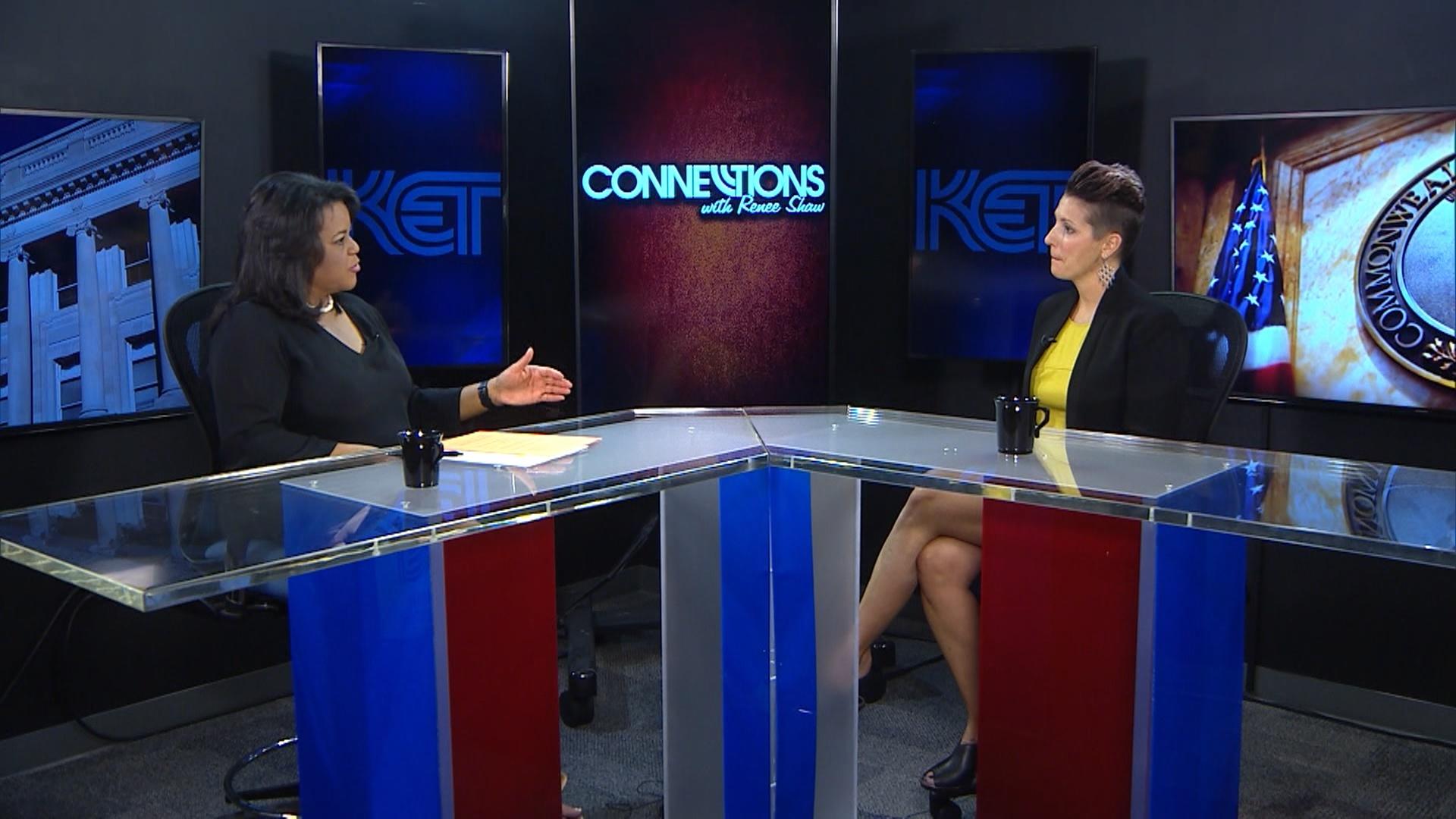
Renee's guest is Cherise Fanno Burdeen, CEO of the Pretrial Justice Institute (PJI). Burdeen talks about her organization's mission to reduce incarceration rates and their efforts to reform the bail system.
Season 13 Episode 34 Length 28:32 Premiere: 06/22/18

About

Connections

KET’s Connections features in-depth interviews with the influential, innovative and inspirational individuals who are shaping the path for Kentucky’s future.

From business leaders to entertainers to authors to celebrities, each week features an interesting and engaging guest covering a broad array of topics. Host Renee Shaw uses her extensive reporting experience to naturally blend casual conversation and hard-hitting questions to generate rich and full conversations about the issues impacting Kentucky and the world.


Tune-In

KET Sundays • 11:30 am/10:30 am
KET2 Sundays • 6/5 pm

Stream

Watch on KET’s website anytime or through the PBS Video App.

Podcast

The Connections podcast features each episode’s audio for listening.


Renee Shaw is the Director of Public Affairs and Moderator at KET, currently serving as host of KET’s weeknight public affairs program Kentucky Edition, the signature public policy discussion series Kentucky Tonight, the weekly interview series Connections, Election coverage and KET Forums.

Since 2001, Renee has been the producing force behind KET’s legislative coverage that has been recognized by the Kentucky Associated Press and the National Educational Telecommunications Association. Under her leadership, KET has expanded its portfolio of public affairs content to include a daily news and information program, Kentucky Supreme Court coverage, townhall-style forums, and multi-platform program initiatives around issues such as opioid addiction and youth mental health.  

Renee has also earned top awards from the Ohio Valley Chapter of the National Academy of Television Arts and Sciences (NATAS), with three regional Emmy awards. In 2023, she was inducted into the Silver Circle of the NATAS, one of the industry’s highest honors recognizing television professionals with distinguished service in broadcast journalism for 25 years or more.  

Already an inductee into the Kentucky Civil Rights Hall of Fame (2017), Renee expands her hall of fame status with induction into Western Kentucky University’s Hall of Distinguished Alumni in November of 2023.  

In February of 2023, Renee graced the front cover of Kentucky Living magazine with a centerfold story on her 25 years of service at KET and even longer commitment to public media journalism. 

In addition to honors from various educational, civic, and community organizations, Renee has earned top honors from the Associated Press and has twice been recognized by Mental Health America for her years-long dedication to examining issues of mental health and opioid addiction.  

In 2022, she was honored with Women Leading Kentucky’s Governor Martha Layne Collins Leadership Award recognizing her trailblazing path and inspiring dedication to elevating important issues across Kentucky.   

In 2018, she co-produced and moderated a 6-part series on youth mental health that was awarded first place in educational content by NETA, the National Educational Telecommunications Association. 

She has been honored by the AKA Beta Gamma Omega Chapter with a Coretta Scott King Spirit of Ivy Award; earned the state media award from the Kentucky Society of the Daughters of the American Revolution in 2019; named a Charles W. Anderson Laureate by the Kentucky Personnel Cabinet in 2019 honoring her significant contributions in addressing socio-economic issues; and was recognized as a “Kentucky Trailblazer” by the University of Kentucky Martin School of Public Policy and Administration during the Wendell H. Ford Lecture Series in 2019. That same year, Shaw was named by The Kentucky Gazette’s inaugural recognition of the 50 most notable women in Kentucky politics and government.  

Renee was bestowed the 2021 Berea College Service Award and was named “Unapologetic Woman of the Year” in 2021 by the Community Action Council.   

In 2015, she received the Green Dot Award for her coverage of domestic violence, sexual assault & human trafficking. In 2014, Renee was awarded the Anthony Lewis Media Award from the KY Department of Public Advocacy for her work on criminal justice reform. Two Kentucky governors, Republican Ernie Fletcher and Democrat Andy Beshear, have commissioned Renee as a Kentucky Colonel for noteworthy accomplishments and service to community, state, and nation.  

A former adjunct media writing professor at Georgetown College, Renee traveled to Cambodia in 2003 to help train emerging journalists on reporting on critical health issues as part of an exchange program at Western Kentucky University. And, she has enterprised stories for national media outlets, the PBS NewsHour and Public News Service.  

Shaw is a 2007 graduate of Leadership Kentucky, a board member of CASA of Lexington, and a longtime member of the Frankfort/Lexington Chapter of The Links Incorporated, an international, not-for-profit organization of women of color committed to volunteer service. She has served on the boards of the Kentucky Historical Society, Lexington Minority Business Expo, and the Board of Governors for the Ohio Valley Chapter of the National Academy of Television Arts and Sciences. 

Host Renee Shaw smiling in a green dress with a KET set behind her.

Reforming the Bail System and Other Criminal Justice Issues

Lawmakers in Kentucky and elsewhere around the nation are exploring a range of reforms that can decrease prison populations and correctional costs, reduce recidivism, and ensure public safety. Many of those efforts focus on what happens to an offender after they’ve been convicted.

But bail reform advocate Cherise Fanno Burdeen says important opportunities for reforming criminal justice come much earlier in the process.

“More people will serve time in pretrial detention in America than will ever serve time upon sentencing,” Burdeen says. “This is really where mass incarceration lives.”

Burdeen is CEO of the Pretrial Justice Institute, a Maryland-based non-profit organization that promotes evidence-informed policies that can eliminate race, gender, and social class disparities during the pretrial phase of criminal justice proceedings. She appeared on KET’s Connections to discuss how changes to America’s money bail system could dramatically reduce prison populations.

Some 30,000 people are arrested every day in America, according to Burdeen. She says only a fraction of those people face serious felony charges like rape, murder, or arson. About three-quarters of them are held on misdemeanor charges for low-level, nonviolent offenses such as property or drug crimes.

“Yet we process everyone almost exactly the same way from the shoplifter to the murderer,” she says.

When a person is arrested and booked into jail, the court will set bail conditions based on the crime allegedly committed. Burdeen says bail is a contract between the defendant and the courts that says he or she will abide by certain conditions before his or her trial. Money bond is just one kind of bail. In some cases the defendant must pay the full bond or some percentage of it to be released. In other cases, the defendant promises to pay the bail bond amount should they fail to return to court. In either situation, the Eighth Amendment to the U.S. Constitution precludes excessive bail amounts.

“What our forefathers actually meant by that was that the state has no right to impose upon you conditions that exceed what would be most likely to get you back into court,” Burdeen says.

The Problems with Money Bail
Advocates of money bail say it helps guarantee that a defendant will appear for their court date. But critics contend the system creates problems on both sides of the financial spectrum. Individuals who have the funds to make bail may be released even if they are charged with a serious or violent crime, whereas low-level offenders who are too poor to pay their bail may sit in jail for days, weeks, or months awaiting trail.

Those individuals have not been convicted of any crime, yet they are removed from their families, their communities, and their jobs. Burdeen says missing work for even a few days can have far-reaching consequences for most people.

“Loss of employment equals loss of income, and loss of income is destabilizing to homes and families,” she says. “I’ve heard way too many stories of people who have lost their ability to pay rent and been evicted from their homes while their loved one was incarcerated in a pretrial status.”

The irony is most charges are “probation presumptive,” says Burdeen, meaning the judge can release the defendant on probation after their court proceeding. So while they may have been incarcerated for days because they couldn’t afford their bail, the judge can release them and no more time will be served.

Burdeen questions why a person who is safe enough to be released after seeing a judge isn’t safe enough to release while they await their court date. She says that amounts to extracting punishment prior to a conviction.

Meanwhile, taxpayers are stuck with the bill to house individuals who ultimately receive probation or a not guilty verdict simply because they couldn’t afford bail. Burdeen says the current bail and incarceration system costs about $14 billion a year. She argues that this money that could be better used to fund health care, education, and job training for everyone, rather than to maintain a bail system that disproportionately incarcerates poor and minority individuals.

“This isn’t about eliminating bail,” Burdeen says. “What we’re working on is replacing financial conditions of release simply because they don’t work with conditions that we know can support people in the community and have it be more likely that they will come to court.”

Alternatives to Money Bail
Even a few days in jail can be traumatic for people beyond the potential of job loss.

“If you’re a high-risk individual [with] a history of violence, you’re unlikely to have been impacted by a few days or a few weeks in jail,” Burdeen says. “But if you come in as a low-risk individual, this is a setting which attaches itself to your psyche, and you will come out higher risk.”

Burdeen says imprisonment shouldn’t be used as a catch-all for anyone who misbehaves. Instead, she says jail should be reserved for people who truly deserve incarceration, while those with problems like an addiction should get diverted into programs specially designed for them.

“When we do come in contact with folks who have behavioral health needs, or are under-educated or under-employed, we have an opportunity to redirect them into other social service networks within our commonwealth that will produce better outcomes,” she says.

The Pretrial Justice Institute suggests a range of options for reducing pretrial prison stays, some of which Burdeen says have proven successful in the District of Columbia as well as in New Jersey and other states. These include:

– Move away from money bail. Burdeen says a judge in one court case found no credible evidence that a money bond works as incentive to get people to return for their court appearance. In fact, she says some research indicates people who promise to pay bail if they don’t return are just as likely to appear as those people who have to post bond to be released.

– Rewrite statutes to allow police to issue citations for certain low-level offenses instead of requiring that they take an offender into custody.

– Employ more data-driven pretrial assessments to help judges better determine the true flight or public safety risk of an offender and whether he or she may need drug or mental health treatment or other social services.

– Make procedural changes that will enable courts to process cases faster and ensure that detention is not used as a way to extract a plea bargain from a defendant.

Burdeen says making these kinds of reforms helped the state of New Jersey keep 125,000 people out of its criminal justice system last year. She says that enables law enforcement and the courts to focus their resources on protecting the public from truly dangerous criminals and on solving crimes.

“We can get detention in this country down to under 10 percent of those arrested,” Burdeen says. “That’s what we’re seeing in D.C. and New Jersey, and I’d love to see that here in Kentucky.”

Sponsored by:

Season 13 Episodes

Marcie Timmerman - Mental Health and Wellness

S13 E43 Length 28:03 Premiere Date 08/24/18

Tiffany Manuel - Affordable Housing

S13 E42 Length 27:32 Premiere Date 08/17/18

Jessica Dueñas - 2019 Kentucky Teacher of the Year

S13 E41 Length 28:52 Premiere Date 08/10/18

2018 KIDS COUNT Data Book

S13 E37 Length 28:48 Premiere Date 07/13/18

A New Task Force on Opioids

S13 E36 Length 28:07 Premiere Date 07/06/18

Shining a Spotlight on Epilepsy

S13 E35 Length 28:02 Premiere Date 06/29/18

Criminal Justice Reform

S13 E34 Length 28:32 Premiere Date 06/22/18

Jay Box - Kentucky Community and Technical College

S13 E33 Length 28:03 Premiere Date 06/15/18

Interim Kentucky Education Commissioner Wayne Lewis

S13 E32 Length 28:03 Premiere Date 06/08/18

Bob King - Kentucky Council on Postsecondary Education

S13 E31 Length 28:09 Premiere Date 06/01/18

Rachel Childress - Lexington Habitat for Humanity

S13 E30 Length 26:22 Premiere Date 05/25/18

2018 Kentucky Primary Races

S13 E29 Length 29:52 Premiere Date 05/18/18

Dr. Donna Grigsby

S13 E28 Length 28:03 Premiere Date 05/11/18

Sexual Assault Awareness and Prevention

S13 E27 Length 28:02 Premiere Date 05/04/18

Kosair Charities Face It Movement; Terry Brooks

S13 E25 Length 28:27 Premiere Date 04/20/18

Child Marriage Laws in Kentucky - Donna Pollard

S13 E24 Length 28:42 Premiere Date 04/13/18

Remembering Dr. Martin Luther King, Jr.

S13 E23 Length 29:22 Premiere Date 04/06/18

Secretary Derrick Ramsey - Apprenticeships

S13 E22 Length 28:09 Premiere Date 02/23/18

Educational Innovation

S13 E21 Length 28:45 Premiere Date 02/16/18

Gerald Smith

S13 E20 Length 28:12 Premiere Date 02/09/18

Perry Bacon Jr.

S13 E18 Length 28:02 Premiere Date 02/02/18

DV8 Kitchen

S13 E17 Length 28:37 Premiere Date 01/19/18

Silas House, New Novel

S13 E16 Length 28:03 Premiere Date 01/16/18

Tawanda Owsley

S13 E15 Length 26:32 Premiere Date 01/05/18

Sexual Harassment Issues

S13 E14 Length 28:37 Premiere Date 12/15/17

Disability Rates and Benefits

S13 E13 Length 27:27 Premiere Date 12/08/17

Good Samaritans

S13 E12 Length 28:42 Premiere Date 11/17/17

A Salute to Heroes

S13 E10 Length 26:18 Premiere Date 11/10/17

Legislative Health Policy

S13 E9 Length 28:12 Premiere Date 11/03/17

Elder Care

S13 E8 Length 29:31 Premiere Date 10/27/17

Preventing Youth Suicide

S13 E7 Length 28:17 Premiere Date 10/20/17

A Proposal for Pension Reform

S13 E6 Length 28:02 Premiere Date 10/13/17

Rethinking Pain Medication

S13 E5 Length 28:02 Premiere Date 10/06/17

Former Gov. Steve Beshear

S13 E4 Length 28:53 Premiere Date 09/29/17

Secretary Elaine Chao

S13 E3 Length 28:52 Premiere Date 09/22/17

Smoking Cessation and Pregnancy

S13 E2 Length 29:32 Premiere Date 09/08/17

Author and Journalist Sam Quinones

S13 E1 Length 28:52 Premiere Date 09/01/17

Author and Journalist Sam Quinones

Preview Length 28:52 Premiere Date 09/01/17

See All Episodes

caret down

TV Schedules

Upcoming

No upcoming airdates

Recent

No recent airdates

Explore KET