Skip to Main Content

Diversity, Equity and Inclusion (DEI) in Higher Education

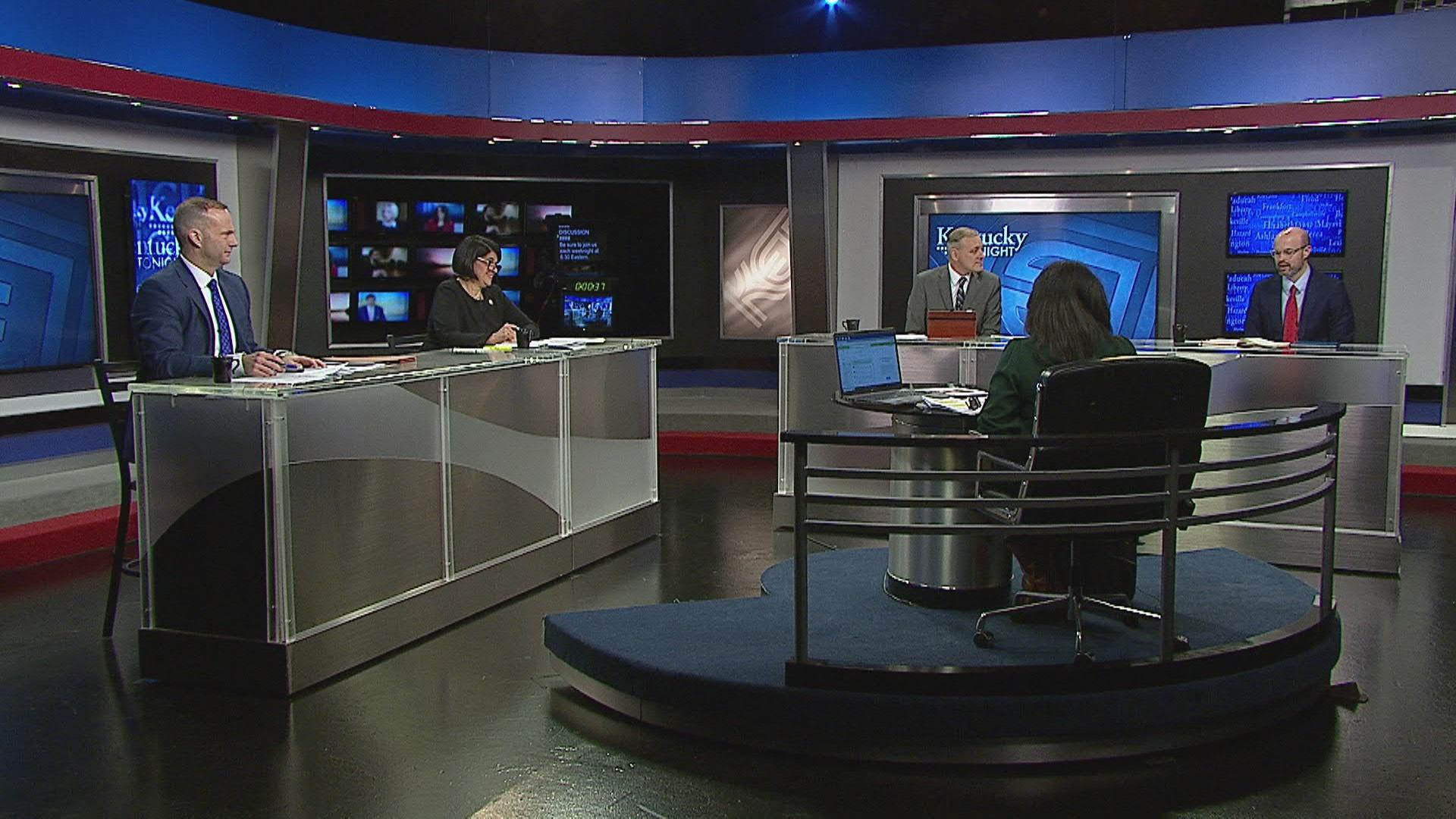
Renee Shaw and guests discuss Diversity, Equity and Inclusion (DEI) at Kentucky colleges and universities. Guests include: Richard Nelson from the Commonwealth Policy Center; State Rep.Tina Bojanowski (D-Louisville); Travis Powell from the Kentucky Council on Postsecondary Education; and State Sen. Mike Wilson (R-Bowling Green), Senate Majority Whip (pre-recorded).
Season 30 Episode 37 Length 56:34 Premiere: 01/29/24

About

Kentucky Tonight

KET’s Kentucky Tonight brings together an expert panel for in-depth analysis of major issues facing the Commonwealth.

This weekly program features moderated comprehensive discussions with lawmakers, stakeholders and policy leaders.

For nearly three decades, Kentucky Tonight has been a source for complete and balanced coverage of the most urgent and important public affairs developments in the state of Kentucky.

Often aired live, viewers are encouraged to participate by submitting questions in real-time via email, Twitter or KET’s online form. Viewers with questions and comments may send an email to kytonight@ket.org or use the contact form. All messages should include first and last name and town or county. The phone number for viewer calls during the program is 800-494-7605.

After the broadcast, Kentucky Tonight programs are available on KET.org and via podcast (iTunes or Android). Files are normally accessible within 24 hours after the television broadcast.

Kentucky Tonight was awarded a 1997 regional Emmy by the Ohio Valley Chapter of the National Academy of Television Arts and Sciences. The series was also honored with a 1995 regional Emmy nomination.

To purchase a DVD:
Call 800-945-9167 or email shop@ket.org.


A simple blue illustration of a communication tower

Tune-In

KET Mondays • 8/7 pm

A simple blue illustration of a monitor

Stream

Watch on KET’s website anytime or through the PBS Video App.

A simple blue illustration of headphones

Podcast

The Kentucky Tonight podcast features each episode’s audio for listening.


Panelists Debate the Merits of Two Bills Addressing University Programs That Are Under Consideration in the General Assembly

Is it divisive to discuss the Holocaust, oppression of women, or slavery? Should special programs exist to help certain groups of university students succeed academically? Are the views evangelical Christians or political conservatives welcomed in college classrooms?

These are some of the issues that two bills before the 2024 General Assembly seek to address. House Bill 9 and Senate Bill 6 focus on diversity, equity, and inclusion at state colleges and universities. Often known by the initials DEI, these initiatives are meant to address historic or systemic inequities in American education and places of work. But critics contend such efforts stifle free speech, perpetuate divisions among people, and foster the kinds of discrimination they were designed to end.

House Bill 9

House Bill 9 would prohibit public institutions of higher education in Kentucky from spending money on DEI programs, teaching or training on so-called discriminatory concepts, investigating allegations of bias, or providing differential treatment based on a person’s race, religion, sex, or national origin.

Rep. Jennifer Decker (R-Waddy), primary sponsor of the legislation, contends DEI efforts have failed to make college campuses more diverse or accessible. She says since the start of DEI programming in postsecondary education in 2011, college enrollment in Kentucky has dropped by 39,000 students, over half of which she says are low-income Black students. Since federal law already prevents discriminatory practices in public education, Decker says that makes DEI offices on college campuses unnecessary.

“They are superfluous and they need to end,” says Decker. “We cannot continue to fund those offices when the data shows they have not helped.”

While HB 9 is meant to stop practices that are discriminatory or unconstitutional, Decker says academic freedom would not be impeded. For example, she says discussions about the historical dynamic of white privilege should occur.

“What is prohibited is the thought that every instance... of white privilege is to be taken as true, not debated, not discussed, and that it persists today,” says Decker. “We want open, honest debate with good will.”

The current version of HB 9, which has not yet been heard by the House Education Committee, gives the state attorney general the power to order schools to comply with the legislation if passed. Injured individuals would be able to file a civil action against a school or the Council on Postsecondary Education for noncompliance.

Critics of DEI initiatives applaud the goals of fighting racism and bigotry but contend the implementation of these programs has resulted in division, exclusion, and indoctrination.

“They’re lofty ideals,” says Andrew Walker, associate professor of Christian ethics and public theology at the Southern Baptist Theological Seminary in Louisville. “But in practice, DEI is something that is far more nefarious, insidious. It’s a trojan horse for very, very progressive ideology.”

Dissenting from that ideology, according to Walker, can have negative repercussions for a student, staff, or faculty member, from being socially excluded to losing out on job opportunities.

Forcing students or employees to adhere to a belief or ideology is not part of any policy mandated by CPE or any individual institution, says Travis Powell, vice president of the council. He says CPE is proud of its DEI policies, which he says broadly define diversity and require schools to provide a safe, supportive, and nurturing environment that honors and respects human differences.

“We’re really talking about all different types of diversity: LGBTQ students, religious diversity, geographic diversity, all the things that make us who we are,” says Powell, “which just makes a more interesting and inviting student body and one where everybody can learn from each other.”

Powell also disputes that DEI has caused higher ed enrollments to decline. He says enrollments across the board dropped in 2011 as the economy improved and students left school to go to work. But since then, he says retention and graduation rates have substantially increased for low-income and under-represented student populations. He says DEI offices and initiatives help those students succeed and close achievement gaps. Should the legislation pass, he fears what might happen to services that help Black males acclimate to college life, efforts to get more women into engineering degree tracks, or campus food banks that serve low-income students.

“If you get rid of what we call DEI, I would be very afraid that students would not be able to get the supports they need in order to be successful,” says Powell.

Senate Bill 6

Senate Bill 6 is a much shorter measure (9 pages compared to 33 for HB 6) which does not call for shuttering DEI offices and programs, but instead prohibits the teaching or training of 16 divisive concepts. These include:

• that a person’s sex or race is inherently superior or inferior to others,

• that one’s race or gender makes them inherently privileged or oppressed, or determines their moral character,

• that an individual should feel guilt or discomfort solely because of their race or sex,

• that the state and nation are irredeemably racist or sexist,

• and that all Americans are not created equal or have unalienable rights.

Primary sponsor Sen. Mike Wilson, a Bowling Green Republican, says he’s heard from state university staff and students who have been denied opportunities for opposing DEI. He says his legislation would not infringe on academic freedom or prevent teaching about thorny historical subjects such as slavery.

“I don’t think it’s an anti-DEI measure because it doesn’t do away with DEI offices or DEI training,” says Wilson. “I think that students want freedom of speech. I think this is something that preserves that.”

SB 9 also allows for claims to be brought against schools for violation of the proposed provisions, which could result in awards of between $1,000 and $100,000. Powell says waiving a school’s sovereign immunity would unleash a range of problems from higher liability insurance costs to having to pay steep legal fees to defend cases they ultimately win.

Rep. Tina Bojanowski (D-Louisville), who is an elementary school teacher, says the fact that a school or professor could be sued will hinder academic freedom. She contends there are some subjects like the Holocaust or treatment of Native Americans that should make people uncomfortable, which she says is different than feeling guilty or personally responsible. She says SB 6, which is awaiting a committee hearing, is “less dangerous” than HB 9, but she fears both measures would be detrimental.

“This legislation will have a chilling effect on administrations’ efforts to support minorities, women, LGBTQ students, faculty on campuses,” says Bojanowski. “Conservative (broadsides) on DEI attack the free-speech rights of students, faculty, and administrators who might want to engage in conversations about identity or race.”

DEI opponents say another flaw in these efforts is how they attempt to diminish achievement by individual students. Richard Nelson, founder and executive director of the Commonwealth Policy Center, says equity as practiced by DEI offices and academic programs aims to ensure equal outcomes for all students, which he believes is unjust. Rep. Bojanowski disagrees, saying that the concept of equity in these programs is about equal opportunity, not equal results.

Nelson also argues that DEI mandates end up silencing political and religious conservatives. He says public universities should be open to all people regardless of their beliefs, and a student’s grades or a professor’s tenure shouldn’t hinge on whether they adhere to any specific points of view, nor should they be made to feel guilty about some historical event.

“We should be practicing academic freedom, ideological neutrality, and viewpoint diversity,” says Nelson. “These DEI bills and DEI offices do no such thing.”

Sponsored by:

Yellow and blue background with white state of Kentucky. Text reads Kentucky's Only Statewide Broadcasting NetworkYellow and blue background with white state of Kentucky. Text reads Kentucky's Only Statewide Broadcasting Network

Season 30 Episodes

Final Negotiations on the State Budget

S30 E43 Length 56:33 Premiere Date 03/25/24

School Safety

S30 E42 Length 56:33 Premiere Date 03/11/24

Early Childhood Education

S30 E41 Length 56:33 Premiere Date 02/26/24

Abortion Legislation

S30 E40 Length 56:33 Premiere Date 02/19/24

School Choice and Education Issues

S30 E39 Length 56:33 Premiere Date 02/12/24

State Budget Discussion

S30 E38 Length 56:33 Premiere Date 02/05/24

Diversity, Equity and Inclusion (DEI) in Higher Education

S30 E37 Length 56:34 Premiere Date 01/29/24

Safer Kentucky Act

S30 E36 Length 56:33 Premiere Date 01/22/24

Legislative Priorities in the 2024 General Assembly

S30 E35 Length 56:34 Premiere Date 01/08/24

Governor Andy Beshear's Budget Address

S30 E34 Length 56:36 Premiere Date 12/18/23

2024 Legislative Preview: Part Two

S30 E33 Length 56:35 Premiere Date 12/04/23

2024 Legislative Preview

S30 E32 Length 56:35 Premiere Date 11/20/23

Analysts Discuss What to Expect on Election Day 2023

S30 E31 Length 56:33 Premiere Date 11/06/23

Candidate Conversations: Lieutenant Governor

S30 E30 Length 56:33 Premiere Date 10/30/23

Candidate Conversations: Governor

S30 E29 Length 56:33 Premiere Date 10/23/23

Political Analysts Forecast the 2023 General Election

S30 E28 Length 56:33 Premiere Date 10/17/23

Secretary of State; Commissioner of Agriculture

S30 E27 Length 56:33 Premiere Date 10/09/23

Auditor of Public Accounts; State Treasurer

S30 E26 Length 56:33 Premiere Date 10/02/23

Kentucky's Economy, Jobs and Taxes

S30 E25 Length 56:33 Premiere Date 09/25/23

Higher Education in Kentucky

S30 E24 Length 56:33 Premiere Date 09/18/23

Kentucky's Health Care Challenges

S30 E23 Length 56:33 Premiere Date 09/11/23

Education Issues in Kentucky

S30 E22 Length 56:33 Premiere Date 08/21/23

Fancy Farm Preview and Kentucky Politics

S30 E21 Length 56:33 Premiere Date 07/31/23

Kentucky's Energy Needs

S30 E20 Length 56:35 Premiere Date 07/17/23

Artificial Intelligence

S30 E19 Length 56:35 Premiere Date 07/10/23

Jobs, Inflation and the Economy

S30 E18 Length 56:34 Premiere Date 06/26/23

SB 150 and LGBTQ Issues

S30 E17 Length 56:33 Premiere Date 06/19/23

Horse Racing Safety

S30 E16 Length 56:35 Premiere Date 06/12/23

A Discussion of Gun Laws

S30 E15 Length 56:34 Premiere Date 06/05/23

Recapping The 2023 Kentucky Primary

S30 E14 Length 56:33 Premiere Date 05/22/23

2023 Primary Election Preview

S30 E13 Length 56:34 Premiere Date 05/15/23

Republican Candidate for Secretary of State

S30 E12 Length 15:00 Premiere Date 05/08/23

Republican Candidates for Governor

S30 E11 Length 1:29:20 Premiere Date 05/01/23

Candidates for Treasurer and Commissioner of Agriculture

S30 E10 Length 1:15:06 Premiere Date 04/24/23

Challenges Facing Kentucky Schools

S30 E9 Length 56:35 Premiere Date 04/17/23

Policy Analysts Recap the 2023 General Assembly

S30 E8 Length 56:34 Premiere Date 04/10/23

Recap of the 2023 Kentucky General Assembly

S30 E7 Length 56:35 Premiere Date 04/03/23

Kentucky Legislation on LGBTQ+ Youth

S30 E6 Length 56:35 Premiere Date 03/20/23

Student Discipline Legislation

S30 E5 Length 56:33 Premiere Date 03/13/23

Gambling Proposals in the Kentucky General Assembly

S30 E4 Length 56:34 Premiere Date 02/27/23

Kentucky's Teacher Shortage

S30 E3 Length 56:33 Premiere Date 02/20/23

Exploring Local Government Issues

S30 E2 Length 56:35 Premiere Date 02/13/23

Child Abuse and Neglect in Kentucky

S30 E1 Length 56:34 Premiere Date 02/06/23

See All Episodes

caret down

TV Schedules

Jump to Recent Airdates

Upcoming

Kentucky Tonight - S33 E4

  • Monday August 24, 2026 8:00 pm ET on KET
  • Monday August 24, 2026 7:00 pm CT on KET
  • Tuesday August 25, 2026 8:00 am ET on KETKY
  • Tuesday August 25, 2026 7:00 am CT on KETKY
  • Tuesday August 25, 2026 1:00 pm ET on KETKY
  • Tuesday August 25, 2026 12:00 pm CT on KETKY
  • Tuesday August 25, 2026 8:30 pm ET on KETKY
  • Tuesday August 25, 2026 7:30 pm CT on KETKY
  • Wednesday August 26, 2026 1:00 am ET on KET
  • Wednesday August 26, 2026 12:00 am CT on KET

Kentucky Tonight - S33 E5

  • Monday August 31, 2026 8:00 pm ET on KET
  • Monday August 31, 2026 7:00 pm CT on KET
  • Tuesday September 1, 2026 8:00 am ET on KETKY
  • Tuesday September 1, 2026 7:00 am CT on KETKY
  • Tuesday September 1, 2026 1:00 pm ET on KETKY
  • Tuesday September 1, 2026 12:00 pm CT on KETKY
  • Tuesday September 1, 2026 8:30 pm ET on KETKY
  • Tuesday September 1, 2026 7:30 pm CT on KETKY
  • Wednesday September 2, 2026 1:00 am ET on KET
  • Wednesday September 2, 2026 12:00 am CT on KET
Jump to Upcoming Airdates

Recent

National and State Politics - S33 E3

  • Wednesday July 29, 2026 1:00 am ET on KET
  • Wednesday July 29, 2026 12:00 am CT on KET
  • Tuesday July 28, 2026 8:30 pm ET on KETKY
  • Tuesday July 28, 2026 7:30 pm CT on KETKY
  • Tuesday July 28, 2026 1:00 pm ET on KETKY
  • Tuesday July 28, 2026 12:00 pm CT on KETKY
  • Tuesday July 28, 2026 8:00 am ET on KETKY
  • Tuesday July 28, 2026 7:00 am CT on KETKY
  • Monday July 27, 2026 8:00 pm ET on KET
  • Monday July 27, 2026 7:00 pm CT on KET

Data Centers - S33 E2

  • Wednesday July 22, 2026 1:00 am ET on KET
  • Wednesday July 22, 2026 12:00 am CT on KET
  • Tuesday July 21, 2026 8:30 pm ET on KETKY
  • Tuesday July 21, 2026 7:30 pm CT on KETKY
  • Tuesday July 21, 2026 1:00 pm ET on KETKY
  • Tuesday July 21, 2026 12:00 pm CT on KETKY
  • Tuesday July 21, 2026 8:00 am ET on KETKY
  • Tuesday July 21, 2026 7:00 am CT on KETKY
  • Monday July 20, 2026 8:00 pm ET on KET
  • Monday July 20, 2026 7:00 pm CT on KET
Top

Contact

Explore KET