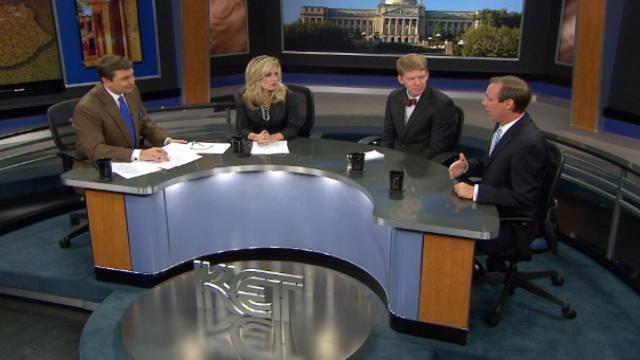


High-profile political visitors and outside money highlighted the discussion of the U.S. Senate race on this weekend’s Comment on Kentucky. With less than a month until Election Day, the pace is quickening in the contest between incumbent Sen. Mitch McConnell and Democratic challenger Alison Lundergan Grimes.
Sam Youngman of the Lexington Herald-Leader reports that the Democratic Senatorial Campaign Committee (DSCC) will spend more than $1 million on ad buys on behalf of Kentucky Secretary of State Grimes. (The national group had already spent $500,000 on the Kentucky race.) That’s not a huge investment, according to Youngman, but he notes that the DSCC has a number of other candidates around the country it also has to support.
That extra infusion of cash comes at a time when polls show McConnell building a lead on the Democrat. That has led some in the national press to shift their focus to other Senate races. But Youngman warns that they shouldn’t write off the Kentucky contest yet, especially with the first – and likely only – debate coming next week. Youngman contends candidates don’t win an election based on a debate performance, but they can lose one. He says the meeting on KET’s Kentucky Tonight will be the first time many voters in the state will be able to get to know Grimes.
Meanwhile Republicans touted a high-profile visitor last week as 2012 presidential nominee Mitt Romney appeared at a private Lexington fundraiser with McConnell. Although Romney formally endorsed the incumbent, McConnell was more focused on President Obama, saying this year’s elections are about defeating the president’s policies.
McConnell spoke in Louisville the next day at a rally for home health care providers. Adam Beam of the Associated Press reports the senator highlighted cuts the Affordable Care Act makes to home health service companies: about 14 percent over the next three years. Beam says McConnell argued the reduced funding will make it harder for senior citizens who use the services to remain in their homes.
Finally, the Grimes camp announced that Hillary Clinton will visit the state later this month to campaign with Grimes. Beam says that’s part of Grimes’ strategy to distance herself from Obama by saying she is a Clinton Democrat.
Court Cases Could Affect Senate Race
Today a federal judge is scheduled to review a lawsuit filed by third-party Senate candidate David Patterson against Kentucky Educational Television. Patterson, who is on the ballot as the Libertarian candidate, claims KET created criteria designed to exclude him from its U.S. Senate debate. For his case to be successful, Adam Beam says Patterson must prove KET sought to intentionally bar him from participating.
If the judge rules in Patterson’s favor and forces KET to include him in the program, Beam says the entire dynamic for next Monday’s debate will be changed, as McConnell and Grimes would have to share their time with Patterson.
Also in court, U.S. District Judge William O. Bertelsman of Covington will hear a case challenging Kentucky’s law prohibiting campaign signs and politicking at polling places. Host Bill Bryant says the current rule mandates a 300-foot buffer zone around voting sites. He warns that a decision in this First Amendment case could greatly change the voting experience if candidates are allowed to have representatives stationed at polling locations.
A Little-Known Cost of Drug Addiction
As Kentucky law enforcement officials continue to battle the flow of heroin and other narcotics through the state, local hospitals face a unique challenge of caring for drug-addicted infants.
Miranda Combs of WKYT-TV in Lexington reports that her recent investigation of the problem revealed more than 950 cases of neonatal abstinence syndrome in Kentucky last year. That condition occurs when babies are exposed to opiates or narcotics while in the mother’s womb. She says the number of cases of the syndrome has increased 20-fold over the last 13 years.
Combs explains that even if pregnant mothers go through a detox program, their children may still be born with symptoms of addiction. Infants that require detoxification may spend as much as two weeks in intensive care. She says since many of the mothers and children are on Medicaid, the state ends up with the detox bills, which amounted to some $40 million in 2012.
In another investigation, Combs traced the source of much of the heroin sold in the state to the infamous Eight Mile neighborhood of Detroit. As local police have cracked down on the heroin trade there, traffickers have simply moved their distribution farther down Interstate 75, according to Combs.
School Supplies and Empty Classrooms
Public school officials celebrated a new round of test scores released last week that showed improved student performance in reading, math, and college and career readiness. But problems still loom in some classrooms around the state.
Miranda Combs says that as many as 350 Kentucky teachers have turned to crowd-sourced funding to buy supplies for their students. She explains that the instructors solicit money on the DonorsChoose website, which supports education-related projects. When faced with insufficient school budgets, Combs says a source tells her that teachers may spend as much as $1,000 of their own money to purchase supplies for the classrooms.
Adam Beam reports on a very different kind of problem in eastern Kentucky school districts: not enough students. As population in some counties dwindles, Beam says local schools are left with less state funding and unused classroom space. He cites the example of Shelby Valley High School in Pike County, which was built for 1,000 students. Now the school has fewer than 600 students, and the principal there is struggling to find good uses for the classrooms he no longer needs. Beam says one room in the school has been converted to an indoor air-rifle range for ROTC students.
–The opinions expressed on Comment on Kentucky and in this program synopsis are the responsibility of the participants and do not necessarily reflect those of KET.