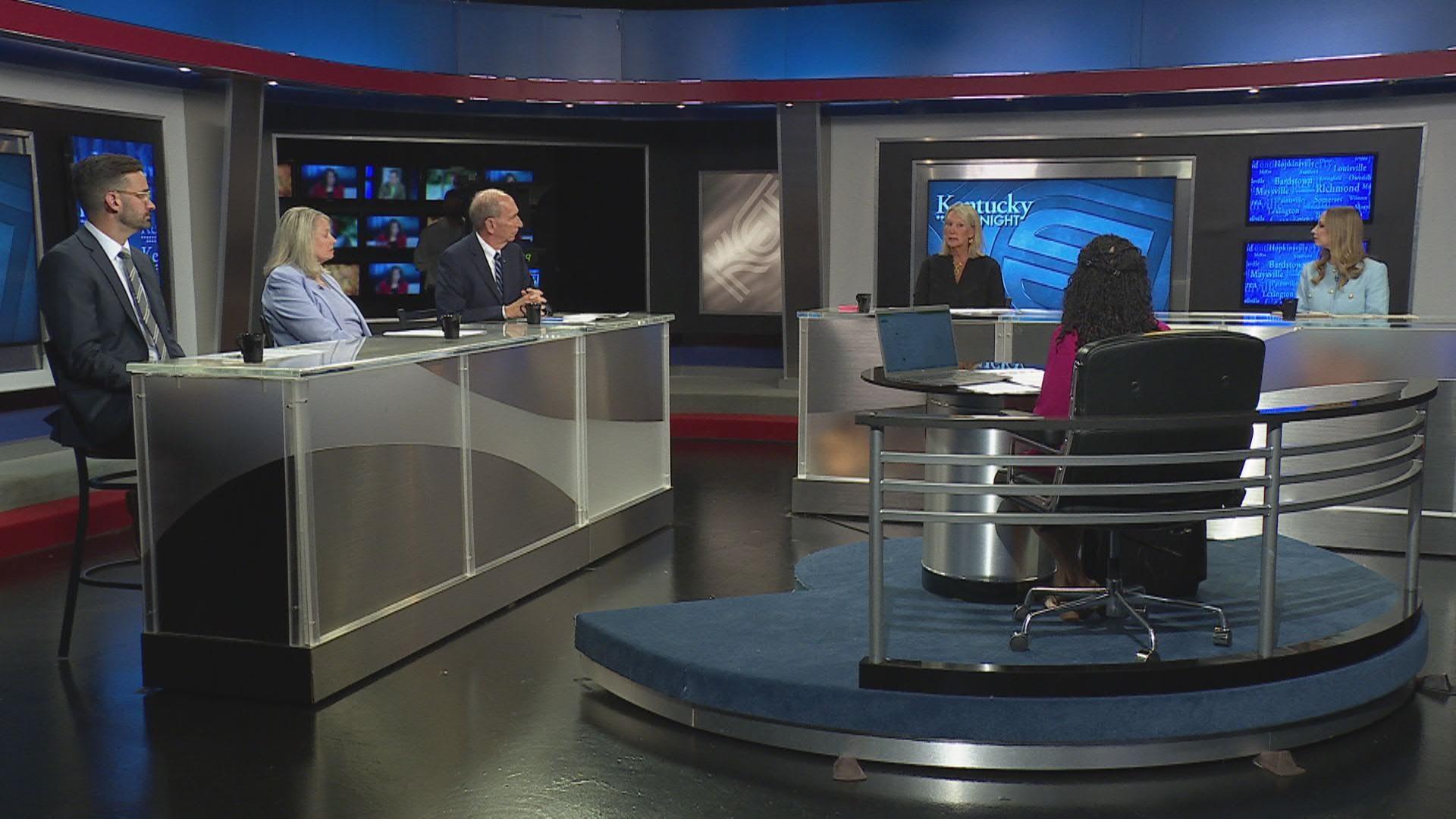
The One Big Beautiful Bill Act (OBBA), President Trump’s 900-page budget reconciliation measure signed into law last week, will reduce federal Medicaid spending by an estimated $1 trillion over the next decade. It also implements a work requirement and new paperwork mandates for certain beneficiaries in the program.
The president, who has repeatedly pledged he wouldn’t cut Medicaid, says the changes will eliminate “waste, fraud, and abuse” in the system, strip benefits from illegal immigrants who shouldn’t be covered, and strengthen the program for those who most need its health coverage.
But the Congressional Budget Office estimates that up to 12 million Americans could end up losing coverage because of the changes. Others fear OBBA cuts will also imperil hundreds of hospitals dependent on Medicaid payments to survive.
Gov. Andy Beshear, a Democrat, says the impacts of OBBA will be devastating for Kentucky, where nearly of third of residents are on Medicaid. He contends 200,000 Kentuckians will lose coverage, up to 25 rural hospitals will close, and 20,000 health care workers will lose their jobs.
“It’s the single worst piece of legislation I’ve seen in my lifetime,” says Beshear. “It is a Congressional Republican and presidential attack on rural America.”
The cuts to Medicaid could have been much worse, according to Mark Birdwhistell, senior vice president for health and public policy at the University of Kentucky. He says Congress could have established lump-sum Medicaid payments to states or set a fixed amount of Medicaid funding per enrollee, both of which would’ve placed greater financial burdens on states. But those changes did not make it into the final legislation.
“What came out is a bill that gives a priority on what Medicaid was intended to do: Take care of women and young children, elderly folks, and those with disabilities,” says Birdwhistell.
OBBA changes impacting Medicaid beneficiaries don’t take effect until after the 2026 mid-term elections. Provisions on hospitals begin in 2028. State Sen. Julie Raque Adams (R-Louisville), who is co-chair of the legislature’s new Medicaid Oversight and Advisory Board (MOAB), says that delay will enable lawmakers and state officials to prepare for how to best implement the changes.
“Kentucky has time to come up with really thoughtful and creative solutions to make sure that we don’t lose that coverage that’s really vital… but it also has to have some component of sustainability for the program,” says Adams. “Republicans are trying to make sure that we run an efficient program that has better health outcomes than we have right now.”
Ahead of the 2026 General Assembly session, Adams says MOAB will work closely with the Kentucky Cabinet for Health and Family Services to learn how state Medicaid money is spent, where cost-savings could occur, and what areas need to be boosted or reduced.
Changes for Kentuckians
Under OBBA, able-bodied adults with no children who enrolled as part of Medicaid expansion will be required to work, go to school, or volunteer in their communities for 80 hours a month. People in that Medicaid group will also have to recertify their eligibility to be in the program every six months instead of annually.
Dustin Pugel, policy director at the Kentucky Center for Economic Policy, says Georgia and Arkansas have tried work requirements with mixed results. He says the challenge for people on Medicaid isn’t so much the work requirement since most people in the program already work. He says the issue is the additional paperwork that enrollees will have to complete.
“What we know about these requirements... is that they are really ineffective at increasing employment, they’re really ineffective at increasing wages, and they’re really ineffective at reducing poverty,” says Pugel. “But (what) they’re very effective at is tripping people up with red tape.”
The fear, he says, is that individuals who meet all the requirements could still lose coverage simply because they failed to correctly file their paperwork. Those individuals would then have to reapply for Medicaid coverage, which Pugel says is an onerous process, or go without any health coverage.
Adams says that shouldn’t be allowed to happen.
“Nobody should be cut off because of a paperwork error,” says the senator. “These are things that administratively we can take a hard look at and fix so that we don’t have those people that are falling through the cracks because that’s not fair.”
The extra documentation isn’t just a problem for enrollees. Anne-Tyler Morgan, health care law attorney with McBrayer PLLC in Lexington, says it’s also a challenge for the state Department for Medicaid Services, which will have to process all that new paperwork.
“I would argue that current Department for Medicaid Services staff is under-resourced in their ability to do that, and so there will need to be capacity added,” says Morgan.
She says that could include hiring more staff or upgrading technology to better handle the increased workload. Morgan says there will also be new opportunities for private companies that assist people with the process of enrolling in Medicaid and completing the routine eligibility paperwork.
As for people who are forced off of Medicaid, Morgan says the state should plan now for how to best help those individuals find coverage.
“Time is of the essence in insuring that proactive steps are taken to make sure that there’s actually somewhere for beneficiaries to go if they are indeed to lose coverage,” says Morgan. “It would be very pie in the sky to think that suddenly because people are disenrolled they are suddenly in a commercially insured environment, healthier than they are now.”
Challenges for Kentucky Hospitals
With about 1.4 million Kentuckians on Medicaid, many of the state’s hospitals and other health care providers depend on Medicaid payments to maintain staffing, facilities, and services. Even so, federal reimbursements only cover about 80 percent of what it actually costs to treat Medicaid patients, according to Kentucky Hospital Association President Nancy Galvagni.
KHA opposed the Senate version of OBBA because it made deeper cuts to Medicaid than the House version did. Galvagni says the association supported the House approach, which U.S. Rep. Brett Guthrie (KY-2) helped craft. She says the Bowling Green Republican understands the importance of Medicaid payments to the state’s hospitals.
“Congressman Guthrie was given a tall task to reach certain savings within Medicaid, but he did it with a scalpel, not sledgehammer because he protected our Kentucky hospitals,” says Galvagni. “We felt like he had a good balance and he understood the need to preserve health care in our state.”
In addition to tightening controls on who gets Medicaid, the Senate version of the bill also limits the use of state taxes on health care providers to increase the federal Medicaid matching money that states receive. Less Medicaid funding going to states will trickle down to less money for hospitals that rely on those revenues.
Galvagni says the Senate version of OBBA will end up cutting Medicaid payments to Kentucky hospitals by 90 percent. She says stabilization money plus some limited discretionary funding included in the bill won’t be enough to make up for the lost revenues.
“Through the program that we had in place, our rural hospitals were getting about $1 billion,” she says. “So $100 million is not going cut it.”
Faced with such a significant financial hit, Galvagni says hospital executives are already considering cuts to staffing and services like maternity care or emergency rooms. She says such reductions as well as outright hospital closures would hurt everyone in those communities, not just those on Medicaid.
If that occurs, Birdwhistell says UK HealthCare stands ready to help fill the gaps for rural communities.
“We can send physicians to remote locations so that people can get care close to home,” says Birdwhistell. “We’re looking at creative, outside-the-box solutions to bolster-up the community hospital system so that people can get the right care at the right time at the right place.”