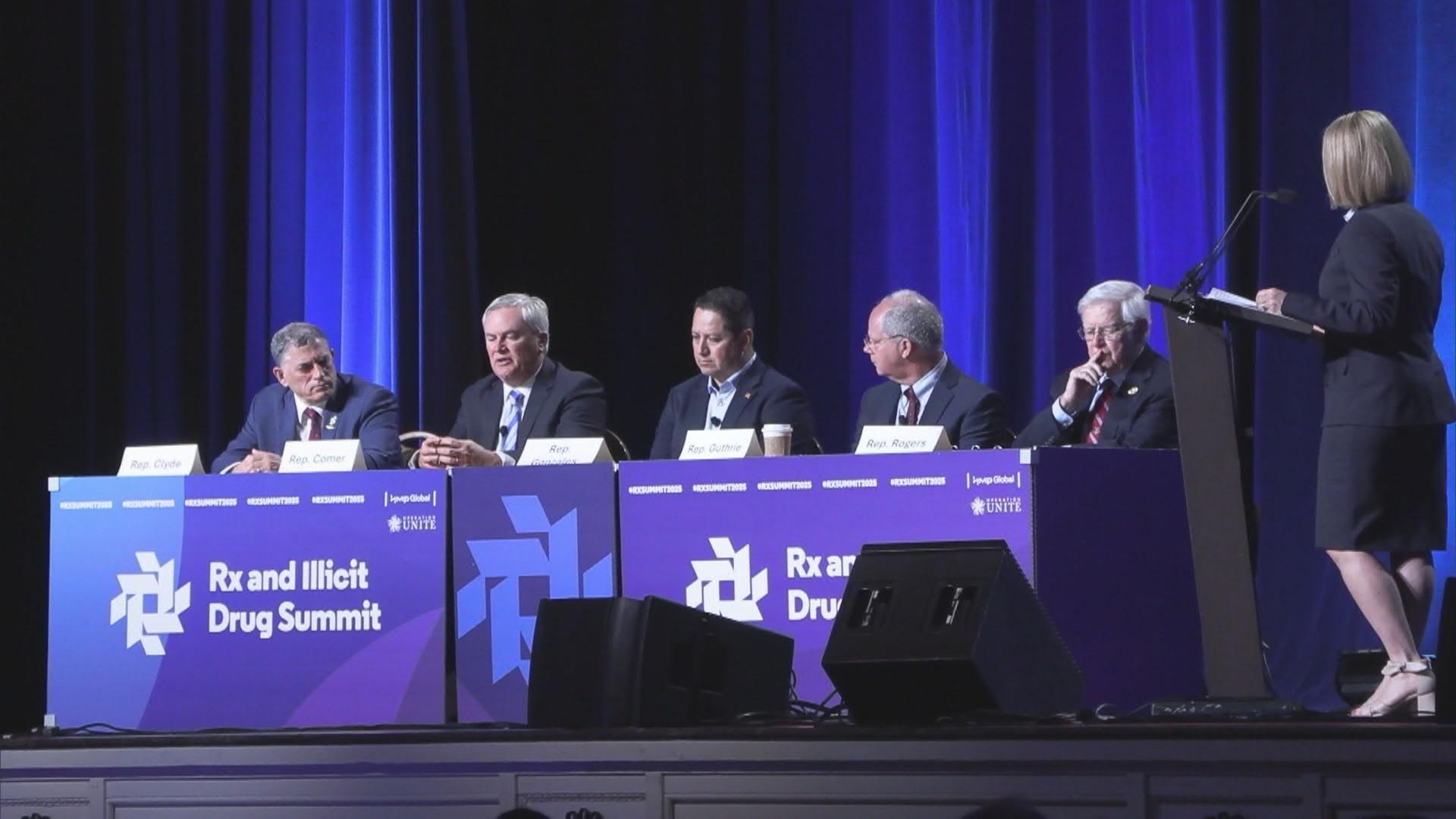
The name of the conference has evolved over the years, but the mission of what is now known as the Rx and Illicit Drug Summit is the same: To bring law enforcement, government officials, medical professionals, treatment providers, and the research community together to exchange ideas on how to address the nation’s drug crisis.
This year marked the 14th gathering that was the brainchild of Congressman Hal Rogers (KY-5) and his Operation UNITE, the group he founded more than two decades ago to help rid communities in his southeastern Kentucky district of illegal drug use. (UNITE stands for unlawful narcotics investigations, treatment, and education.) What started as a modest regional conference has grown into one of the largest such meetings in the nation.
“I did not anticipate the explosion in the numbers of people,” says Rogers. “We’re seeing people come here that’s never been to something like this before… There’s enthusiasm, there’s love of life, and there’s people ready to go to work.”
More than 3,000 people attended the 2025 summit in late April in Nashville to hear speakers ranging from U.S. Attorney General Pam Bondi to Health and Human Services Secretary Robert F. Kennedy Jr. as well as treatment clinic operators, people in recovery, and others.
“We ask our speakers to identify what’s working in their communities, what evidence do they have that it’s working, and how can those efforts be replicated,” says Doug Edwards of the HMP Global Psychiatry and Behavioral Health Learning Network, which now organizes the summit.
When she first started covering the conference several years ago, Wall Street Journal health and medicine reporter Julie Wernau says the focus was more on heroin use. Now the discussions largely center around fentanyl use, especially fentanyl mixed with other drugs like the veterinary sedative xylazine, which goes by the street name tranq. She says a crucial part of the conference is the open exchange of ideas among people working on different parts of the nation’s addiction crisis.
“There’s public health officials, they’ve seen something in their community, they’re not really sure who to go to about it... Maybe they’re trying to get fentanyl test strips... or maybe they want to understand how to stop this cycle of recidivism inside their jail, and they learn something here and then take that back to their community,” says Wernau. “It’s a very analog way ... of spreading information that still works.”
Federal Funding for Drug Enforcement and Treatment
Attendees heard some good news to start this year’s gathering: Opioid overdose deaths in Kentucky dropped by 30 percent in 2024.
“That says to me, keep up the good work, that you’re on the right path, and I think we are,” says Rogers.
The Congressman attributes that decrease to the work of Operation UNITE and to President Trump’s efforts to stem the flow of illegal drugs crossing the southern border into the United States. U.S. Attorney General Pam Bondi says customs agents have seized 21.5 million fentanyl pills and 3,100 pounds of fentanyl already this year.
“It’s these crazy drugs that are all made in China and shipped to Mexico and coming right across the border into our country,” says Bondi. “We’re doing everything we can to get this trash off our streets.”
But there is concern that potential cuts coming from Congress and the Trump administration’s Department of Government Efficiency could impact drug interdiction efforts. Rogers says the Drug Enforcement Agency has done a “great job” and that he has recommended a funding increase for DEA as part of his work on the House Appropriations Committee.
House Oversight Committee Chair James Comer (KY-1) says he is looking for ways to trim the federal budget. But he adds that lawmakers must understand that it takes money to secure the southern and northern borders, apprehend drug traffickers, and help people recover from addiction.
“I’m trying to do my part to make sure that when we look at things to cut that we don’t cut anything pertaining to drug recovery or drug eradication efforts,” says Comer.
Lawmakers are also exploring changes to Medicaid, the health insurance program for low-income individuals and disabled Americans that operates in partnership between the federal and state governments. Some fear a decrease in federal funding could result in fewer people getting addiction treatment and more overdose deaths.
Congressman Brett Guthrie (KY-2) says Medicaid is projected to grow by $800 billion above inflation over the next decade. He says the federal government pays 90 percent of states’ Medicaid costs, so without controls on the program, it will eventually collapse.
“If you’re going to get 90 percent of the money from the federal government for a state program, the federal taxpayer needs to make sure you’re managing that,” says Guthrie, who is chair of the House Energy and Commerce Committee, which has jurisdiction over some health care-related issues.
But Guthrie adds that states shouldn’t have to cut any benefits like addiction treatment as long as they administer their Medicaid programs in such a way as to limit the growth in their costs to no more than the rate of medical inflation.
Trends in Addiction and Treatment
The fight against drugs is a personal one for Health and Human Services Secretary Robert F. Kennedy Jr., who became addicted to heroin when he was a teenager. After entering a 12-step program, Kennedy says he’s been in recovery for 42 years.
“I wanted to be just a normal person who didn’t wake up in the morning thinking of drugs,” says the secretary. “If you believe in God, you’re more likely to get sober and your sobriety is going to be more enduring.”
Kennedy, who still goes to recovery meetings, says his agency has $4 billion to fund “nuts-and-bolts” approaches to recovery, including making treatment drugs suboxone and methadone as well as the overdose reversal drug Narcan more available. He also wants to support prevention education programs and provide fentanyl detectors that can determine if heroin and other street drugs are laced with deadly fentanyl. The secretary also advocates banning cellphone use in schools, which he says can improve the grades and mental health of students.
Research continues to show that addiction is a brain disorder rather than a moral failure, according to Nora Volkow, the director of the National Institute on Drug Abuse. She says brain chemistry determines the effect a drug may have on an individual. Some people find taking an opioid pleasurable, while others hate how the drug makes them feel. For those who do become addicted, she says the compulsion for a fix is as fundamental as the need to continue breathing.
One new area of research that shows promise is how pharmaceuticals like Ozempic and Wegovy may reduce an addict’s desire to drink, smoke, or do drugs. She says more clinical trials are needed to see if the weight-loss drugs could be effective tools for addiction treatment.
“If the data turns out as we hope it will, we will have the first treatment for poly-substance use disorder because it’s not targeting a specific drug, it is basically going after substances that produce addictive behaviors,” she says.
Volkow says researchers, public health officials, and policymakers also need to the monitor the growth in cannabis products, which she says are being produced to have higher and higher levels of the psychoactive compound THC. She says the use of these products could lead to a range of adverse health outcomes ranging from getting into accidents to young people dying from myocardial infarctions.