
Congressman Hal Rogers had long been bothered by the trash spoiling the beauty of the Eastern Kentucky countryside.
“Ever since I have been congressman, I have – obviously like everyone else – noticed the litter and trash, old cars in creeks, and so forth,” he said. “I said, ‘What can I do about it?"”
A waste-water treatment association meeting in Louisville back in the late 1990s brought Rogers in contact with Brigadier General James Bickford, the state’s natural resources secretary at the time. They decided to create a federal, state, and local initiative to attack the problem.
Eastern Kentucky PRIDE (Personal Responsibility in a Desirable Environment) was a result of the strategy. The effort focuses on personal responsibility and provides citizens educational resources, while seeking grant money needed to make an impact.
“It just takes one person to litter,” Rogers said. “It takes all of us to keep it clean.”
PRIDE now serves 42 counties in the southeastern part of Kentucky, from Monroe, Metcalfe, and Green counties in the west to Carter and Boyd counties in the northeast.
“When it comes to the earth we all live here,” said Calvin Saum, Breathitt County solid waste coordinator. “What one person does affects the other.”
Tammie Wilson, president and CEO of PRIDE, remembers seeing trash in the creeks as a child. Now, thanks to PRIDE, over 411,000 volunteers have participated in cleanup projects over the years, collecting over 960,000 tires and over 796,000 bags of trash.
“Attitude is so hard,” said Jack Keeney, who serves on the PRIDE board of directors, “especially when people have grown up understanding: ‘Why, we always threw things off the front porch, we always threw things in the creek. We always did this or did that.’ You just don’t change those habits overnight.”
Spring cleanup events bring together community groups to tackle the problem. Dave Shuffett of Kentucky Life took part in the Dale Hollow Lake Spring Cleanup in 2013 in Cumberland County. More than 200 volunteers turned out.
Cumberland County Judge-Executive John Phelps said the county has tire amnesty days, as well as free dumpster days for citizens to dispose of large items. “Don’t throw them over the hillside,” he said. “We’re poisoning ourselves with this. This stuff all finally winds up in our waterways and eventually back to us.”
By encouraging local efforts to make the region more appealing, PRIDE is also intended to spur economic development. In Pulaski County, volunteers took part in the 2014 Highway 27 Cleansweep. “It’s just so important for when our tourists come in every summer for this place look the best it can look,” said Tiffany Bourne, community development director for Pulaski County government.
PRIDE also helps schoolchildren learn to take care of the great outdoors. PRIDE-led students from McCreary County Middle School toured the London Regional Recycling Center and the Laurel Ridge Landfill, where they learned about proper solid waste management and recycling.
“We can’t continue to throw our garbage away in a landfill,” said Mark Davis, a PRIDE field representative. “Number one, we don’t have the land and space to sustain that. And two, why would we need to throw these items away when we can recycle?”
PRIDE also focuses on water quality projects. From 1997-2014, over 7,000 septic systems have been installed in the 42-county region served by PRIDE and over 29,000 more homes gained access to sanitary waste-water treatment. For example, in 2014, a new municipal sewer line was installed to serve 80 homes in McCreary County.
Many counties don’t have sewer lines that reach all homes, however. PRIDE also works to replace leaking septic tanks. Arch Combs, an excavation contractor, worked to replace an old septic system at a Wolfe County home. “I know that what we’re doing here has a significant impact,” he said. “… I think they’re really some of the better projects that I’ve ever known.”
PRIDE has also been responsible for the building of 397 outdoor classrooms, 67 nature trails, and 61 wetlands and rain gardens.
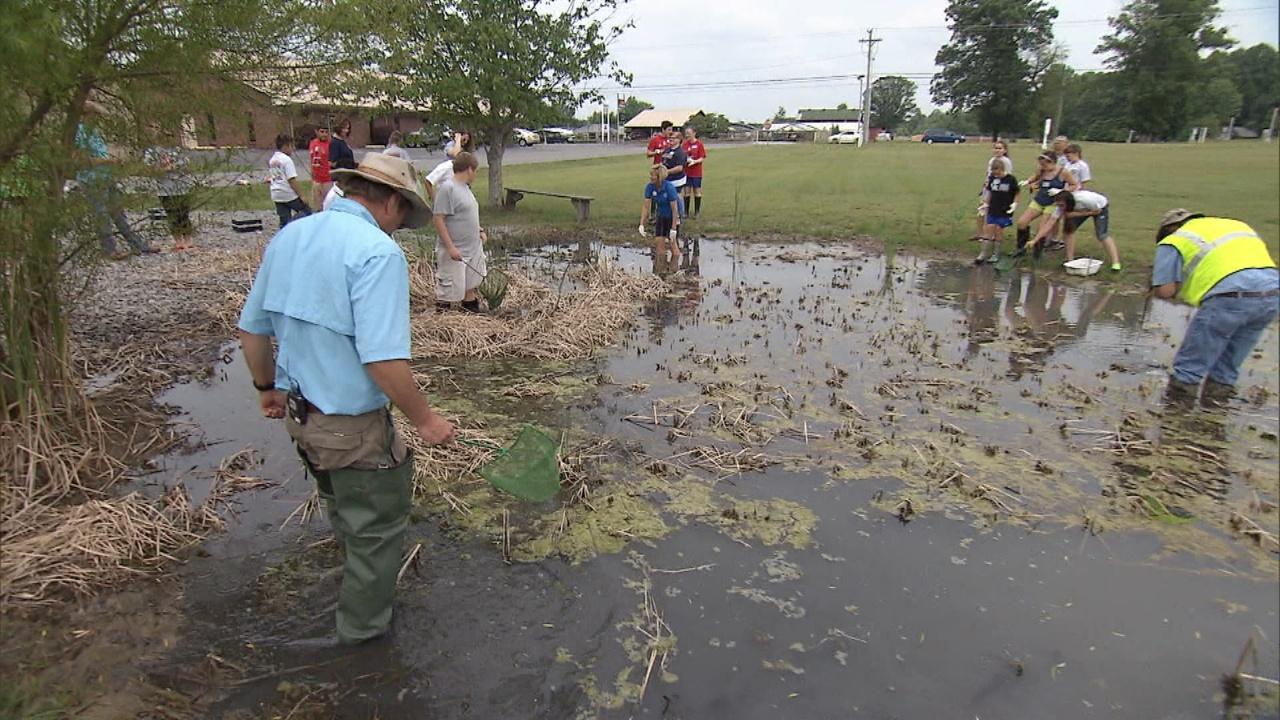
At Russell County Middle School, students are maintaining a wetland outdoor classroom. PRIDE added a rock pathway to divert water so it wouldn’t cause erosion. Leading the students with the help of the PRIDE team were wetland ecologist Tom Biebighauser and teacher Jean Clement.
Students gathered water samples and other specimens for testing. Biebighauser showed the students a predaceous diving beetle and a dragonfly larva, both signs of clean water.
“You find those in a wetland, you know the water’s clean,” he said.
Congressman Rogers is particularly pleased with PRIDE’s work in the schools. “I think we’ve educated a whole new generation,” he said.