Skip to Main Content
Watch Interim Joint Committee on Appropriations and Revenue

Contraception and the Affordable Care Act

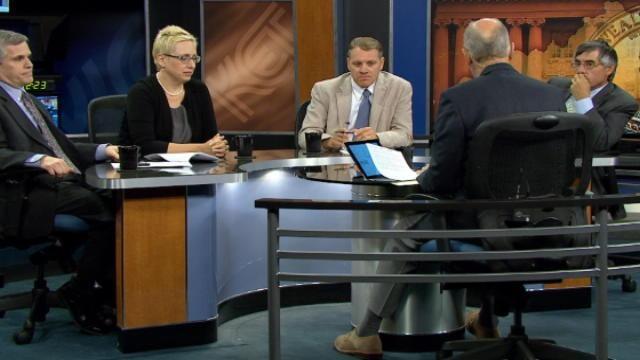
Bill and his guests discuss contraception and the Affordable Care Act. Scheduled guests: Amy Cubbage, a Louisville lawyer and member of the American Civil Liberties Union of Kentucky; Richard Nelson, executive director of the Commonwealth Policy Center; Samuel Marcosson, a University of Louisville law professor; and Paul Salamanca, a University of Kentucky law professor.
Season 21 Episode 33 Length 56:33 Premiere: 07/27/14

About

Kentucky Tonight

KET’s Kentucky Tonight brings together an expert panel for in-depth analysis of major issues facing the Commonwealth.

This weekly program features moderated comprehensive discussions with lawmakers, stakeholders and policy leaders.

For nearly three decades, Kentucky Tonight has been a source for complete and balanced coverage of the most urgent and important public affairs developments in the state of Kentucky.

Often aired live, viewers are encouraged to participate by submitting questions in real-time via email, Twitter or KET’s online form. Viewers with questions and comments may send an email to kytonight@ket.org or use the contact form. All messages should include first and last name and town or county. The phone number for viewer calls during the program is 800-494-7605.

After the broadcast, Kentucky Tonight programs are available on KET.org and via podcast (iTunes or Android). Files are normally accessible within 24 hours after the television broadcast.

Kentucky Tonight was awarded a 1997 regional Emmy by the Ohio Valley Chapter of the National Academy of Television Arts and Sciences. The series was also honored with a 1995 regional Emmy nomination.

To purchase a DVD:
Call 800-945-9167 or email shop@ket.org.


A simple blue illustration of a communication tower

Tune-In

KET Mondays • 8/7 pm

A simple blue illustration of a monitor

Stream

Watch on KET’s website anytime or through the PBS Video App.

A simple blue illustration of headphones

Podcast

The Kentucky Tonight podcast features each episode’s audio for listening.


Contraception and Religion: Hobby Lobby Ruling Raises Questions

The Burwell v. Hobby Lobby Supreme Court case not only struck a blow to part of the Affordable Care Act, but it also raised substantial questions about how corporate personhood could encompass religious beliefs. The panelists on Monday’s Kentucky Tonight program tried to untangle these thorny issues as they discussed the Hobby Lobby decision.

The Supreme Court ruled in June that closely held for-profit companies could be exempted for religious reasons from the ACA’s mandate to include contraceptive drugs in an employee’s health insurance coverage. Of the 20 contraceptives included under Obamacare, the families who own the companies that brought the lawsuit believe four of those drugs abort a fertilized egg.

The court held that the owners could not be forced to pay for a drug that violates their religious convictions if there was a less restrictive way of providing that medication to their employees.

Interpreting the Supreme Court Ruling
Richard Nelson, executive director of the Commonwealth Policy Center, says the Hobby Lobby case is more about religious freedom than contraception. He believes private business owners should be allowed to operate their companies according to their spiritual convictions. He says Hobby Lobby does still provide for 16 other forms of birth control under its health plan. But the company would have faced nearly $475 million in annual fines for not offering the four so-called abortifacient drugs.

While that financial burden would’ve been substantial for Hobby Lobby, University of Louisville law professor Samuel Marcosson contends the Supreme Court didn’t give proper consideration to the third parties in the case: the company’s female employees. He says that’s a flaw in the majority’s decision.

“The court has had a long tradition of limiting the ability of government to accommodate religious beliefs when it would impose substantial burdens on third parties who would be affected by those accommodations,” Marcosson explains. “I think that’s where the court really failed to engage fully the issues in this case.”

Marcosson and Nelson disagree on the scope of the court’s decision. Nelson sees the ruling as very specific to closely held, family-based companies and life-ending contraceptive drugs. But Marcosson says he can envision circumstances where any company, arguing religious convictions, could seek to deny all contraceptives covered under the ACA.

Louisville attorney Amy Cubbage says she fears the broader implications of the ruling. She argues the Hobby Lobby case was very much about contraception and abortion. She says the five men in the court’s majority didn’t care that the case involved the reproductive rights of women.

“If Hobby Lobby had been saying, we don’t want to cover vasectomies because they affect men, I don’t think you’d have five men on the Supreme Court saying that would be OK,” Cubbage says.

Corporations and Religion
Another significant element of the Hobby Lobby decision was how the Supreme Court acknowledged that the company could hold religious beliefs the way an individual can. Marcosson says that follows the logic of the 2010 Citizens United ruling that gave corporations the rights of citizens to make campaign contributions.

He argues that it’s unfair to give companies the legal protections afforded corporate entities and religious freedoms granted to individuals. Marcosson contends that while businesses whose owners profess specific religious beliefs should get equal treatment in the marketplace, they shouldn’t receive special treatment.

Richard Nelson challenges that notion, saying it’s unfair to expect individuals of faith not to carry their religious principles into their work. He says the founders of Hobby Lobby have conducted their operations according to biblical principles since the 1970s. Without the religious accommodation granted by the Supreme Court, Nelson says Hobby Lobby would’ve gone out of business and put thousands of employees out of work.

“What I’m hearing is…that there’s no place for religious values or beliefs in your own business,” Nelson says. “That’s not what this country is about.”

Principles of Religious Freedom
The court’s decision was based in part on the Religious Freedom Restoration Act (RFRA), which prevents laws that restrict or burden a person’s right to freely exercise their religious beliefs.

University of Kentucky law professor Paul Salamanca says the bill was popular when it was introduced in 1993: It passed both houses of Congress with overwhelming majorities and was signed into law by President Bill Clinton. But since then, RFRA has come up against what Salamanca calls “fissure points” in American culture, specifically over issues involving abortion as well as LGBT rights.

The plaintiffs in the Hobby Lobby case argued that the government’s compelling interest to provide cost-free contraceptives unduly burdened their religious convictions. They opposed paying for the four drugs specifically designed to terminate what they deem a human life. The court upheld that argument, saying the government had other less restrictive means of achieving its interest: The government itself could pay for the contraceptive drugs, or the insurance company could be required to bear the cost of the drug without passing the expense back to the employer or the employee.

Religion and the Supreme Court
Salamanca sees a larger trend on the part of this court to be more receptive to hearing religious freedom claims. He points to the Hobby Lobby ruling and a decision earlier this session where the Supreme Court upheld the rights of legislative bodies to pray at the start of official meetings.

But not everyone who argues for religious exemptions is successful. Salamanca cites a 1983 ruling in Bob Jones University v. United States. Based on its founder’s religious convictions, the South Carolina school had denied admission to African-American students or to those who were in interracial marriages. The Internal Revenue Service revoked the university’s non-profit status because of its discriminatory practices. The school sued and the case wound up in the Supreme Court, where justices ruled in an 8-1 decision that the rights of religious schools did not trump efforts to eradicate racial discrimination in education.

“So just because the test is strict, doesn’t mean that religiously scrupulous employers would win every case,” Salamanca says.

On the other hand, Samuel Marcosson says the courts have been reluctant to question the sincerity, nature, and scope of claimed religious beliefs. He says the Supreme Court didn’t question the religious convictions of the owners in the Hobby Lobby case even though the company has retirement funds invested with manufacturers of abortifacient drugs.

The opinions expressed on Kentucky Tonight and in this program synopsis are the responsibility of the participants and do not necessarily reflect those of KET.

Sponsored by:

Green and blue background with a white schoolhouse. Text reads Used in Every Kentucky School DistrictGreen and blue background with a white schoolhouse. Text reads Used in Every Kentucky School District

Season 21 Episodes

Energy Policy

S21 E36 Length 56:33 Premiere Date 08/24/14

Minimum Wage

S21 E35 Length 56:33 Premiere Date 08/17/14

Immigration

S21 E34 Length 56:33 Premiere Date 08/10/14

Contraception and the Affordable Care Act

S21 E33 Length 56:33 Premiere Date 07/27/14

Jobs and the Economy

S21 E32 Length 56:33 Premiere Date 07/20/14

Same-Sex Marriage

S21 E31 Length 56:33 Premiere Date 07/13/14

State Budget and Tax Reform

S21 E30 Length 56:33 Premiere Date 07/06/14

Brent Spence Bridge

S21 E29 Length 56:33 Premiere Date 06/29/14

Campaign Finance Laws

S21 E28 Length 56:33 Premiere Date 06/23/14

Public Employee Pensions

S21 E27 Length 56:33 Premiere Date 06/15/14

U.S. Foreign Policy

S21 E26 Length 56:33 Premiere Date 06/08/14

Energy Policy

S21 E25 Length 56:33 Premiere Date 06/01/14

2014 Election Primary

S21 E23 Length 56:33 Premiere Date 05/17/14

1st & 3rd Congressional District Democratic Primaries

S21 E22 Length 56:33 Premiere Date 05/11/14

5th and 6th District Democratic Primary 2014

S21 E21 Length 56:33 Premiere Date 05/04/14

U.S. Senate Democratic Primary 2014

S21 E20 Length 28:01 Premiere Date 04/27/14

U.S. Senate Republican Primary 2014

S21 E19 Length 56:33 Premiere Date 04/20/14

2014 General Assembly

S21 E18 Length 56:33 Premiere Date 04/13/14

The Death Penalty

S21 E16 Length 56:33 Premiere Date 03/30/14

LGBT Rights

S21 E15 Length 56:33 Premiere Date 03/23/14

Medical Review Panels

S21 E14 Length 56:33 Premiere Date 03/16/14

Expanded Gambling in Kentucky

S21 E13 Length 56:33 Premiere Date 02/24/14

State Tax Reform, Feb 17, 2014

S21 E12 Length 56:33 Premiere Date 02/17/14

Minimum Wage

S21 E11 Length 56:33 Premiere Date 02/10/14

Charter Schools, Feb. 3, 2014

S21 E10 Length 56:33 Premiere Date 02/03/14

State Budget 2014

S21 E9 Length 56:33 Premiere Date 01/27/14

Statewide Smoking Ban

S21 E8 Length 56:33 Premiere Date 01/20/14

2014 General Assembly

S21 E6 Length 56:33 Premiere Date 01/06/14

Kentucky State Budget

S21 E5 Length 56:33 Premiere Date 12/16/13

Employment Non-Discrimination Act

S21 E3 Length 56:33 Premiere Date 11/25/13

Immigration Reform

S21 E2 Length 56:33 Premiere Date 11/11/13

Election 2014

S21 E1 Length 56:33 Premiere Date 11/04/13

See All Episodes

caret down

TV Schedules

Jump to Recent Airdates

Upcoming

Kentucky Tonight - S33 E4

  • Monday August 24, 2026 8:00 pm ET on KET
  • Monday August 24, 2026 7:00 pm CT on KET
  • Tuesday August 25, 2026 8:00 am ET on KETKY
  • Tuesday August 25, 2026 7:00 am CT on KETKY
  • Tuesday August 25, 2026 1:00 pm ET on KETKY
  • Tuesday August 25, 2026 12:00 pm CT on KETKY
  • Tuesday August 25, 2026 8:30 pm ET on KETKY
  • Tuesday August 25, 2026 7:30 pm CT on KETKY
  • Wednesday August 26, 2026 1:00 am ET on KET
  • Wednesday August 26, 2026 12:00 am CT on KET

Kentucky Tonight - S33 E5

  • Monday August 31, 2026 8:00 pm ET on KET
  • Monday August 31, 2026 7:00 pm CT on KET
  • Tuesday September 1, 2026 8:00 am ET on KETKY
  • Tuesday September 1, 2026 7:00 am CT on KETKY
  • Tuesday September 1, 2026 1:00 pm ET on KETKY
  • Tuesday September 1, 2026 12:00 pm CT on KETKY
  • Tuesday September 1, 2026 8:30 pm ET on KETKY
  • Tuesday September 1, 2026 7:30 pm CT on KETKY
  • Wednesday September 2, 2026 1:00 am ET on KET
  • Wednesday September 2, 2026 12:00 am CT on KET
Jump to Upcoming Airdates

Recent

National and State Politics - S33 E3

  • Wednesday July 29, 2026 1:00 am ET on KET
  • Wednesday July 29, 2026 12:00 am CT on KET
  • Tuesday July 28, 2026 8:30 pm ET on KETKY
  • Tuesday July 28, 2026 7:30 pm CT on KETKY
  • Tuesday July 28, 2026 1:00 pm ET on KETKY
  • Tuesday July 28, 2026 12:00 pm CT on KETKY
  • Tuesday July 28, 2026 8:00 am ET on KETKY
  • Tuesday July 28, 2026 7:00 am CT on KETKY
  • Monday July 27, 2026 8:00 pm ET on KET
  • Monday July 27, 2026 7:00 pm CT on KET

Data Centers - S33 E2

  • Wednesday July 22, 2026 1:00 am ET on KET
  • Wednesday July 22, 2026 12:00 am CT on KET
  • Tuesday July 21, 2026 8:30 pm ET on KETKY
  • Tuesday July 21, 2026 7:30 pm CT on KETKY
  • Tuesday July 21, 2026 1:00 pm ET on KETKY
  • Tuesday July 21, 2026 12:00 pm CT on KETKY
  • Tuesday July 21, 2026 8:00 am ET on KETKY
  • Tuesday July 21, 2026 7:00 am CT on KETKY
  • Monday July 20, 2026 8:00 pm ET on KET
  • Monday July 20, 2026 7:00 pm CT on KET

America's Next 250 Years: Civic Engagement & Service - S33 E1

  • Wednesday July 8, 2026 1:00 am ET on KET
  • Wednesday July 8, 2026 12:00 am CT on KET
  • Tuesday July 7, 2026 8:30 pm ET on KETKY
  • Tuesday July 7, 2026 7:30 pm CT on KETKY
  • Tuesday July 7, 2026 1:00 pm ET on KETKY
  • Tuesday July 7, 2026 12:00 pm CT on KETKY
  • Tuesday July 7, 2026 8:00 am ET on KETKY
  • Tuesday July 7, 2026 7:00 am CT on KETKY
  • Monday July 6, 2026 8:00 pm ET on KET
  • Monday July 6, 2026 7:00 pm CT on KET
Top

Contact

Explore KET