Rising inequality was front and center in last year’s presidential election. Democratic primary candidate Bernie Sanders based his outsider campaign largely on policies aimed at resurrecting the American middle class, and Republican Donald Trump won the general election in an upset when four Rust Belt states – Ohio, Pennsylvania, Michigan, and Wisconsin – switched from Democrat to Republican in 2016 partially in response to Trump’s message of economic populism.
Since the recession of 2008, the U.S. economy has recovered in many areas – the stock market and the unemployment rate, for example – but most of the actual monetary gains have gone to those in the highest income brackets. Nobel Prize-winning economist Joseph Stiglitz has studied the economic roots of inequality for decades, and he has a set of proposals to alleviate what he sees as the greatest challenge to 21st-century capitalism at home and abroad.
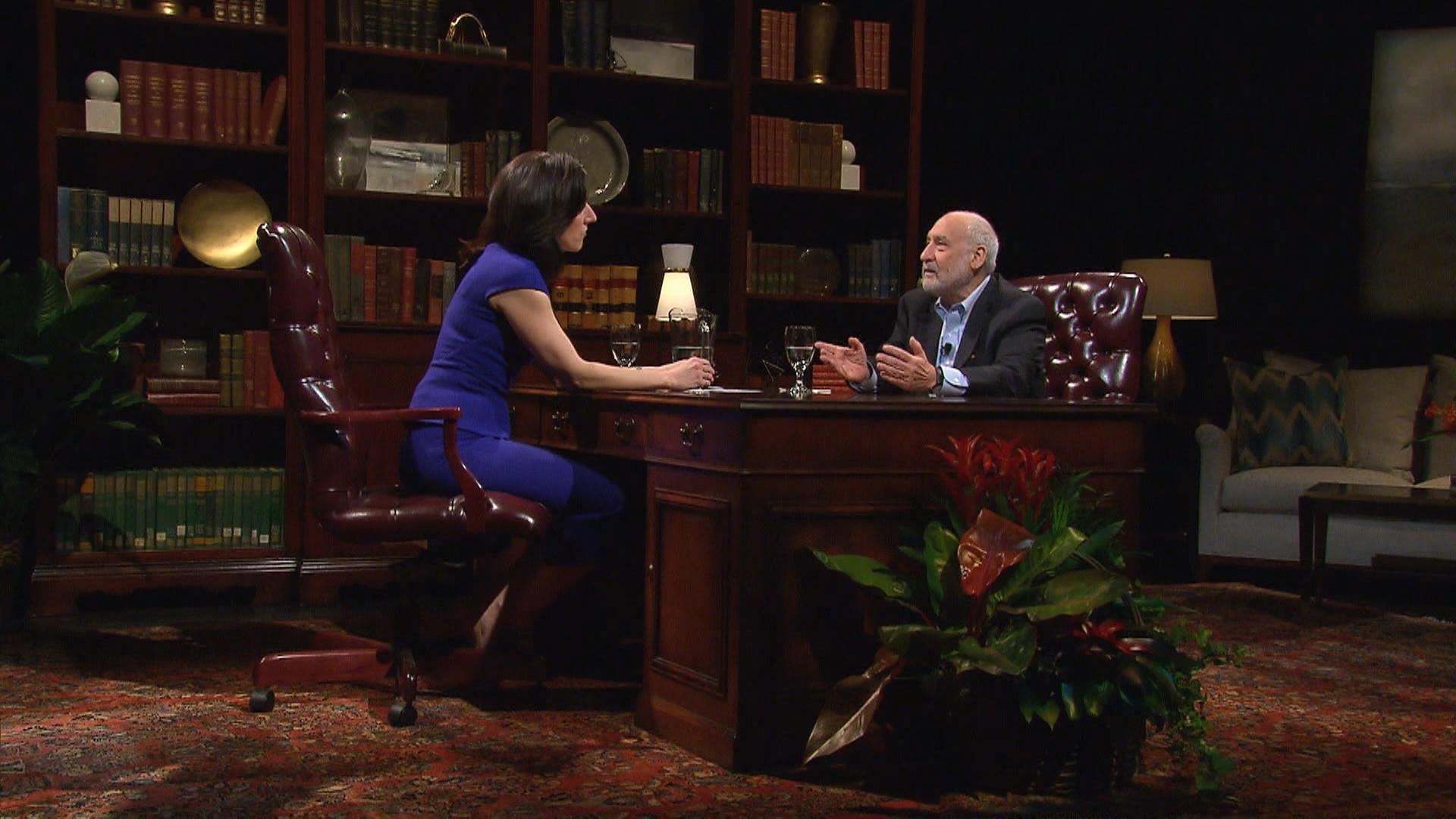
Stiglitz was interviewed by Financial Times columnist and author Rana Foroohar in April at the University of Louisville as part of the Kentucky Author Forum series. Their discussion was filmed by KET for its Great Conversations series.
Stiglitz is a professor at Columbia University’s Business School and has been a leading expert in global economics for over 40 years. His best-known general audience books include Globalization and Its Discontents (2002), The Great Divide: Unequal Societies and What We Can Do About Them (2015), and his most recent book, The Euro: How a Common Currency Threatens the Future of Europe (2016). Stiglitz served as the senior vice president and chief economist of the World Bank from 1997-2000 and received the Nobel Prize in Economics in 2001.
Foroohar previously was a columnist and assistant editor with Time magazine and is the author of Makers and Takers: The Rise of Finance and the Fall of American Business (2016). She begins the discussion by recalling how Stiglitz first came to prominence as an economist. After conducting extensive research and using a series of mathematical equations, Stiglitz established a fact of contemporary economics that challenged previous orthodoxy. “Today it seems obvious, but when you first came up with it, it was not – which is that markets aren’t always efficient,” Foroohar says. “It’s pretty basic, but nobody was saying it back then.”
Inequality’s Rise and its Impact on Society
Stiglitz says that his breakthrough was based on the imperfection, or asymmetry, of information in economic systems. He says that, from the days of 18th century economist Adam Smith onward, most models relied on the assumption that agents relayed accurate information to one another in order to facilitate economic activity. But that turned out not to be true, Stiglitz says.
“The result of my research – I like to summarize it in one sentence,” he says. “Adam Smith talked about the ‘invisible hand’ – the pursuit of self-interest leads the economy as if by an invisible hand to the well-being of everybody in society. What I showed was that the reason that the invisible hand was invisible was that it wasn’t there.”
The inefficiency of contemporary markets is most evident in the widening inequality between the wealthy and the middle and lower socioeconomic classes, Stiglitz says. The U.S. does not have, and has never had, a pure market economy, he explains; the nation’s economy has always been managed through government laws and monetary policy. And over the past 40 years, he says, “We re-wrote the rules of the American economy.”
This gradual shift in government management of the economy began during the Jimmy Carter administration in the late 1970s and continued through both Democratic and Republican administrations, Stiglitz says. It has resulted in policies that favor tax relief for the richest Americans as well as deregulation of major economic sectors such as finance.
Stiglitz says that, in the first few years following the 2008 recession, the stock market rebounded and many corporations reported record profits, but middle-class Americans saw little to no improvement in their own financial fortunes. “And that disjunction between what our leaders were saying and what was being experienced on the ground, I think, led to a lot of anger in some parts of the country. A lot of what I saw in 2016 was a reflection of what was going on in the data that I had looked at.”
One example of how the modern U.S. economy has changed can be seen in how bankruptcy laws treat capital investments versus student debt. Stiglitz observes that financial firms and real estate investors are able to easily discharge failing acquisitions from their portfolios, while student debt in America, which has exploded to over a trillion dollars, is permanent. “There’s something iniquitous about that,” Stiglitz says, and he argues that it has a stifling effect on social mobility and economic growth.
Stiglitz isolates the financial sector as a particularly troubling force in modern economic instability. He recalls working with members of the Bill Clinton administration during the late 1990s and advising them against their plans to repeal the Glass-Steagall Act of 1933, which separated commercial banking from investment banking. The 1999 repeal of Glass-Steagall contributed to the mid-2000s housing bubble and subsequent recession, Stiglitz argues, as banks repackaged risky mortgages into securities and traded them with little to no oversight.
Stiglitz says that there was an opportunity for government officials to re-introduce a more equitable system of economic management in the months following the 2008 collapse, but he argues that the “too big to fail” mentality led Washington to give the major financial banks most everything they requested, at the expense of smaller community banks across the U.S. “While we re-capitalized the big banks, we didn’t re-capitalize the small ones,” he says. This has resulted in reduced lending activity that remains in place eight years after the recession. This is especially harmful to potential homeowners, who have far less ability to secure a mortgage, traditionally the economic foundation of a middle-class lifestyle.
The False Promise of Globalization
Stiglitz expands his analysis of the current U.S. economy’s condition and relates it to the situation in Europe, which is highly unstable due to failing support of the euro among European Union member nations. “This morality play in Europe is a scene I’ve seen over and over again,” he says, “except it has one further aspect to it. When the countries signed together to have a single currency, they didn’t think about what would happen if there was a crisis. In the United States, if a bank, say in the state of Washington, has a problem, the federal government resolves it, comes to the rescue, and the depositors are protected. If the state of Washington had to bail out that bank, the state of Washington would be bankrupt. But in Europe, if a bank in Greece or a bank in Spain has trouble, the country has to bail it out.”
Europe may not be in recession, Stiglitz notes, but its current economic growth rate is an anemic 1 percent. He says the malaise in Europe is similar to our own in that a large segment of society has been left behind as companies once focused on domestic production and employment became international conglomerates. This transformation has affected all Western democracies, even accounting for the fact that most European countries have a stronger social safety net compared to the United States.
“The workers were told that globalization is great, it’s going to make all of us better off, we’re going to grow the economy and trickle-down economics mysteriously is going to make sure that everybody gets the benefits … and it didn’t happen,” Stiglitz says. “And it’s even worse because not only did workers’ wages go down, they’re then told that you have to accept cutbacks in government services so that we can compete, and we have to lower taxes on the rich and on corporations, or otherwise they’ll leave. And people start scratching their heads and saying … this doesn’t add up.”
This false promise of globalization, Stiglitz believes, has contributed to the public’s loss of confidence in political and economic elites in both the U.S. and Europe. He adds that some economists did predict that globalization would lead to inequality unless it was accompanied by stronger government policies regarding fair trade, job re-training, and incentives for entrepreneurship. “We got one side of that deal,” he says, “which is the opening up of trade and the job losses, but we didn’t do the other side of the deal.”
Solutions to Current Crises
Stiglitz sees a similar wrongheaded approach to inequality in the current congressional push to repeal the Affordable Care Act, which according to the Congressional Budget Office will result in 23 million Americans losing their health insurance while giving high-income earners a large tax cut.
He also says that a lot of the current rhetoric regarding the U.S. government’s ability to “bring back” manufacturing jobs is misleading since it does not accurately reflect the current and future growth sectors in the global economy. He points out that globally, manufacturing jobs are in decline, primarily due to automation.
“Basically, it’s very simple: if productivity increases rapidly, more rapidly than demand, employment will go down,” he says. He makes a comparison between the state of manufacturing today in the U.S. and that of the agricultural sector at the start of the 20th century. Back then, Stiglitz notes, 70 percent of all Americans were engaged in agriculture. Today, that number is 3 percent. Manufacturing filled the employment gap to a large extent during the early years of the 20th century, with a major boost during World War II. Stiglitz says that our goal today should be to train new workers, and re-train existing workers, for jobs in the modern, technologically driven service economy.
In closing, Stiglitz and Foroohar observe that the global capitalist economy is at a crossroads, as technological advances eliminate jobs even in developing markets such as China, and growth rates are modest at best. This uncertain situation calls for a major reassessment of corporate governance and, even more importantly, government economic policy both in the U.S. and in other countries, Stiglitz says. Such a change in mindset would forsake obsessing over short-term profits and instead value long-term growth and stability. The new approach should also prioritize job sectors that benefit the public good such as health and education, Stiglitz argues, and he reaches back into not-too-distant history to illustrate his point.
According to Stiglitz, what many Americans think of as the nation’s golden era – the postwar years of the 1950s and 1960s marked by uninterrupted growth and an expanding middle class – came about due to specific government policies such as major infrastructure projects, progressive taxation, and broad investment in human capital such as the G.I. Bill.
“We were a much poorer nation in 1945, after World War II – we had a debt-to-GDP ratio of 130 percent,” Stiglitz says. “But our response to that was not to shrivel down and say, ‘We can’t do anything.’ Our response was to grow the economy. … We were a poor country then, relative to where we are now, and we said we could afford it. And now we say we can’t even provide two years at a community college for free? So, it’s not a question of what we can afford, it’s what we choose to do.”