The current Republican presidential primary season has dominated the national news cycle for months. Real estate magnate and businessman Donald Trump maintains a sizable lead in the delegate count, and his policy positions have caused many establishment Republicans to publicly oppose his candidacy.
Journalist, political commentator, and author E.J. Dionne argues that Trump’s rise to a front-running position in the Republican race for the White House is the result of a turn toward the extreme right in the conservative movement that gradually happened over the past half-century, leading to its present state of disarray.
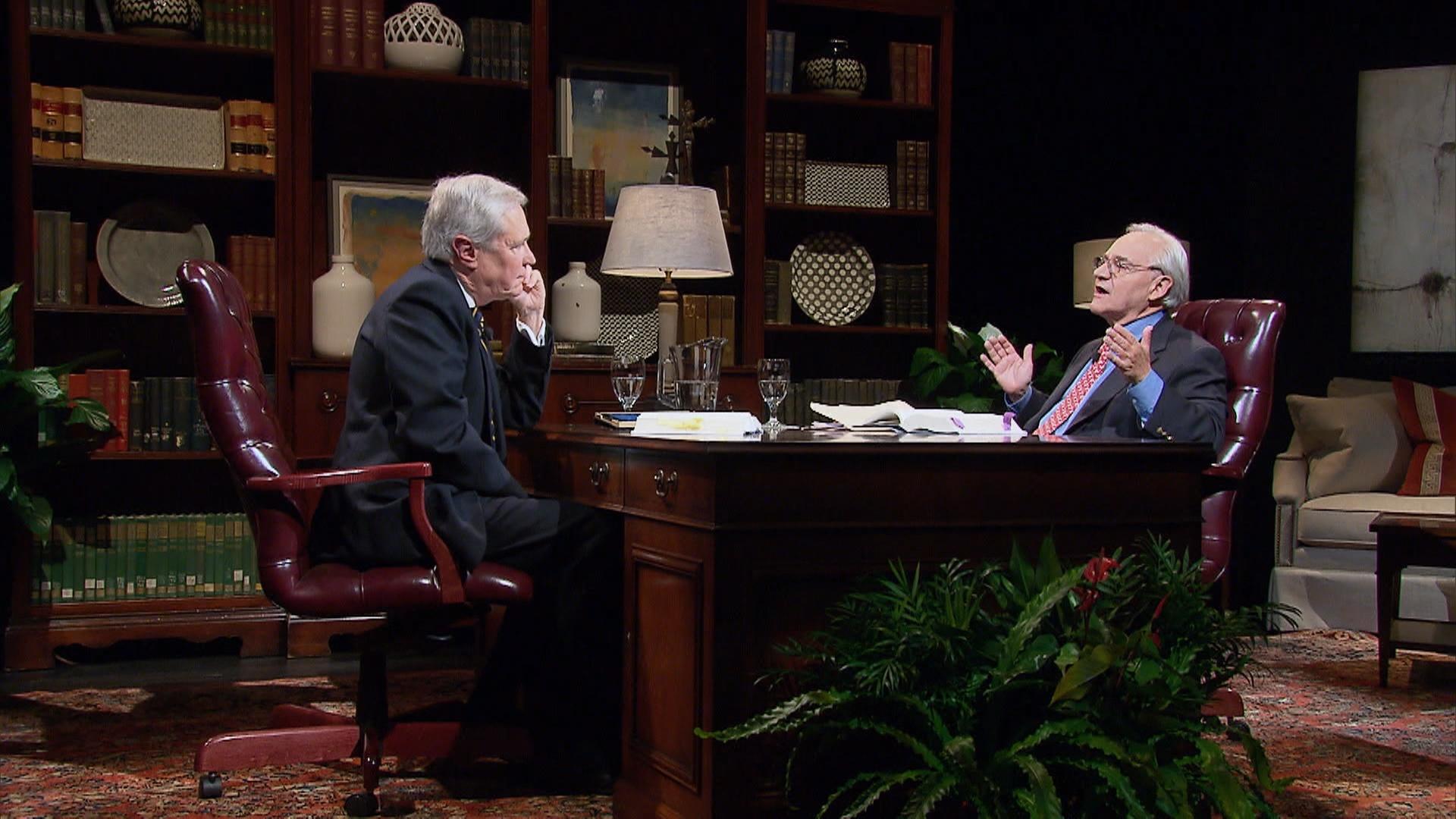
The Washington Post columnist recently visited the University of Louisville’s Kentucky Author Forum to discuss his sixth book, Why the Right Went Wrong: Conservatism – From Goldwater to the Tea Party and Beyond. He was interviewed by James Fallows, national correspondent for The Atlantic, for KET’s Great Conversations.
Dionne, who is also a senior fellow at the Brookings Institution and a frequent guest on public affairs talk shows such as PBS NewsHour, has known Fallows since they were students at Harvard University. Both grew up in the late 1950s and early 1960s, and the two, both now liberal Democrats, shared an early affinity for 1964 Republican presidential candidate Barry Goldwater.
Goldwater published the popular book The Conscience of a Conservative in 1960 and was supported by future President Ronald Reagan in 1964. Although he lost that election in a landslide, the U.S. senator espoused an unwavering commitment to limited federal government that became the foundation of the conservative movement in subsequent decades, according to Dionne.
In Why the Right Went Wrong, Dionne argues that the rise of Goldwater and influential publications such as William F. Buckley’s National Review were a reaction to the presidency of Republican Dwight Eisenhower in the 1950s. Eisenhower, according to Dionne, “believed in making peace with the New Deal,” and his continuance of social programs established by President Franklin D. Roosevelt in the 1930s were incompatible with conservatives who valued individual freedom above the public interest.
Dionne regards Eisenhower as one of the heroes of 20th-century conservatism. He says Eisenhower’s positions balanced restraint along with an awareness of government’s role in solving the problems of a rapidly changing world.
In this way, Dionne says Eisenhower’s brand of conservatism adheres to the philosophy of Edmund Burke, the 18th-century English statesman and thinker who is regarded as one of the founders of conservative principles.
“Eisenhower I think of really as a Burke-ean conservative because he wanted to preserve the American way of life,” Dionne says. “That’s a basic form of conservatism. He was very pro-business, he was very fiscally responsible, and he was sympathetic to religion. But he thought that certain things simply become part of our way of life over time, and that some of the New Deal programs were passed to solve discrete problems of a new era, and you just didn’t throw them out the window. He was also pragmatic enough to know that Republicans would lose elections if they tried to repeal some of these programs.”
Broken Promises and a Vanishing Moderate Wing
Dionne agrees with many historians that Barry Goldwater’s defeat in 1964 positioned the hard right wing of the conservative movement squarely against the more moderate establishment. Over the next 15 years, the movement grew in size and power until it gained a position in the political mainstream with Ronald Reagan’s election as president in 1980.
But even then, Dionne argues, signs of unrest within the movement were already apparent. His first sentence in Why the Right Went Wrong, read by Fallows, states that “The history of contemporary American conservatism is a story of disappointment and betrayal.”
Dionne says that the far right’s ingrained opposition to federal government programs created during the New Deal is at the crux of their sense of betrayal. Politicians have vowed to roll back such programs time and time again, he says, but “these promises are made to be broken – they cannot be kept, in particular reducing the size of government.”
Why is this? “Two great analysts of public opinion years ago, decades, ago, Lloyd Free and Hadley Cantril, said Americans are ideological conservatives and operational liberals,” Dionne says. “[Americans] are very critical of government in the abstract, but actually want it to do quite a lot.”
Dionne notes that the federal government’s share of the national gross domestic product was roughly the same at the end of Ronald Reagan’s eight-year presidency as it was at the beginning. Under Reagan, welfare programs such as Social Security and Medicare were bolstered through compromise legislation.
Though Reagan is often viewed now as a conservative hero, Dionne argues that his willingness to “give you 70 percent of what you want” as chief executive led to a further separation between ideologically pure conservatives and the moderate wing. This fissure continued to widen during Bill Clinton’s Democratic presidency in the 1990s as Congressman Newt Gingrich led a Republican wave in Congress, and then in the early 2000s when George W. Bush won the White House on a platform of “compassionate conservatism.”
Dionne says that George W. Bush’s greatest moment was when he called for Americans to espouse tolerance towards Muslims and the Islamic faith shortly following the Sept. 11, 2001, terrorist attacks in New York City and Washington, DC. According to Dionne, polling after those attacks showed that Republicans initially responded to Bush’s outreach by showing more tolerant views towards Muslims. That trend was soon overwhelmed with the U.S. invasions of Afghanistan and then Iraq, and anti-Muslim sentiment grew on the right.
Since Bush left office in 2009, Dionne argues, the Republican Party has shifted even farther to the right, and even more so after Democratic President Barack Obama’s re-election in 2012. Obama racked up large vote majorities among African-Americans, Latinos, and Asian-Americans in 2012, and this dominance among growing demographic groups – especially Latinos – caused some Republican leaders to urge the party to moderate its positions after 2012, particularly on immigration.
“The Republican National Committee commissioned their autopsy about what went wrong in the 2012 campaign, and their recommendation included a lot of things, including that the party needed more openness toward Latinos and Asians and others,” Dionne says. “You look at this [current] presidential campaign, and I guess the Republicans assume that was an autopsy of another party and another country. It’s just been put on a shelf.”
Possibilities for Renewal
Why the Right Went Wrong arrives at a time when roughly 60 percent of Democrats would vote for a politician willing to compromise, according to a Pew poll that Dionne cites. Only slightly more than a third of Republicans would do the same.
“I think it’s important for people to come to terms with this, that the polarization in our country is asymmetric,” Dionne says. “It’s not that each side has moved the same degree to the left or the right. Something very different has happened on the right than has happened on the left. The Republicans really have moved farther right, conservatism has moved farther right.”
In his book, Dionne looks back at the 2012 Republican presidential primary campaign and identifies two candidates who held policy positions that were more inclusive, which could help the conservative movement grow again. Former Sen. Rick Santorum, who emphasized the plight of working-class whites in the modern economy, and former Utah Gov. Jon Huntsman, who offered a platform that engaged young voters and minorities, each had positive ideas to contribute to the shrinking GOP, Dionne says.
Both Dionne and Fallows also talk about what they view as a far more encouraging picture of the United States than is evident by observing the national political climate. Fallows’ article in the January/February 2016 issue of The Atlantic, “How America Can Rise Again,” reports on several innovative, collaborative approaches within communities across the U.S. that successfully address economic and social problems while Washington remains in gridlock.
Fallows says he believes the United States is ideally positioned as the global leader in every socioeconomic area save one. “Our only problem,” he says, “is that our national government doesn’t work. That’s one problem, but it’s a serious problem.”
Dionne agrees, and says the larger message of Why the Right Went Wrong is that practicing extreme politics, whether on the left or on the right, is destructive to the American project. “That degree of obstruction just doesn’t work in a system of separated powers,” he says. “If we had a multi-party system, then a really conservative party of this sort would not be a problem, because they would eventually have to make deals with the center to create some kind of government. But that is not our system.
“Liberals have been quoting Edmund Burke and have been throwing Burke at conservatives for several generations,” Dionne adds. “But I do try to argue that, when you think about what conservatism really is about, it’s about prudence, it’s about balance. Burke talked about [conservatism being] a ‘desire to preserve and a disposition to improve,’ and the two go together. If you’re not for any adjustment, you’re not a conservative, you’re a reactionary. And I don’t think that most conservatives want to be reactionary.”
The Current Campaign and a Final Prognosis
Dionne credits “reforma-cons” such as former George W. Bush speechwriter and aide Michael Gerson and other young thinkers such as Reihan Salam and Ross Douthat as sincere in their efforts to bring the conservative movement and Republican Party back toward the center, even if he disagrees with many of their policy positions. He also concedes that conservatives are correct to direct attention to rising divorce rates and children being born to unmarried parents.
“I do think we need a real debate on the family in this country,” he says. “That’s the one issue I talk about where I wish we could cross party lines, because conservatives are right that family breakdown is a problem. But family breakdown itself is partially a result of economic forces that bring enormous pressures to bear on poor and working class families. And we have to talk about both of those things at the same time.”
As for the current Republican presidential primary, Dionne regards front-runner Donald Trump’s positions on immigration and Muslims as potentially destructive to his chances in the general election, and says he thinks that the Republican Party will fall victim to “a rule of three” in that they will have to suffer three successive presidential election defeats before finally undertaking efforts at lasting reform. This, he notes, happened to the Democratic Party in the 1980s, and more recently to the Conservative Party in Great Britain.
“If anything good comes out of the Trump campaign,” Dionne adds, “I hope it focuses everybody’s attention on the people who are really stuck in the new economy, both because of globalization and technological change.” He argues that Democratic candidate Bernie Sanders’ success in several early primaries and caucuses is due to this economic focus, particularly as it relates to working-class whites. Dionne believes that the Democratic Party must win back that constituency, who were “Roosevelt’s people, they were Truman’s people,” if they want to hold the White House.
The Democratic Party and progressive movement have their own problems, Dionne observes, but generally appeal more to an increasingly diverse electorate and in particular to young voters. Dionne says millennials “are the most progressive generation in this country since the New Deal generation, by lots of measures.” He believes that the conservative movement needs a major overhaul in both ideological flexibility and emotional tenor if it wants to regain the political dominance it enjoyed during the Republican heyday of Reagan.
“At the end of my book I say that conservatives rightly revere those who came before them, but they will not prosper if they continue to yearn for a past they will never be able to call back to life,” he says. “They will not be successful if they celebrate only the America that once was, not the vibrant nation that is being born now.”