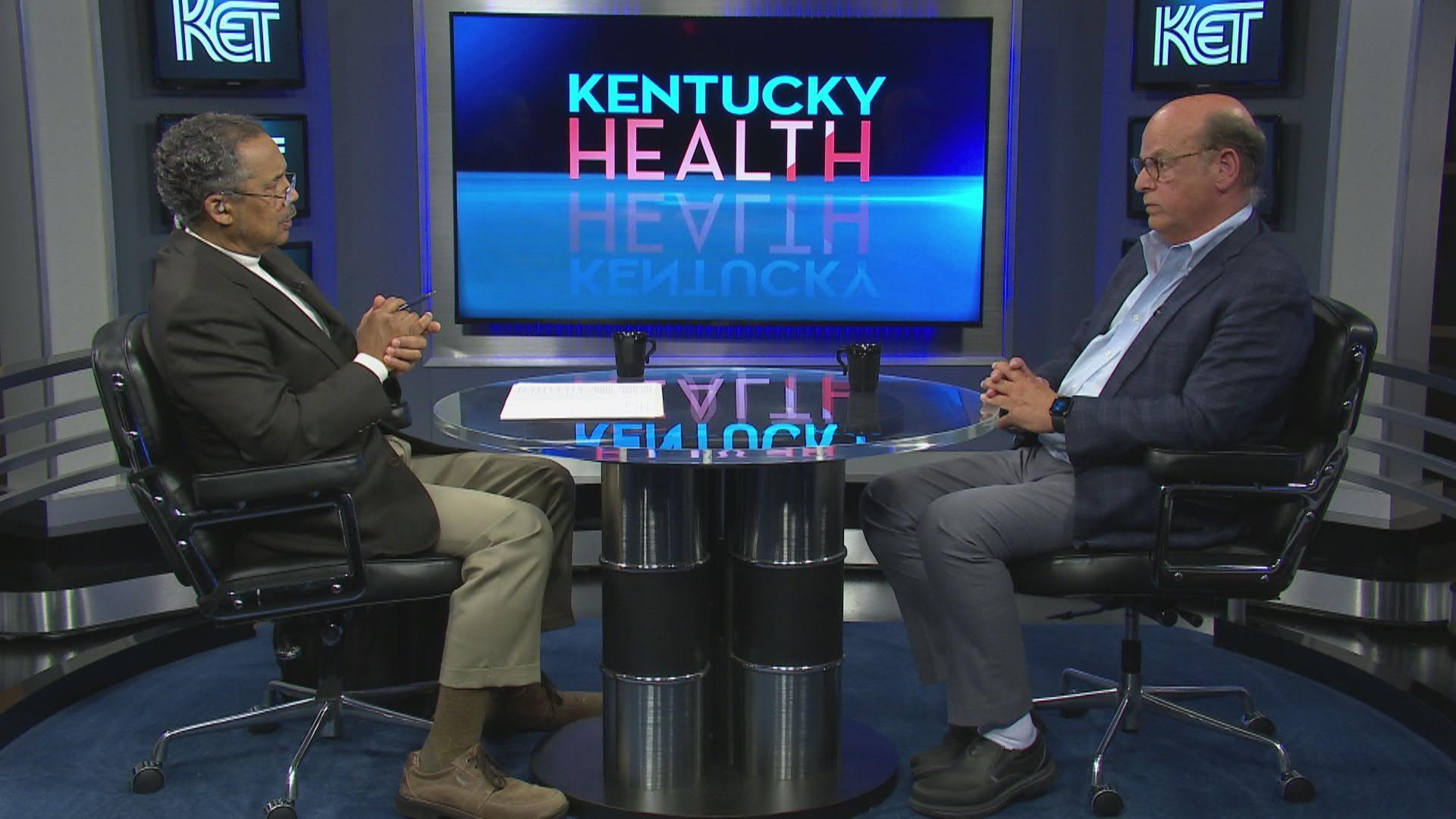

On this episode of Kentucky Health, host Dr. Wayne Tuckson welcomed Dr. Matthias Loebe, MD, PhD, a cardiothoracic surgeon at UK HealthCare and professor of surgery at the University of Kentucky College of Medicine, for a discussion about heart transplants. Here are takeaways from the episode.
1) The surgical procedure for heart transplants is fairly routine and has been established since the first transplant of a human heart was performed in 1967 by Dr. Christiaan Barnard in South Africa. The main challenges to success come from a myriad of post-transplant complications.
Loebe says that in the 1980s, the development of effective immunosuppressive drugs first used in kidney transplants helped lower organ rejection rates, ushering in a new era of cardiac transplants with much improved patient outcomes. Now, a team approach is standard for heart transplants, including cardiologists, surgeons, anesthesiologists, nurses, counselors, physical therapists, and others. This team works together on a comprehensive task, starting with the selection of qualified recipients, continuing through the operation itself and then on to dedicated management of the patient afterwards.
“We look at survival rates of 95 percent after one year, and very good long-term outcomes with a good quality of life of 20 years or so after the transplant,” Loebe says. “You have to remember that our programs are very strictly supervised by the federal government, and so we are measured by one-year outcomes… in how many patients survive 12 months, and we have to achieve about 94 percent. So that means everything really has to work out well, which is to the great advantage of our patients.”
Loebe explains that the surgical steps to replace a heart involve leaving the back side of the atria (upper chamber) from the patient’s original heart in place and then sewing in the tissue of the new heart – the rest of the atria and then the ventricles – on that existing structure. “The sewing part of the heart transplant is very simple,” he says.
2) Criteria for receiving a heart transplant is based on need, and recent innovations in perfusion and transportation of a donated heart have helped patients receive life-saving assistance from a nationwide network.
Loebe says that the main qualification for receiving a new heart is simply failure of the existing one, noting that studies have shown patients that go to the hospital for cardiac care once in the year prior to the transplant surgery benefit the most. Data for patients are entered in a computer via the United Network of Organ Sharing (UNOS) which identifies the patients and matches them with organs. These hearts are transported in a machine that perfuses them (delivers blood) and keeps them beating until they can be inserted into the recipient.
“In particular, with the new allocation system, the sickest patient gets the organ offered first, which for us means that most patients that we transplant today are in the intensive care unit on some type of support to keep them alive and are very sick,” Loebe says.
However, Loebe explains that patients with a recent history of cancer (within the past five years), are morbidly obese, and/or are regular smokers with no intention to quit do not qualify for a heart transplant.
3) As preparation for a heart transplant, many patients may use a left ventricular assist device (LVAD) to help improve their health prior to the major surgery. These devices can also extend the lifespan of persons who aren’t qualified for transplants.
Loebe says that there are several medications cardiologists can give patients with heart failure to get the organ to beat more rapidly, but they lose effectiveness after a while. On the other hand, over the past 20-30 years mechanical devices such as artificial hearts and, more productively, LVADs have been developed, improved upon, and used to benefit patients.
LVADs are pumps inserted into the left ventricle of the heart and connected to a miniaturized external device with controls and a battery. The LVAD helps the left ventricle pump blood into the rest of the body, and patients who respond well to this device can conduct nearly all of the daily activities they did before the LVAD aside from swimming.
“We know that with the new generation of pumps, the one-year, two-year, three-year outcomes are equal to heart transplantation, so we can also use them as an alternative to heart transplants,” Loebe says. “We have patients that have lived 20 years with these devices…. It’s a viable and meaningful option.”
In fact, Loebe says that LVADs have largely supplanted artificial hearts as the preferred alternative option for patients in need of a transplant. “With the assist devices, you have the native heart still there as kind of a backup system,” he explains. “And sometimes we see recovery of the native heart, which is something we here in Lexington are particularly focused on. In some patients you can take the LVAD out after a year or two because their native heart has recovered from the cardiomyopathy.”
4) In recent years, persons with end-stage cardiac disease and renal failure received transplanted organs from genetically modified pigs. These xenotransplantation procedures resulted in very short lifespans for the recipients, and while they did provide new medical knowledge for researchers, it will be years if not decades before they become commonplace.
“Things change and breakthroughs are made, and hopefully in this area as well,” Loebe says. “But if you look at the cost of this therapy, it’s tremendous to raise these animals and modify them, and the risk of transmitting diseases from the animal world into the human (one), is a great concern. At least one of the heart patients, the word was he got an infection from the animal.
“These patients lived for a couple of weeks, and of course that’s no comparison to the therapies we have available that give 20 years of life to the patient,” he continues. “So I think there’s a lot more work that needs to be done, and obviously there are a lot of ethical questions that need a public discussion.”