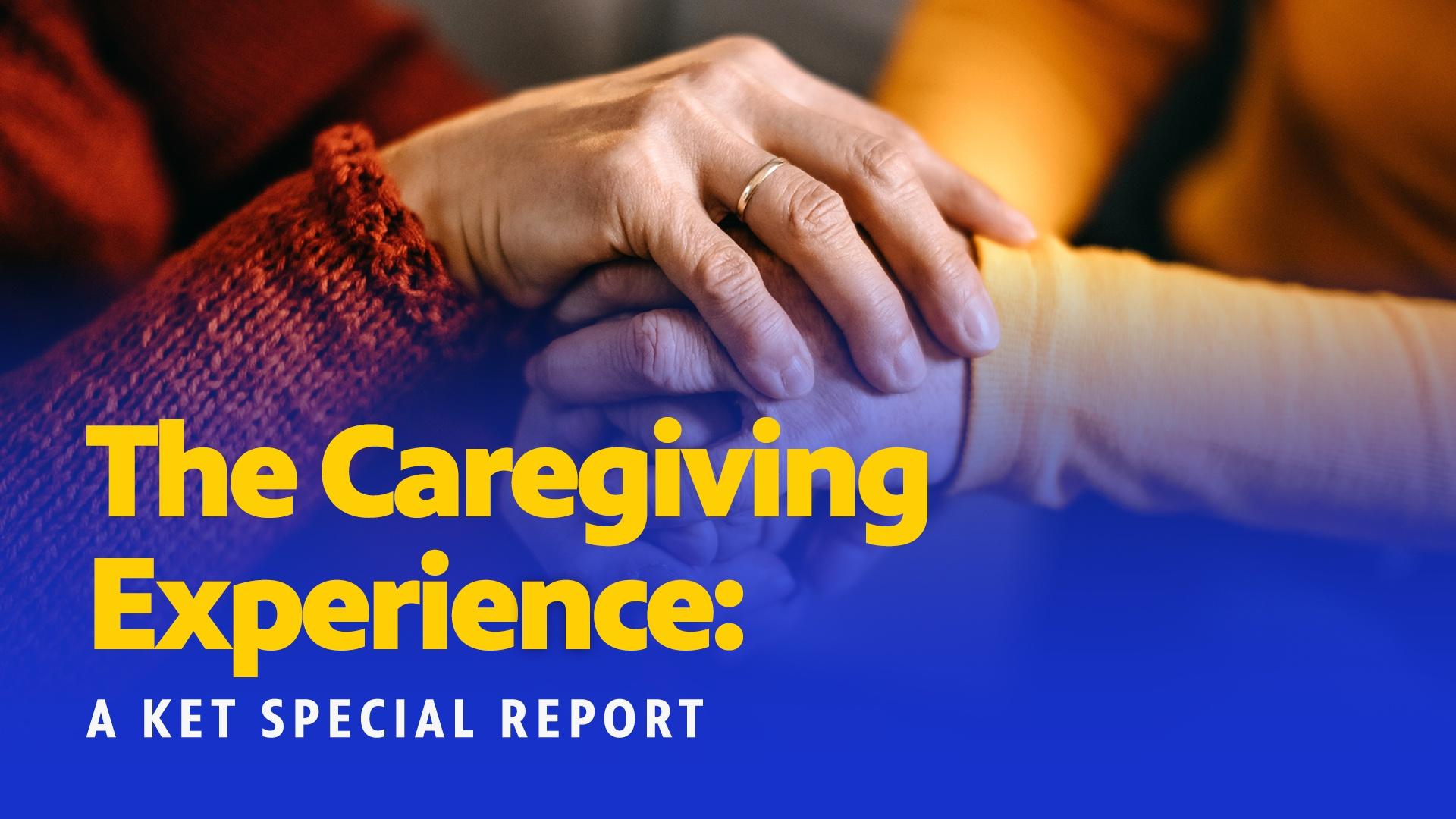
This special report examines the hidden costs of caregiving. Topics include the impacts of caring for loved ones, ways to maintain positive relationships with those being cared for, and support services available to caregivers. This program is funded in part by the Foundation for a Healthy Kentucky.
Here are three key takeaways from the special report:
1) Nearly a million Kentuckians have some caregiving responsibilities. That number is expected to rise in the years ahead, creating a demand for more services.
According to statistics from the AARP and the National Alliance for Caregiving, 28 percent of adults in Kentucky, or 987,000 people, provide largely unpaid and unsupported care to relatives or other loved ones. Since the costs of staying in long-term care facilities are expensive and not covered by Medicare, the burden of caring for aging loved ones often falls on family members. More than a third of caregivers in the state are children tending their parents, and nearly two-thirds of caregivers in Kentucky are women.
One family in Kentucky falls into what’s called the “sandwich generation,” where adults balance the responsibilities of caring for aging parents while also raising their own children. Based on AARP and National Alliance for Caregiving statistics, around 29 percent of Kentucky caregivers fall under this category.
When he was a child, Jeramie Vance watched his parents take care of their parents. But that didn’t prepare him for the challenges of helping his fiancée care for her 77-year-old father Don, who has advanced dementia. The couple also raises their 13-year-old daughter, Leigh.
Family time is scarce due to the round-the-clock demands of caring for Don. According to Jeramie, he and his partner and daughter were able to go out to eat together only three times in a 14-month period.
“The average cost of a long-term care facility is $18,000 to $24,000 per month in our region, and most people can’t afford that,” he says. “The mental, the physical, the financial – every bit of it is 100 percent demanding.”
2) Providing care changes the dynamics of familial relationships, whether it’s a child with a parent, a spouse with their partner, or even between siblings as they divide up caregiving duties. The shifts in authority and responsibility will present challenges but can also lead to deeper bonds.
Statistics from AARP and the National Alliance for Caregiving find that 31 percent of family caregivers report moderate to high levels of emotional stress. Elizabeth Rhodus, an occupational therapist with the Sanders-Brown Center on Aging at the University of Kentucky, has her own story of caregiving and sacrifice. After getting married, relocating to Florida, and starting a career, she moved back to Kentucky to help care for her mother who had pancreatic cancer.
As her mother’s disease progressed, Rhodus felt their relationship change from one oriented around the future and potentially becoming free from the disease to one focused on the present, where providing emotional support and enjoying the time left became the goal.
“This is probably the most difficult time of your life, when you’re losing someone,” Rhodus says. “The roles you’ve experienced, and the support (your loved one) has provided for you for so long, you’re having to re-identify yourself and understand new roles.”
“No one tells you you’re going to become a caregiver, it just sort of slowly happens over time,” says Benjamin Mast, professor of psychological and brain sciences at the University of Louisville. “You find yourself taking on things that the person you’re taking care of used to do very easily – managing money, taking medication, or even just keeping them safe in the home. And so you have a mix in this relationship, you have the old part and then you have this new piece that comes in and really starts to make a shift.”
Caregivers for loved ones diagnosed with a terminal illness may begin to experience what Mast calls “pre-death” grieving. This can lead to conflicting emotions as the loved one enters his or her final weeks of life as well as suppressed emotions after they pass. “Sometimes people feel a sense of relief that that part of their journey together is finished,” Mast explains. “And that can prompt a whole new set of emotions, such as guilt.”
For family members or any group of people who share caregiving duties, it’s important to establish clear and honest lines of communication and to responsibly delegate roles, says Kelly Parsons, social worker with the Sanders-Brown Center. Those who have a stronger emotional bond or who are closest in physical proximity to the person receiving care might feel overburdened with tasks. If so, they should make their feelings known rather than let stress build up.
“That’s when people kind of have covert ways to express their needs, passive ways to say how they’re feeling,” Parsons explains. “So for family dynamics in caregiving, I think that everybody coming on the same page and knowing that they have clear communication really affects their (person being cared for) in a positive way.”
Twins Kiara and Kylie Gray have strengthened their own bonds while caring for their grandmother Hannah Dunne in Louisville. Dunne, who has COPD and small-cell lung cancer, has to receive oxygen constantly. The twins, who both are young professionals, alternate helping their grandmother with morning breathing treatments, giving her medicine, helping her take showers, and many other duties.
The sisters say communicating their own needs and their specific caregiving responsibilities helps them work together and balance their schedules at home and work as best they can.
“A couple of weeks ago, we had a conversation about feeling appreciated and what that looks like for one another – and in our new season of things, (finding out) what each one of us needs,” Kiara says.
3) There are many support services available for caregivers to help them with their many responsibilities and to give them a break.
According to the AARP and National Alliance for Caregiving report, common caregiving tasks include grocery or other shopping (81 percent), housework (80 percent), transportation (75 percent), giving medicine (70 percent), medical and nursing tasks (65 percent), preparing meals (60 percent), managing finances (60 percent), and arranging outside services (42 percent).
Fulfilling any one of those tasks is difficult, much less all of them. But there are support services provided by both the government and nonprofit organizations, starting with the National Family Caregiver Program offered through the U.S. Department of Health and Human Servies.
This program, according to Kelly Parsons, offers monetary support to caregivers via grants to states that can be used for a variety of services, including respite care and counseling. Within Kentucky, Parsons says the state’s 15 Area Agencies on Aging and Independent Living can assist caregivers in applying for Medicaid waivers (if they qualify), getting respite care, accessing legal services, and finding local help.
“(Contact) can be done in an email – it doesn’t have to be face-to-face communication,” Parsons says. “It could just be the primary caregiver laying out all of the resources they’ve located and say, ‘Hey, I need help.’ So, really I think the first thing is, asking for help. And it’s not necessarily help for you, it’s help for your (loved one.)”
One important support service for caregivers is respite care. According to AARP and the National Alliance for Caregiving, 91 percent of family caregivers in Kentucky have never used respite care. It provides short-term relief for primary caregivers through a network of substitutes, providing them time to re-connect with their own interests and re-charge their energies.
“The primary caregiver is not going to be able to continue providing care for their loved one if they’re burnt out, unhappy, depressed, worn, and broken down,” says Heather Harden, manager of caregiver programs for the Northern Kentucky Area Development District. “We’ve got to make sure that they’re taking their breaks, and when they take their breaks they get to do something they like to do or that’s benefiting them in some way.”
Shirley Hudgens and Kathy Nafus participate in the respite care program via the Northern Kentucky Development District, which is funded by the National Family Caregiver Support Program. It provides pay for up to 16 hours a month granted to another caregiver (which can be another family member or friend) to assume duties while the primary caregiver takes time off.
“As long as I have some ‘outs’ where I can go out with friends or play cards or go to a meeting – that gets me through the week, you know,” says Hudgens, who is primary caregiver for her husband.
The AARP also offers substantial resources for supporting caregivers, says Charles Williams, longtime volunteer with the Kentucky chapter. These can be accessed through their website and include the Prepare to Care document. Williams recommends that any adult who has loved ones who might need assistance down the road to read that document and learn about the enormous responsibilities of caregiving as well as the variety and quality of services available.
“A lot of people don’t go after the resources because, number one, they don’t even know that they’re a caregiver until they’re knee-deep into the business of being a caregiver,” Williams explains. “Once they figure out where they are, and the dire straits they’re in, and what caregiving places upon a person financially and time-wise, then they start asking questions.”